
Horizontal Jigging for Kingfish

Horizontal and jigging are two words that, at least in New Zealand, would normally contradict each other. This adaptation of shore jigging has been as effective at catching the local yellow tail kingfish, as it has been at turning the heads of traditional vertical jiggers and stickbaiters, says John Walkley.
Horizontal jigging is a method that presents jigs through the entire mid column of water for the duration of the retrieve. This differs from traditional techniques which only work the surface or directly under the boat. Such is the versatility of this method that it can be used either landbased or from the boat. Horizontal jigging is a highly effective way to prospect for kingfish, and can be done on your existing stickbait outfit.
This is not a new phenomenon. Shore jigging, as it is coined internationally, is a highly popular method of fishing overseas, and is generally utilised to target trevally and mackerel species from land. Horizontal jigging is a scaled-up adaptation of this method, devised to work heavier jigs at any depth or range from either boat or shore.
I was introduced to this style of fishing several years ago while living in Australia. At certain times of the year, schools of kings would venture into the shallows during their spring migration, creating a spectacle not unlike the tarpon migrations in Florida. Although you would think this would be like shooting fish in a barrel, it is not. While Sluggos, stickbaits and livebaits will at times raise interest, horizontal jigging was the most effective technique.
The method employed was to scan the school on side-scan and keep them in our peripheral while matching their cruising speed. Once we were set parallel to these fish, we would present a jig from 30-50m away in 2-10m or water and retrieve it across the path of the school. When everything came together, this would entice an aggressive bite, producing a 1.2 to 1.5m kingfish. Seeing how effective this method was on Aussie kingfish, I was eager to see if the method had merit in the shallow reefs and inshore fisheries of the North Island. To say it was effective is an understatement.
On the first day trialling it here, my very first cast on an 18m reef produced a quality inshore kingfish. But the success didn’t stop there – it continued to produce 14 more during this dawn session. My brother, an avid stickbaiter, frothed the surface for only two kingfish in the same period. In the same timeframe, a dozen or more boats close by only managed to raise one fish (that I saw). Some may say it could have been the day or conditions, but this result has been replicated consistently whenever kings are present.
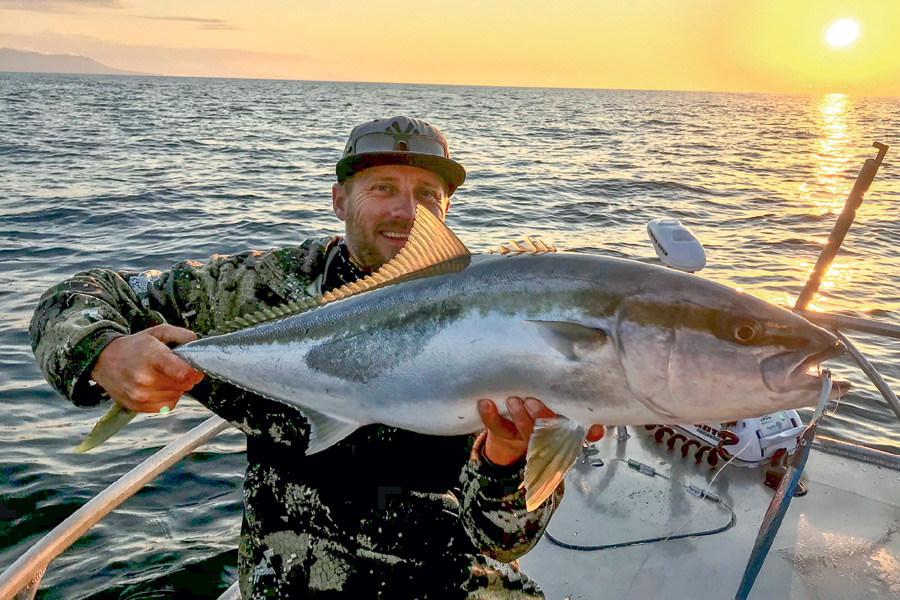
Targeting peak times is a key factor to consider.
Why it is effective
Firstly, I need to say that both topwater and vertical jigging methods are both very effective ways to catch kingfish. However, these methods only target the surface or directly below the boat. Meanwhile, there is a whole chunk of mid water 360 degrees around the boat which is begging to be explored. This is where horizontal jigging comes in. Visualise the water column split into thirds, and the middle third is the area you are trying to target with this method. Getting your lure consistently in this section will ensure your jig is seen by kingfish in whatever depth they are holding. As a result, the jig will be seen by more kings, which equates to an increased number of hook-ups.
The technique
There are a few ways to utilise this method and they are similar regardless of whether you’re landbased or casting from the boat. Say you find yourself working a reef of about 20m. You would cast your jig as far as required and let it sink freely for a period. Close the bail once you are happy that you are close to the bottom or at the desired depth. You don’t want to hit the bottom too often, but it is sometimes necessary, at least on the first cast, to gauge the sink time. Keep an eye on your line during the initial drop as on occasion takes can be registered in a similar way to soft-baiting.
The retrieve is the same motion as vertical jigging, just slower. Perhaps two to three jigs per second with a wind in between. Perform 15 or so jigs, then either let it sink on a tight line if you are in less than ten metres water, or an open bail if you are deeper. Repeat the retrieve again once you are back at the desired depth. Continue this jigging method until the jig is back to the boat or shore. Depending on the application, you can adjust this method to work both close to the bottom or just underneath a tightly packed bait school just by changing the sink time or the number of pumps in between sinks.
Where to use this method
As mentioned, this method can be used from the shore or boat. I have personally had success with this method in depths ranging from two to thirty metres deep. Although you can use this in most water depths, in the deeper applications you will be focusing on only the mid water. Additionally, you could try to work near the bottom under a work-up to target large snapper as well. You could also work the jig just metres below feeding trevally and kahawai and pull the kings from directly under the school.
In terms of areas that are worth prospecting, the honest answer is anywhere you would normally be using the other methods. Shallow reefs, headlands and areas where baitfish aggregate. In general, if the area is known for holding kingfish and the fish are present, then this is probably the best searching tool at your disposal.
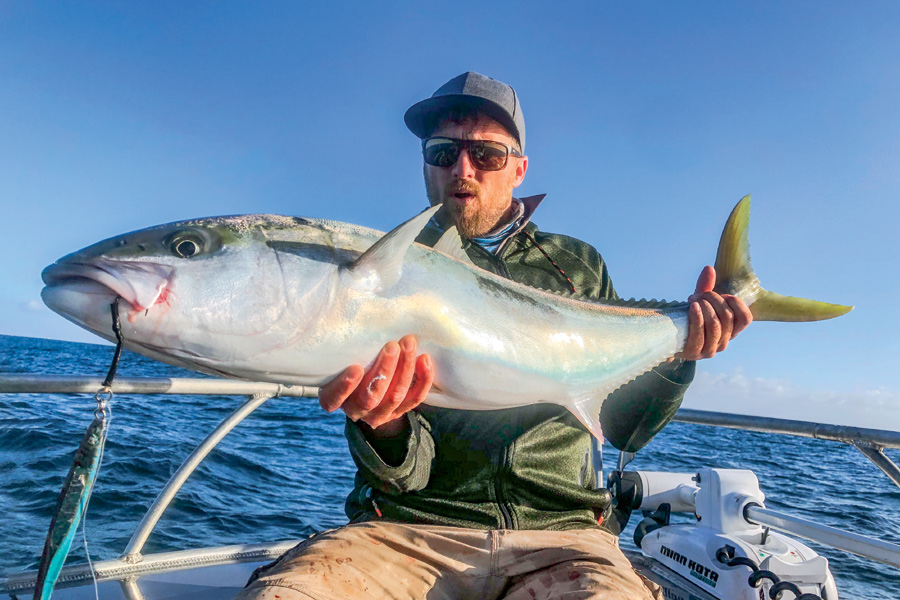
A fat mid water king found while prospecting a shallow reef.
Rods and reels
The beauty of this style of fishing is that you don’t need to buy another outfit. Your current stickbait combo will comfortably perform the task. Anything in the PE3 to PE6 range and around eight feet will be fine. The length of the rod helps you achieve the range on the cast but doesn’t hinder you on the retrieve. A rod that is slightly more parabolic will have better performance and cause less physical fatigue when fishing for longer periods.

Sometimes going a bit smaller, like with this Jackson Plunge, can convert picky fish.
Jig choice
To the sharp point of the conversation. Firstly, the ideal jig weight for this method is between 150-220 grams. However, jigs up to 300 grams can be used for greater depths, provided your rod can handle casting the weight. Additionally, 80-120 gram jigs can be used in shallow water or if the fish are feeding on small baitfish. Be prepared to catch more kahawai when down-sizing your jig as this method is also irresistible to them. I have tried several of the jigs on the New Zealand market and have had plenty success with the Oceans Legacy Long Contact in 130g, Ocean Angler Acid Drops in 200-300g, Knife jigs in 80g, Zest Hardy long jig in 160g and Cuttlefish in 200g, Jackson Plunge in 85g and Glowbite Lightning Rods in 180g.
You can experiment with other jigs but generally they need to have a ‘flattish’ side to produce some erratic action and not be overly tail heavy. Pure knife jigs don’t produce the same flutter. In saying that, you don’t want the jig to be wide like a slow jig either as it will be harder to work and the sink-rate will be slower.
The next time you’re on the water and are faced with a large area to work, give this method a try. You will be surprised at how fast your catch-rate will increase once your jig is being seen by more kingfish.
|
|

Fishing Reports Visit Reports
Outer Hauraki Gulf Fishing Report 17/09/26
Spring wind the handbrake. Spring is starting to make its presence felt in the outer... Read More >
Top of the South Fishing Report - 17/09/26
Early snapper in Tasman Bay. Well, spring is finally here, and the days are getting... Read More >
Bream Bay Fishing Report - 17/09/26
Good snapper catches reported. After Tangaroa turned off the fish tap for a month or... Read More >
Bay of Islands Fishing Report - 17/09/26
Pacific bluefin tuna for the lucky few. The last fortnight has seen more fishable days... Read More >


Saturday 26 September 2026
Major Bites
 - -
- - Minor Bites
 - -
- - Sunday 27 September 2026
Major Bites
- Minor Bites
 - -
- -
Comments