
Harling for Trout

For a number of years now Grant Dixon has moved his trout fishing endeavours away from Taupo in favour of the lakes of the central plateau, citing poor numbers and small fish as the reason. On a family holiday to Hatepe, on the eastern shores of the Great Lake, he had reason to rethink this position…
I grew up trolling the Taupo shoreline with my father and grandfather, and have pleasant boyhood memories of landing good-sized and conditioned trout deep-trolling the likes of Mine and Whakaipo Bays. Flatfish in either pearl or ‘spotty gold’ were the lures of choice, fished down to 20 metres plus, using steel and copper wire. Not particularly sporting, but effective.
As a youth, hundreds of hours were spent aboard the family Pelin Nomad cabin cruisier Optimist, exploring the Western Bays based out of Kinloch or Boat Harbour. By now, harling had been introduced into the plan of attack, and it was a fun way to catch fish – two colours of lead with 50 metres of light backing out, trolling the likes of a Taupo Tiger or Red Dorothy through the shallow patches.
When the trout were ‘on the harl’, there was no better place to be. But in more recent times I was one of many to become disenchanted with the Taupo fishery. The numbers had become less, the fish were definitely smaller, and I was introduced to the likes of Lakes Tarawera, Okataina and Rotoiti. Tarawera was the home of the ‘R-strain’ mega trout, and it was not unusual to catch fish averaging 2.5-3kg in a morning’s session when harling my favourite trolling run ‘under the mountain’.
Opening day on Tarawera was also something special. It started with a blessing of the boats the afternoon prior, followed by the first day of fishing after the winter closure (the closure gives the fish a fair chance of spawning undisturbed). It could be mayhem, but also fun with plenty of camaraderie and good-natured competition.
During that period, a return trip for a couple of days to Taupo confirmed that my decision to primarily fish the Central Plateau lakes had been a good one.
Roll the clock around five years, and the family Christmas at Hatepe provided an opportunity to re-acquaint my relationship with the Great Lake. With no expectations, brother-in-law Bob Ohlson and I set out at 5:00 am for a former favourite haunt – harling the Horomatangi Reef. To cut a long story short, by 9:30 am we were back at the ramp with a limit of six trout each, having caught 19 in total.
We were harling a selection of the popular Taupo trolling flies in tandem, and on four occasions we hooked and boated two fish. It was action as I remembered it all those years ago. Many of the fish were not in their prime condition, recovering from the annual spawning run, but we ended up with a bin of nice rainbows on ice.
Conditions were perfect. There was a ripple on the water courtesy of a 10 knot westerly and early on there was good cloud cover. Making an effort to get out of bed early saw us enjoy the Horomatangi harling runs with not another boat in sight.

Some of the better fish taken harling the Horomatangi Reef's shallower contours on an overcast morning with a little wind to ruffle the surface.
Was this just a fluke? There was one way to find out. Daughter Miah joined us the next morning, as did Bob’s wife Yvonne and the action proved not quite as hot, but there were plenty of fish to keep us occupied. A third day with a new crew on board was just as successful. The scorecard over the three days read 51 trout boated; all caught harling with the exception of one that fell to a jig. We kept 24, and of the 27 fish we returned, four were under the legal size of 35cm, another seven didn’t make the boat’s self-imposed limit of 45cm, with the remainder being those in the poorest condition. There were also ten or so strikes that didn’t stick.
Overall, we had spent just over 16 hours on the water, including travelling time, at an average of 3.2 fish an hour while the key was on.
It was also interesting seeing the colour of the flesh and the fish’s condition, which depended on their food source. One exceptional fish we caught deeper on a jig was a rich red in flesh colour and had a gut full of koura.
The following are a few tips, tricks and observations from our time on the water.
Set the alarm
It is the early bird that gets the trout. We were on the water most mornings before dawn with lines in the water just as the light appeared on the horizon. I have always preferred early morning to evening for harling.
How far back?
My harling set-ups are fairly standard – 5-7 metres of trace, two colours of lead and 100 metres of backing. I have a white mark after the first 50 metres of backing and rarely go past that. Thirty to forty metres of backing out is more than adequate. The clearer the conditions, the further back I will run the terminal tackle.
I have two sizes of Alvey reels for harling – the 455B and the 426B. I bulk out the spool with a few centimetres (in depth) of 24kg mono, just to increase the arbour size and consequently produce a better retrieve rate.
Work the depths
Lake Taupo is well-charted bathymetrically. When harling, I like to work between five and 10 metres, running a curved line between the two depths. Two colours of leadline incorporated in the harling set-up will take you down 4-5 metres.
Three’s a crowd
While the regulations allow up to three flies on a line, in practical terms, this is one too many. I like to rig my terminal tackle with two traces running off the swivel – the top fly being on a short 15cm dropper, the second ‘tail-end Charlie’ on a metre trace. This is quite manageable, even if you get fish on both flies. If this happens, net the rear fish first then sweep upwards and get the top fish.
A little breeze is good
While you don’t want to be fishing in a gale, we had up to 10 knots of SW on our first and most productive morning, with the sky overcast. The bite lasted the longest. I believe a little bit of wind is better than flat calm as the fish have less time to see and size up the fly and tend to strike instinctively. Bigger flies appeared to work better in the rougher conditions.

Darker, overcast or early morning conditions where there is a little movement in the water go hand in hand with harling success.
Don’t stop
When you get a strike, keep running the boat forward for 50 metres or so. You will be surprised how many times the other lines will take a hit. If you are trolling into the wind, turn away from the side the hooked up rod is on. This puts a belly in the line and when you stop, it means you are not being pushed directly back down the line, which makes it difficult to stay tight on the fish.
When using one-to-one reels such as an Alvey, it can sometimes be hard to retrieve the line fast enough, hence the turn. Hooking up down-wind will mean the boat naturally keeps tension on the line, reducing the opportunity for the fish to shake the hook free. This is more important when trolling lures as opposed to flies.
What flies?
How long is a piece of string? All the ‘standard’ patterns worked for us – Taupo Tiger, red and yellow-bodied Dorothy, Green Orbit, Yellow Lady, Jack Sprat and Ginger Mick. If you are new to the area, best practice is to check out your local tackle store. Their advice is usually genuine, and they have current intel as to what is working. Go with a range of the standard flies in several hook sizes.
What speed?
I am happy harling/trolling at anything from 1.5 knots up to just under 3.0 knots. We have a Mercury Verado 250HP V8 on the back of the magazine’s Billfisher 735 project boat Fishing News. A feature of the Mercury is Troll Control, which allows me to reduce the idle speed down to 500RPM producing 2.0-2.5 knots trolling speed which was ideal.
It constantly impresses me the way the modern, large horsepower fourstroke motors perform at slow speed. If I want to reduce speed further, I can ‘bury the nose’ by fully extending the Lenco tabs and trimming the outboard in as far as it will go. This will knock at least half a knot off the boat speed. Just remember to reset everything before taking off at full throttle!
Downriggers for harling?
Hell yes! Downriggers have revolutionised trout trolling. They enable you to run light (6kg mono in my case) line as opposed to leadline and backing, producing a far more spectacular experience for the angler. They are readily adjustable to any depth, and while they take a little more skill and experience to set, the results make the effort worthwhile. We run two Scotty ‘riggers on Fishing News – one electric, the other manual – and I would not be without them for trout trolling.
When fishing downriggers, you do need to be more vigilant on the helm. Both the depth sounder’s signal and the downrigger weight will encounter any change in depth at the same time!
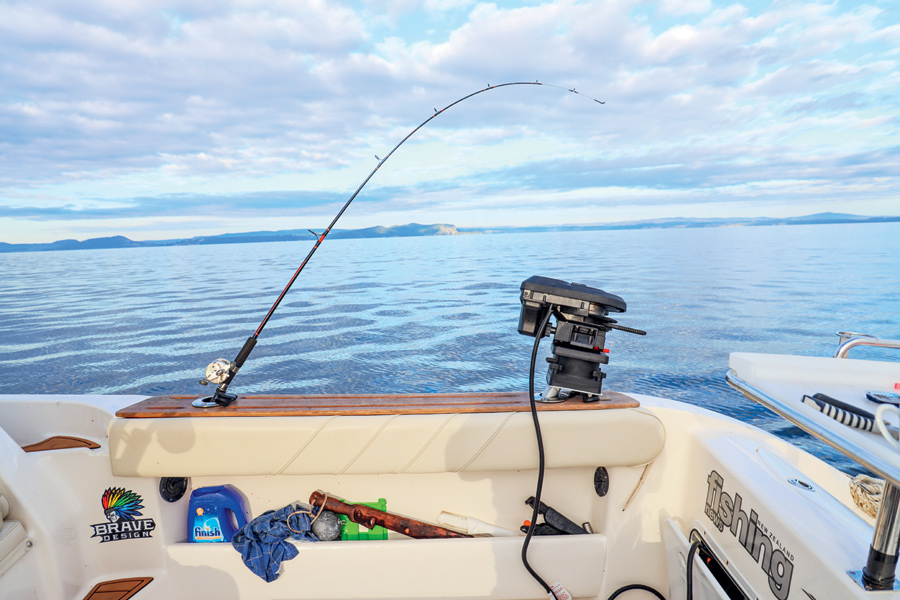
Downriggers have revolutionised trout trolling and have a place in harling.
Use the technology
A decent sounder/plotter is a bonus in any fishing situation and trout trolling is no different. The charted bathymetric lines give you an accurate game plan while the sounder will confirm those depths as well as indicate bait and fish. On the Furuno TZ Touch 2, the schools of smelt and their attendant feeding trout were clearly indicated, and it was simply a matter a running the flies past their nose – don’t you love it when a plan comes together! The AccuFish function even told us what size the trout were and with the track function on I was marking where we had the strikes and then running back over them. We used a different colour track for different days and could soon see a pattern emerging – the value of good electronics.
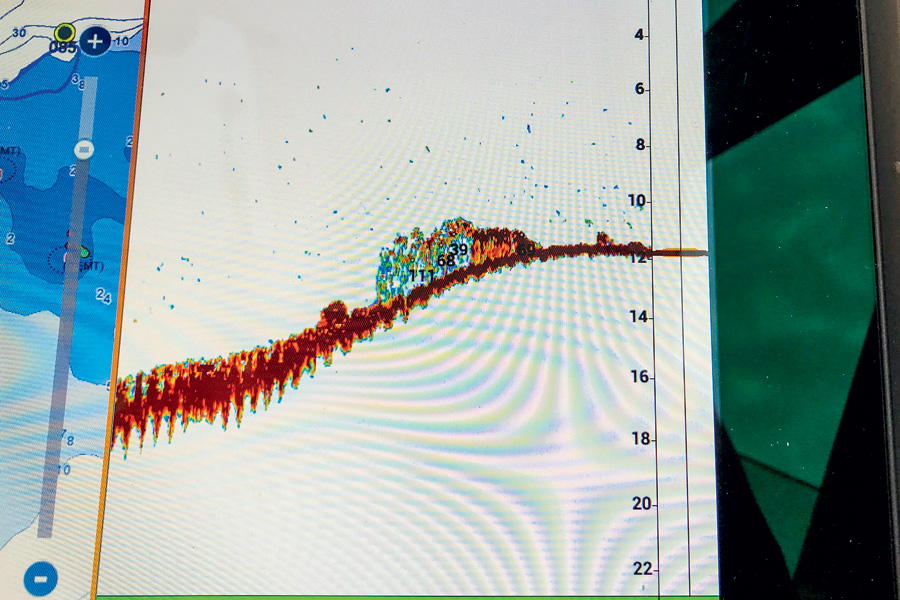
The sounder shows a large school of smelt and the Furuno AccuFish feature indicates several trout patrolling it.
Autopilot is another handy piece of kit, especially when you are running lines out short-handed. It might be considered a luxury on a trout trolling boat, but it does prove useful, especially when deploying downriggers with an inexperienced crew on board – you can leave the helm to set the lines.
Rigging lures
On this trip we didn’t have much success harling lures. Cobras, Kiwi Lures and Tassie Devils are normally among my favourites and I like to remove the internal wire rig they come with and replace it with my own hook set-up that enables the lure to slide up the line on hooking-up. This gives the fish less opportunity to use the weight of the lure as purchase in its attempts to shake it free, especially when going aerial.
I also like to get a fine saw and cut a slot in the tail into which I place the split ring, effectively holding the hook in an upright position. I find I get a better hook-up rate and it is less likely to catch on the bottom or in weed than if left facing down or to the side.
Lure tidy
A tip I was shown by Rotorua’s Kevin Coutts, a former trout guide, was to secure the fly or lure to the rod using a plastic clothes peg. There is nothing more frustrating than trying to take a rod out of the cabin and finding the dropper trace and lure have become tangled in other gear.
Have choices
Go trolling well-armed with a selection of both flies and lures at your disposal. You can’t beat having plenty of ‘bling’.
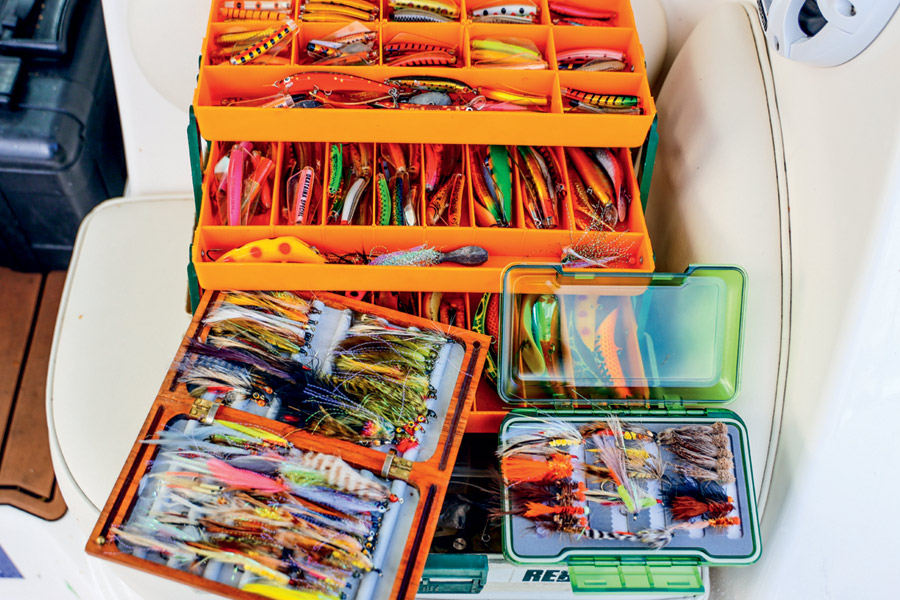
If you have enough 'ammunition', something is going to find the mark!
The hand-brake
When using one-to-one reels with their primitive drag systems, I prefer to deploy the palm of my winding hand against the bottom of the spool to create drag once the fish is hooked. When I get to the leadline on the retrieve, I will put the ratchet on to prevent any over-run or reduce slack line should I get it wrong!
Use the index finger of the hand that is holding the rod to guide the line evenly on the spool as you make the retrieve. This is especially important when pulling the line in without a fish. Yes, it is easy to birds’ nest a centrepin reel, just ask me to show you how!
Setting the drag for trolling is a matter of personal preference and experience. It shouldn’t be so tight as to rip the hook out of the fish’s mouth, or so loose as to create slack line after the initial strike. Always have the ratchet on. Is it possible to be spooled by a trout on the troll? You had better believe it!
Sharpen up
Trout hooks are no different than those used in the marine environment – occasionally the point becomes dulled or is bent over after catching on a rock or snag. Carry a hook sharpener and use it to keep the point in good shape.
Erratic is good
The late Keith Draper was a very successful trout fisherman across all facets – fly fishing and trolling. When harling he would either make slow, sweeping movements with his rod tip, or pull a little line back and forwards through the guides, giving the lure a more erratic, natural action.
|
|
|

Fishing Reports Visit Reports
Manukau/West Coast Fishing Report - 15/10/26
Big spring snapper in 60 metres. The El Niño weather pattern isn’t going to be... Read More >
Rotorua Fishing Report - 15/10/26
Solid start to the season! The Rotorua lakes have all started the season well, and... Read More >
Tutukaka Fishing Report - 15/10/26
Big snapper in shallow. Things remain relatively quiet on the fishing front out of Tutukaka,... Read More >
Tauranga Fishing Report - 15/10/26
Bait and temperature on the rise. It’s been great to get out and see some... Read More >


Wednesday 21 October 2026
Major Bites
 - -
Minor Bites
 - -
Thursday 22 October 2026
Major Bites
- - Minor Bites
- -
Comments