
Handling calamari

Calamari, when prepared right, is a real delicacy and this is what makes eging so rewarding for us. Just like the squid’s endless combinations of camouflage, the same applies to preparing calamari dishes (your imagination is your limit). This article briefly covers what happens between catching and cooking and shares some of our favourite recipes.
Like any seafood, taking good care of your squid catch greatly improves its eating quality. We like to dispatch our squid as quickly and humanely as possible using a small tool called a squid iki-spike. It looks like a flathead screw-driver. Squid have several main nerves, so it is necessary to iki them twice in different spots.
First, point the iki-spike in the direction of the mantle just above the head at angle of around 60 degrees and push. If done correctly, the body of the squid will immediately change colour to white as the chromatophores are shut down. If one side of the body turns white but the other side doesn’t, repeat again but offset the spike slightly towards the side that didn’t change colour.
Next, firmly pushed the iki-spike in between the eyes to kill the head. It can take a couple of attempts to get this right. Another neat trick, if you don’t have the tool, is to do a quick and sharp karate chop just above the eyes. Then, immediately put the squid on ice.
During land-based missions, we like to bring small chilly bins with cooler/ice packs, which we then fill up with a bit of saltwater to keep the squid cold and out of the sun. Exposure to the sun can ruin them.
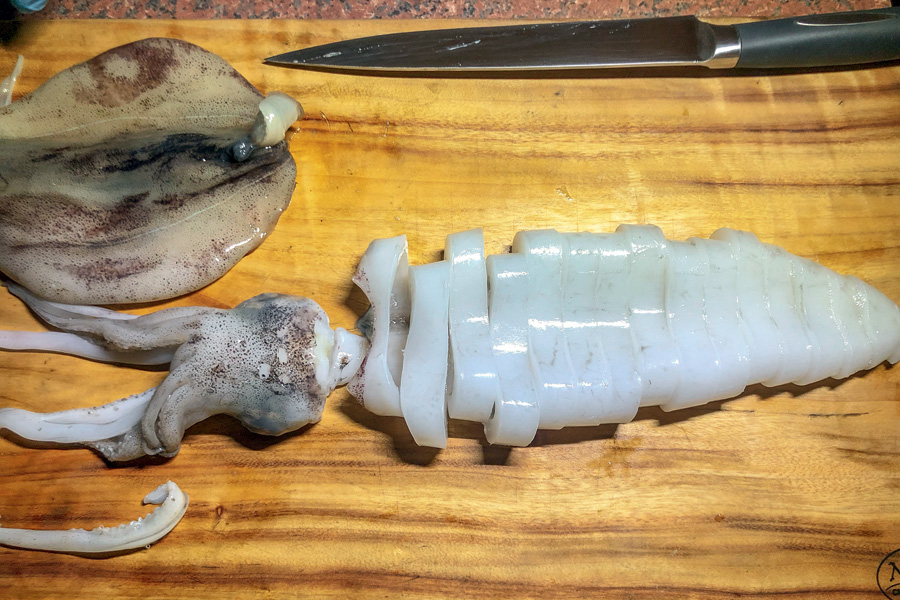
Squid can be stored in the freezer for a long time, but it is important to gut and clean them first. To do this, use your fingers to separate the guts from the mantle along the cartilage line or backbone of the squid. If done correctly, the head and the guts should come out in one piece. Remove the wings and peel off the skin (the wings can also be eaten). Then, cut just below the eyes and remove the beak from the tentacles. The tentacles are also great to eat. Give them a thorough wash and then put them in a sealed bag and into the freezer until it is ready to be eaten.
We prefer to store our squid as tubes, as it gives us more options to cook with than if it were cut lengthways and stored as an envelope of squid.
|
----- Advertisement -----
|

Fishing Reports Visit Reports
Raglan Fishing Report - 12/11/26
Big spring snapper. With the more settled weather over the last couple of weeks there’s... Read More >
Mercury Bay Fishing Report - 12/11/26
Snapper hit and miss. Most reports have been telling us it’s becoming more difficult to... Read More >
Northland Fishing Report - 12/11/26
The switch has been flicked on! Call it what you want, El Niño, global warming,... Read More >
Tauranga Fishing Report - 12/11/26
Snapper and kahawai in close. Again, we start on a positive note, with some nice... Read More >



Wednesday 25 November 2026
Major Bites
 - -
Minor Bites
 -
 -
Thursday 26 November 2026
Major Bites
- - Minor Bites
- - Popular Articles

Softbait Fishing - Part 1 - gear selection
John Eichlesheim writes an article about selecting the right equipment for softbait fishing... Read More >
Softbait fishing Pt 2 - tips and tricks
Techniques, tips and tricks of softbait fishing – getting the most from your soft baits.... Read More >

Surfcasting - setting yourself up
Gary Kemsley helps sort out the necessary gear for intending surf fishers.... Read More >

Squid - How to catch them
Squid fishing is a rapidly growing aspect of fishing - Paul Senior shares some hints and tips to get started.... Read More >
Comments