
Gamefishing - Using lures part 3
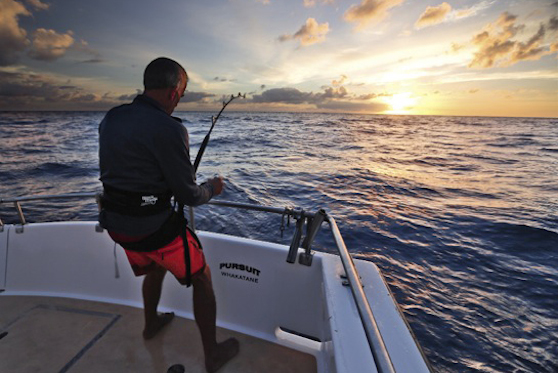
One factor was responsible for dramatically increasing my hook-up ratio on marlin: I reduced my reel’s ‘strike’ drag to approximately 3 or 4kg, regardless of the line’s breaking strain.
Why? Well, the traditional, relatively heavy ‘strike’ drag pressure of around a third the line’s strength makes it harder for the marlin to turn out of the pattern at an angle that allows a more effective hook-up to occur. Also, it can be difficult to lift the heavily loaded outfit from the rod holder, and then, upon clearing the holder, anglers are sometimes overwhelmed by the weight that suddenly comes on. Outfits have been lost in such circumstances.
So try around three kilos of drag pressure – that’s just enough to hold a lure firmly in position and not much more. You’ll find that when a marlin takes a lure, what follows is much more civilised and calculated. As the reel continues to scream (no, the marlin generally doesn’t let the lure go, as one might suppose), the angler removes the rod from the holder and carries it to the chair or places it in a stand-up bucket while the rest of the crew continue to clear the gear. Then, as soon as it’s obvious the marlin has veered out of the lures or starts jumping, push the drag lever up to help drive the hook home…
As all game fishers know though, not all bites result in hook-ups, regardless of the drag setting. They also know a missed hook-up is not necessarily the end of the opportunity – provided the skipper and/or the angler take quick action. First up, it’s important to quickly wind the lure back to its original position (as this is the scenario that initially provoked the interest). Then try turning the boat one way or another to give your pattern of lures an alternating slowing and accelerating type action that often proves too enticing to resist. Still no good? Perhaps turn the boat back to where the marlin was last seen and/or vary your trolling speeds.
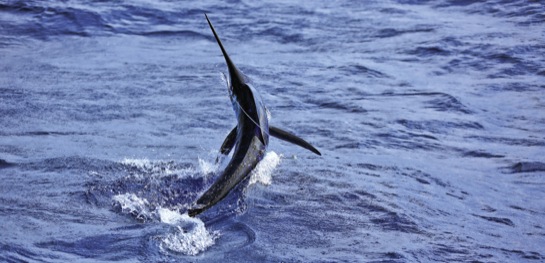
I’m also a big fan of literally taking things into my own hands. If a marlin is just shadowing a lure running directly off the rod tip, try stabbing the rod sideways to give the lure short spurting movements. Most times you’ll be pleasantly surprised at how excited the marlin becomes, generally taking the lure – but be careful not to pull back so hard you propel the lure right out of the water. Also, stay alert for slack line looping around the rod tip – I’ve seen this happen, and the result wasn’t good.
Some anglers like to take this a step further: after firing the fish up until it races in to grab the lure, its mouth open and bill waving around above the surface, these guys free-spool the lure back into the marlin’s mouth. This is very exhilarating when done successfully, but also very risky. A heavy-duty spool filled with rapidly unloading line can be hard to control, and a terminal backlash is likely if you’re not particularly capable.
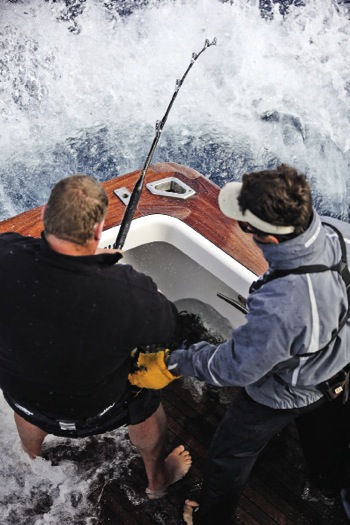 Next, having got the bite and with your reel steadily losing line, it’s time to place the rod butt in the rod bucket or chair gimbal, clip yourself into the harness (which should have been adjusted to fit your body earlier), before possibly upping the drag, leaning back and then enjoying the experience.
While this is going on, the boat should keep going ahead until the remaining gear is cleared and stowed (be sure to hold the lure hooks so they don’t swing and catch someone in the rush). This also ensures plenty of line is dumped in the water. Lots of mono dragging around equates to a heap more pressure on the fish, so the hook is usually driven in further or at least maintains its sometimes tenuous hold.
Then, if fishing from a decent-sized launch with a proactive skipper, you can begin charging backwards, the engines thundering and the boat shaking, with swells crashing up over the transom as the skipper follows the angle of the line disappearing into the water, regardless of where the marlin might physically be jumping (unless it looks as if you are about to cut yourself off).
On a smaller trailer boat, as the angler will usually be using stand-up gear, he or she positions him or herself in one stern corner so the helmsman can see the angle of the line and run the boat ahead along and slightly in front of it – a much safer option than reversing quickly and possibly filling the boat with water.
It’s useful to have an extra person or two available. On bigger boats they might be responsible for manoeuvring the fighting chair so the angler and rod tip remain aligned with the line’s angle. They can also relay what’s going on to the skipper, perhaps calling out or indicating by hand signals what the line angle is in relation to the boat’s stern, or that line is leaving the reel – that sort of thing. Also, most stand-up anglers appreciate a steadying hand on the back of their harness. Just providing the angler with a drink of water or some much-needed encouragement mid-battle can be small but invaluable contributions, too.
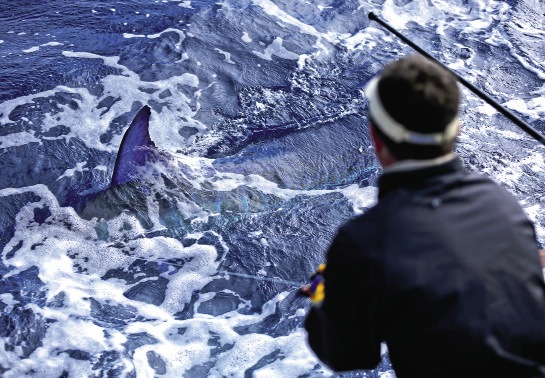
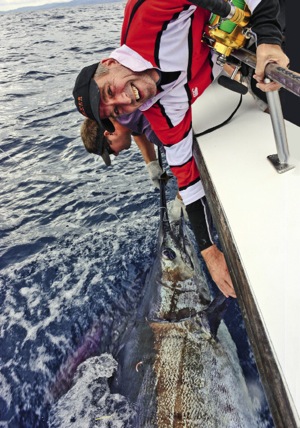 A skipper should use the boat to try and remain reasonably close to the marlin if possible, moving at a pace that enables the angler to keep the line tight at all times. (While there are some ‘old school’ anglers who believe anglers should earn their marlin by winding them all the way back to a stationary boat, these fish are often eventually brought in dead or in an exhausted state, making them unsuitable for release if desired.)
Then, once the fish has settled down, it’s up to the skipper to create some angle on the line so the marlin is more easily planed up through the water column (in the meantime, the crew should be preparing the necessary gear for tracing the fish, tagging or gaffing). Sometimes this will involve moving the boat away from the marlin – a hard thing to do when the struggling angler has just spent the last 20 minutes putting that line on, but the sacrifice is often worth it. And even if it’s not, the next time could prove much more productive as the fish tires. Also, it’s worth changing the boat’s position so the line pulls from different sides of the fish’s mouth; you’ll often find an angle that makes the fish react differently, perhaps coming up to the surface close by for a tracing opportunity.
Once you do get the fish close enough to trace, it pays to wear some sturdy leather gloves – ideally snugly fitting specialist tracing gloves, but heavy-duty gardening gloves will do. When learning to trace marlin, it’s better to simply grab the line with your fingers trapping the line against the palm (called ‘pinching’) rather than wrapping the line right around your hand, as poor technique can lead to a half-hitch and some bad accidents! For similar reasons, always have a sharp knife handy, perhaps strapped to the trace-man’s waist or leg.
Once brought within range, the gaffer/tagger must be sure a tag/gaff can be planted into the marlin’s upper body without risking the angler’s line. If gaffing the marlin, it pays to have a flying gaff at your disposal. This should incorporate just enough rope so it can be tied around the most solid fixture on the boat – a hefty bollard or perhaps the fighting chair’s pedestal – with enough rope remaining so the gaff hook is able to be placed into the fish and not much more. Excess rope can allow big fish to get the momentum required to break away.
When planting the gaff, always get behind the trace and try to place (don’t slash!) it over the marlin’s upper back, before pushing downwards and pulling firmly back in one smooth motion.
Once the struggles and foam subside, place a rope around the tail to ensure your marlin stays caught, and then try to pull it in bill first, as parts of the anatomy get snagged on the boat when trying to bring it in by the tail.
As for intending taggers, the tag should be placed in the upper shoulder, away from the lateral line and ideally slanting back along the fish’s body. Don’t whack it in with all your might, as this can bury it, and only place it if you can do so accurately – a marlin with a tag sticking out its eyeball isn’t much use to science.
Next, unhook your fish; if using a single hook rather than a double, you’ll be much happier about doing it.
Then, after watching the marlin swim off into the depths, hold your hand up for all the high fives coming your way, and let out a loud “YA-HOOOO!”
Hooked up! And the sun has barely peeked above the horizon – looks like being a good day!
 |
This article is reproduced with permission of |
Fishing Reports Visit Reports
Outer Hauraki Gulf Fishing Report 17/09/26
Spring wind the handbrake. Spring is starting to make its presence felt in the outer... Read More >
Top of the South Fishing Report - 17/09/26
Early snapper in Tasman Bay. Well, spring is finally here, and the days are getting... Read More >
Bream Bay Fishing Report - 17/09/26
Good snapper catches reported. After Tangaroa turned off the fish tap for a month or... Read More >
Bay of Islands Fishing Report - 17/09/26
Pacific bluefin tuna for the lucky few. The last fortnight has seen more fishable days... Read More >



Saturday 26 September 2026
Major Bites
 - -
- - Minor Bites
 - -
- - Sunday 27 September 2026
Major Bites
- Minor Bites
 - -
- -
Comments