
Gamefishing - using lures part 2

While lures can hook marlin pretty much wherever they’re placed in the spread, familiarity with the conditions that really suit various head shapes will make a huge difference as to how the lure performs and the number of fish that strike it.
Much of what a lure will do in the water is determined by the shape of its face, with three broad categories – pusher, angle-faced and bullet – covering the most common designs.
Pushers
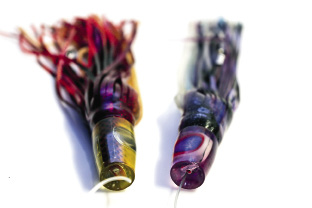 Pushers have a flat or concave face and are designed to splash and bubble in a reasonably straight line. The size of the face varies considerably in pusher lures, from large, concave, almost cup-shaped lures such as the Pakula Beer Barrel/Shaker and Moldcraft Super Chugger, to the much smaller flat faces found on some of the little Zukers and Kilwell Pacifics.
Pusher-type lure actions are affected by: whether there is a central tow-point or a deliberately offset one; the size of the face; the head’s overall weight; and whether the face is flat or concave. These aspects combine to produce very different attributes.
For example, large pusher lures with concave faces tend to dig in really hard, so work nicely in positions where relatively sharp line angles are usual. This makes them well suited to being trolled directly off the rod tip, either on the second or third pressure wave, or from the short-positioned outrigger. And for similar reasons, they also make an excellent ‘moose’ or ‘shotgun’ lure set right out the back and deployed from an elevated position – either a rocket launcher/flybridge rodholder (depending on the size of boat) or via an ‘up-rigger’ device.
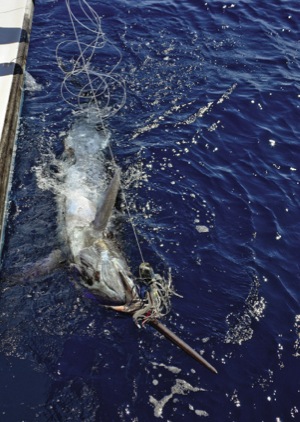
 Having said that, they really fizz when flat-lined (the process of pulling the mainline down from the rod tip and securing it at a lower level, usually with a rubber band or AFTCO Roller-Troller) on the second pressure wave back, too.
They do have a major disadvantage though: due to all the water pressure working on their face, they can catapult right out of the water if air suddenly replaces the water – a common scenario in rough conditions.
On the other hand, longer heads with smaller faces, sometimes aided by extra weight, can continue to work well in virtually all conditions. Rather than flying out of the water in choppy seas and tumbling as other designs will, these lures end up slithering and sliding down the wave faces in a very appealing way, trailing bubbles. Such lures work in a wide variety of positions within the lure spread and in most sea conditions (the Zuker 5.5 is a particularly good example), suiting people who like to ‘set and forget’ or don’t want to buy too many lures.
Sitting in between these two pusher extremes is a heap of lures sporting ‘medium’ faces, with the Pakula Sprockets (in all sizes through to the ‘Animal’) being amongst the best known, along with the mid-range Kilwell Pacifics, such as Eyecatcher and Baitfish (although the latter appear hard to come by now). While this type of lure is also very popular, reduced line elevation can be required when conditions are rough so the lures are less likely to fire out the water.
Angle-faced lures
 Angle-faced lures are slightly less popular than pusher-styles, probably because they require a little more skill to get running well. But when you DO get them fizzing, they’re an absolute joy to watch. And boy, do they get eaten!
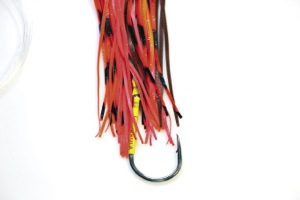
To realise the angle-faced lure’s true potential, good hook size and orientation need to be understood (much more so than when using flat-faced, pusher types). For example, if the hook(s) are too large, the lure can become ‘ruddered’, reducing its action. As a general guide, if using double-hook rigs, the head of the lure should just pass through the gape of the hook – or almost do so – for it to be of a suitable size. Personally, though (along with many other experienced fishers), I far prefer a single hook that’s a size or two larger on ALL my lures, as this is still lighter and less disruptive to the lure’s action than two smaller ones. Single hooks generally hook up as effectively as doubles, and are certainly much safer for crew and fish alike. For best results, place this hook well to the rear of the lure’s skirt; I like the curve of the hook to protrude beyond the skirt.
However, it’s important to secure the hook into position so its point sticks upwards on the longer side of the lure’s angled head, as this balances the lure nicely, enabling it to perform better in the water and helping to ensure that the softer, upper part of the marlin’s mouth comes into contact with the hook point. To achieve this, a hook-rig holder, toothpick or rubber band is needed.
Hook-rig holders tend to be incorporated within the lure’s head and secure the rig’s crimp, shackle or hook eye. Otherwise, it’s necessary to toothpick or rubber-band your lure firmly onto the trace. I like the flatter plastic toothpicks, as they fit into the curved gap between the lure and trace more snugly. But whatever you use, be sure to insert the toothpick at the rear of the lure’s head or you can change the lure’s action.
Winding on a rubber band ‘wedge’ onto the trace is harder to do, but this does grip the lure better (provided there’s space to accommodate one). For those who want to do this, note that the rubber band wedge needs to very slowly increase in diameter, so tension must be maintained on the trace throughout the winding-on process, which is more easily done with two people. Once done, slowly bring the lure head down onto the tapered ‘band and wiggle it firmly into place.
Although many angle-faced lures still run relatively straight in the lure pattern, some based on the scoop faced Kona-head pattern – named after the Hawaiian island from which this design originated – skitter and dance all over the place. While they’re very effective in bringing fish up and getting them excited, their action can be so erratic that even the marlin can’t catch them. Consequently, they’re often deployed as a teaser lure (especially in fine conditions), with anglers hoping that should the lure prove frustrating for the marlin to catch, another more easily-caught lure will be nailed instead. However, as these lures can charge all over the place, they are best positioned right out the back of the pattern.
The bullet head
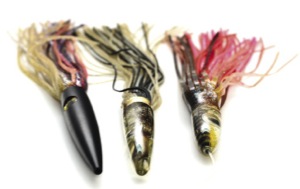 Although mostly used in lures meant for tuna and wahoo, the bullet can also prove effective on marlin. Due to its streamlined shape and often having a little more weight than usual, this type thrives in rough and/or high-speed trolling conditions, staying nicely in the water and simply being pushed around by the current and wake. This makes them a good lure to run in a short ‘rigger position or way out the back as the ‘shotgun’.
Lure color
While lure size, head shape and positioning (in the spread) are the most important components for successful lure fishing, there are times when the colour of a good lure can make a massive difference, too.
Most keen gamefishers have experienced times where a certain colour combination has been favoured above the others on offer – but one has to wonder whether the fish would have settled for another colour if the successful lure was to be removed from the pattern. Another moot point is whether a certain coloured lure is ignored at the time purely because of its hue or as a result of being placed in the wrong position – or is the wrong shape or size. And, of course, maybe it does or doesn’t incorporate fluorescent/ultra-violet/lumo materials – three properties that appear to attract and trigger predatory interest.
Whatever. By having four or five tried-and-true colour combinations out at any one time and playing around with their positions in the pattern, you should find success. Personally, I try to ensure my starting line-up includes the following colour combinations (in order of preference): black and purple/blue, perhaps with a touch of orange (basically ‘tuna’ colours); blue and white/pearl and pink (flying fish) – ‘Evil’ is a particularly effective version of this; lumo green (and a variation commonly known as ‘Express’); green and yellow (kingfish, mahimahi and koheru); brown and pink/cream (squid); and green, yellow and orange/red (mahimahi). Having said that, a Pakula ‘Animal’ with magenta and pink skirts really did the business for me for several years – just wish I could find those colour skirts again!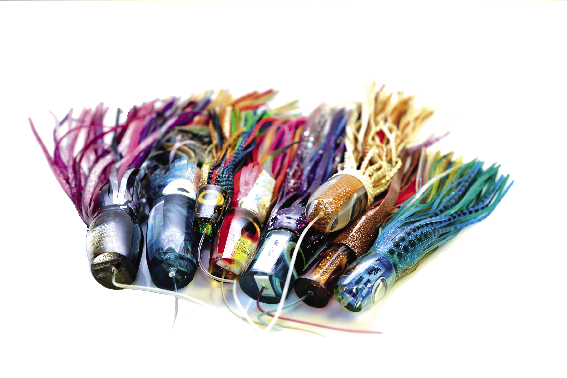
Traces
Choosing the best trace material for each lure can be a hard call. Basically, the lighter the trace, the less it restricts the lure’s natural action, but it must also be tough enough to cope with bill abrasion, possible tail wrapping, boatside hull rubbing, as well as enable the trace man to have a decent pull if necessary.
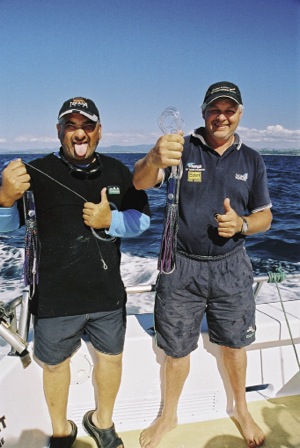 Consequently, I generally rig all large, strongly moving lures with 500lb nylon and the smaller sizes with 300-400lb. Keep in mind that while fluorocarbon trace material is very tough, it is also very dense, so dampens the lure’s action a little. It is, however, ideal when using baits.
The length of the trace tends to be determined by the tackle being used and the number of people on hand to help. If fishing according to IGFA rules (in a contest say, or when seeking records), leaders cannot exceed 15’ in length if your tackle is 10kg or less (with up to 5’ of doubled mainline providing a combined 20’ length of stronger line), while gear over 10kg allows up to 30’ of trace and 10’ of doubled line for a combined length of 40’. Personally though, I find around 20’ and a very short double work pretty well for most fish and the crew on board.
Wind-on leaders can be very useful, especially if the boat is short-handed, as they remove the need for a trace man. They also enable stand-up anglers to control their fish right to the side of the boat, and mean no potentially dangerous leader material ends up lying around on the deck. The only real disadvantages are that as these leaders are much thicker than the mainline, they eat into the reel’s capacity, and if the angler’s not careful, they can hump unevenly on the spool and become jammed against the reel’s frame.
Part 3: the lures go in the water!
 |
This article is reproduced with permission of |
Fishing Reports Visit Reports
Outer Hauraki Gulf Fishing Report 17/09/26
Spring wind the handbrake. Spring is starting to make its presence felt in the outer... Read More >
Top of the South Fishing Report - 17/09/26
Early snapper in Tasman Bay. Well, spring is finally here, and the days are getting... Read More >
Bream Bay Fishing Report - 17/09/26
Good snapper catches reported. After Tangaroa turned off the fish tap for a month or... Read More >
Bay of Islands Fishing Report - 17/09/26
Pacific bluefin tuna for the lucky few. The last fortnight has seen more fishable days... Read More >


Friday 25 September 2026
Major Bites
 - -
- - Minor Bites
 - -
- - Saturday 26 September 2026
Major Bites
- - Minor Bites
- -
Comments