
Gamefishing - using a dredge Pt 3
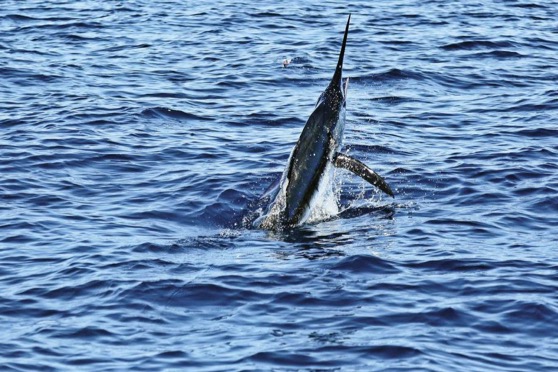
I hope the following tips help when you set up for your style of dredge fishing and avoid some of the trial and error we had to go through.
Baits, baits and more baits

What sort of bait should you put on your dredge? When tournament fishing, we use two double dredges with about 30 natural mullets all chin-weighted and attached to the dredge via snaps and swivels. It’s a huge expense and takes the crew many hours to prepare, but our justification is that we will do whatever it takes to give us an edge or to compete fully with the other boats.
Rubber baits with paddle tails are also effective and give off great vibrations – on some days they can work better than natural baits. A bunch of coloured rubber squids works well too, as do flat pieces of rubber cut out to match tuna shapes (brand name Mudflaps). Some people use Mylar strips with fish shapes on them, but I feel this is a little one dimensional, showing only a shape without the movement and vibration.
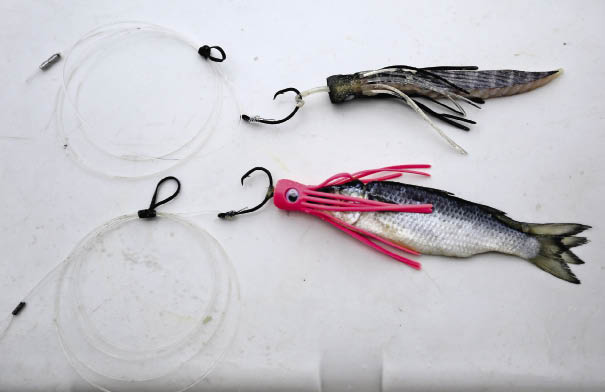
The 250mm-long rubber paddle-tail bait is my favourite, being hardy, easy to use and very lifelike. On some days they seem to raise more fish than natural dead baits.
TIP: When using paddle tail baits, cut a ‘V’ section out of the paddle tail, otherwise towing these baits at seven knots will break the tails off. The cut-out section reduces the drag on the bait.
Bait to dredge arm connection.
The attachment used to connect your bait to the dredge arm depends on the baits being run. For the rubber bait we use a corkscrew-style wire with a snap on the end. Other options are a snap-swivel straightened out and then pushed up into the bait.
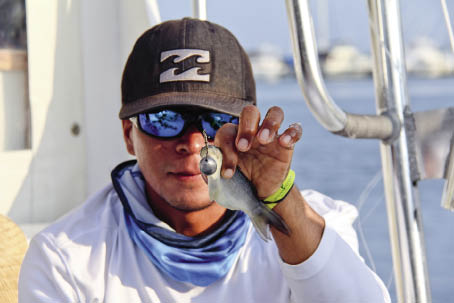
For natural baits we make up wire holders for the bait incorporating an ‘egg’ weight, with the bait attached via a rubber band. Some rubber baits come with fixing points already attached. The ‘egg’ weight is used to get the natural bait swimming and stops it from spinning.
TIP: Make sure there is a swivel between the bait and dredge arm so the bait can move freely and will not shear off due to movement fatigue.
TIP: Use only the best quality stainless steel swivels, and try to use similar metals to prevent corrosion and gear failure.
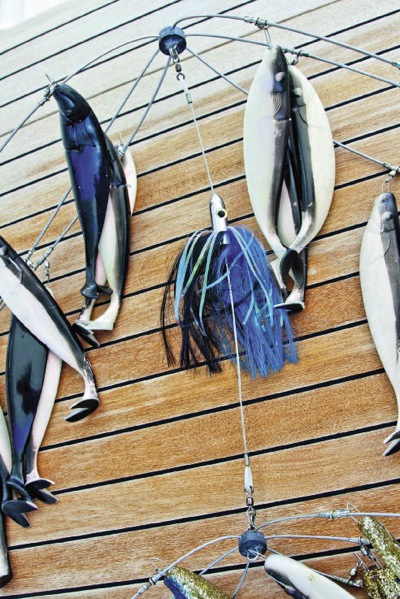
TIP: For extra security, stitch rubber baits onto the fixing points with waxed thread to prevent baits falling off and being lost.
Swivels – lots of them
As the dredge is being towed through disturbed water, it’s going to end up surging, twisting, jerking and even spinning a little at times. Consequently, the more heavy-duty swivels you have, the better.
The basic rule is to have a swivel in front of every major component, including dredge arms, connecting wires, weights and baits. Make sure you use high quality swivels of 300kg plus for the main parts of the dredge and 40kg for the baits. If using an electric reel to pull in the dredge, make sure you have swivels at every fixing point on the line and the pulleys as well.
Nothing wrong with being bent
Dredge arms are straight when new but we like to bend our arms backwards 10-20 degrees for a couple of reasons:
• It stops tangles and makes putting the dredge in the water easier when the boat is moving forward.
• It’s more streamlined and stops the dredge spinning.
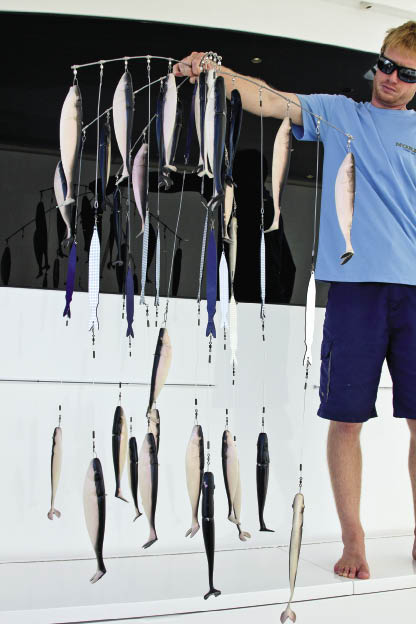
TIP: I have seen people make their own dredge arms and think heavy is best. The best arms are made from thin 2-3.3mm wire. Flex in the arm gives the dredge its pulse and makes the bait move more like a school of fish.
Flash is flash
Some reflection and flash give the dredge a little more appeal, just like you see in a bait ball when a predator shoots past it or when a school of bait moves quickly and changes direction. Consequently. there’s nothing wrong with adding a little bit of flash to the dredge. Try sliding a glittery lure over the short length of connecting wire between the two arms, or adding small lures in front of your baits.
The hook that catches the fish
Once you have your dredge set up and running, it’s time to put out your baits. This part is only as good as your imagination and, of course, what you can get your hands on. Examples include: natural swimming dead baits, chugger heads in front of dead baits, skipping baits, small lures, rubber bait, belly flap baits – the list goes on.
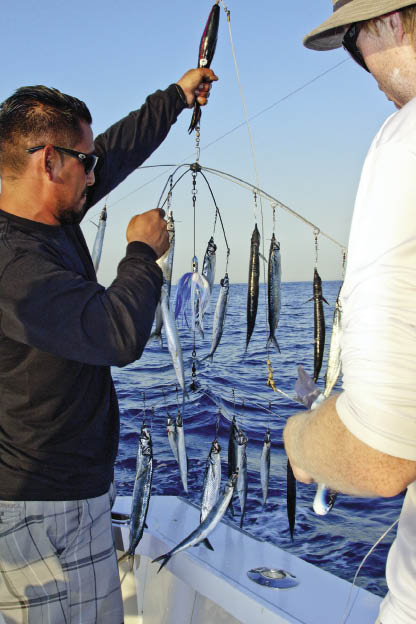 We use what is available and/or can get hold of easily. If lots of skipjack are around, we use the belly flaps for baits; if mackerel are nearby, we use these as swimming or skipping dead baits.
Circle hooks are the trend now for bait fishing because released fish have a much better chance of survival. ‘J’ hooks can be used, but require a slightly different approach when setting the hook.
TIP: If using belly flaps and dead baits, catch them in advance, brine and salt them, and store them in zip-lock bags. A brine-hardened bait will last a lot longer than a fresh bait.
TIP: A medium Moldcraft Chugger lure with the inner skirts removed makes a great backup spare bait if you run out (see photo p29). You can run a ‘J’ hook rig or even a circle hook in front of it; it’s surprising how well these work.
Dredge-style fishing is a very productive way of raising and catching marlin, and has been proven overseas on the tournament circuit for quite a few years. It takes a few days to get used to this new way of targeting billfish, but once sorted it is actually a very simple method.
Good luck and tight lines.
For more information on Tony Orton Sportfishing check out offshoreadventures.net
 |
This article is reproduced with permission of |
Fishing Reports Visit Reports
Manukau/West Coast Fishing Report - 15/10/26
Big spring snapper in 60 metres. The El Niño weather pattern isn’t going to be... Read More >
Rotorua Fishing Report - 15/10/26
Solid start to the season! The Rotorua lakes have all started the season well, and... Read More >
Tutukaka Fishing Report - 15/10/26
Big snapper in shallow. Things remain relatively quiet on the fishing front out of Tutukaka,... Read More >
Tauranga Fishing Report - 15/10/26
Bait and temperature on the rise. It’s been great to get out and see some... Read More >



Friday 23 October 2026
Major Bites
 - -
- - Minor Bites
 - -
- - Saturday 24 October 2026
Major Bites
 - -
- - Minor Bites
- -
Comments