
Gamefishing – the NZ gamefish tagging program
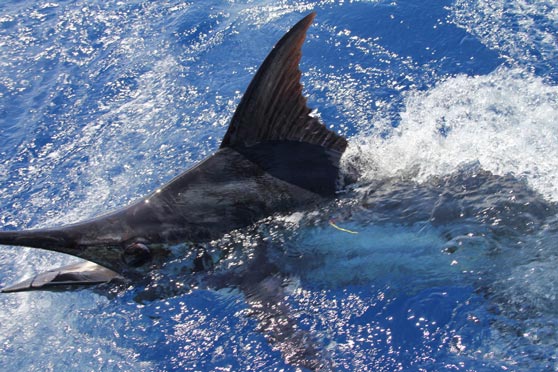
Before I proceed further, perhaps I should outline my pedigree with respect to the subject. I co-ordinated the gamefish tagging programme for 20 years. Along the way I somehow became a charter skipper as well (it’s a long story) and that is my primary occupation today; so of course I found the subject most interesting.
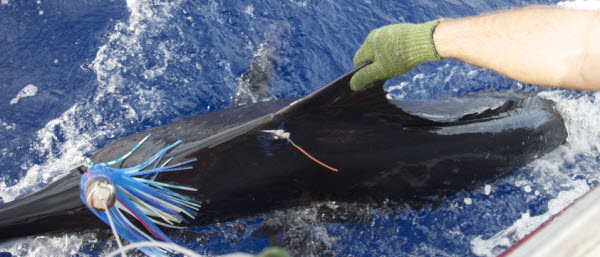
The article lists five major ‘arguments’ in assessing whether marlin tagging has any usefulness in the years ahead and is taken from an original article by Craig Worthington. I might add that Craig was not necessarily arguing in favour of each proposition, but discussing issues that many fishers have raised in recent times.
Argument Number One:
Marlin tagging is not a conservation practice.
To a great extent I agree with this. The main object of the marlin tagging programme is not conservation, even though many people believe this to be so. Obviously, Craig is under the same misapprehension as many others in suggesting that conservation is the main reason for tagging marlin. The object of tagging marlin in New Zealand is to learn more about their distribution and movement. The fact that tagging allows anglers to practice conservation is a by-product of the programme, not its objective.
The number of marlin caught annually by recreational fishers in New Zealand is likely to be of little consequence to the Southwest Pacific striped marlin stock. In comparison with commercial catches of marlin elsewhere in the Pacific, the two thousand or so marlin taken by anglers here each year are almost irrelevant as far as the total stock is concerned.
Nor is the ‘voluntary’ 90kg weight limit related to sexual maturity. The size was chosen arbitrarily because an examination of catch records showed that if all striped marlin up to 90kg were tagged and released, this would approximate a 50% tag rate, in line with the request from the Minister of Fisheries in 1987 when he implemented the Billfish Moratorium. In other words, the 90kg limit was necessary to fulfil the NZ Big Game Fish Council’s part of the deal that allowed foreign long-lining to be restricted and later ousted from the EEZ.
We are not tagging immature fish with the aim of allowing them to return to distant spawning grounds, to make some future contribution to the numbers of marlin that later return to New Zealand.
In summary then, the reasons for tagging are primarily to collect information on distribution and movement of marlin. Conservation is a side issue.
Argument Number Two:
.jpg) Marlin do not survive the tagging process
Marlin do not survive the tagging process
It’s not the tagging process that affects fish (if correctly performed) but the playing process. As Craig says, the survival issue has been debated for years. There are two separate issues raised in this argument: the survival of marlin caught on rod and reel; and the survival of marlin caught on commercial tuna long lines.
Firstly, rod and reel marlin. There is good reason to believe, as Craig states, that most marlin that are mouth-hooked and handled properly will easily survive if tagged and released. Proper handling does not include removing a marlin from the water or holding its head out of the water for long periods while the hook is retrieved or photographs taken. I like to compare pulling a marlin out of the water before release to grabbing an athlete immediately after he/she has run a marathon, and holding them underwater for two minutes. If you think about it, this is so obvious it should not need to be pointed out to anyone.
The fact that tag recoveries are made at all proves some marlin do indeed survive. However, the best evidence to date comes from acoustic tagging experiments off California, where striped marlin were caught on rod and reel, tagged, and tracked for periods of up to two days. The conclusions of this experiment included the observation that striped marlin exhibited erratic behaviour for up to two hours after release, after which activity returned to what the researchers termed ‘normal’. Tagged marlin, while being tracked, were observed to feed with other fish, free-jump and tail downwind, again with other untagged marlin. Included in fish that were successfully tracked was one that had thrown its stomach out during the fight, and another that came to the boat completely exhausted.
The new generation pop-up satellite tags now available will enable us to conclusively demonstrate the ability of striped marlin to survive catch and release within the next two years.
As far as marlin caught on tuna long lines are concerned, Craig thought that they had little chance of survival. This was central to his concern about the apparent waste of a valuable resource. In fact, estimates of survival of striped marlin released from New Zealand long lines are extremely high, at around 80% or more. Certainly, since New Zealand commercial fishers have been obliged to release all their marlin, large numbers of marlin have been caught in the recreational fishery with tuna hooks and varying lengths of trace in their jaws. If these fish had been tagged before release, a large number of them would have been tag recoveries. Unfortunately, because many long line fishers have become disenchanted with the levies imposed upon them, most have chosen not to co-operate with the tagging programme, which is voluntary.
Commercial fishers I have spoken to believe that striped marlin hooked on long lines quickly settle down after the initial panic, and because the snoods are of considerable length - and widely spaced apart - there is enough slack in the line to allow them to swim in big circles without becoming exhausted. In fact, some fishers claim that marlin survive far better on long lines than they do on recreational lines.
To allay a further fear raised about tuna long lining - namely that “There is a large amount of tuna and broadbill long-lining going on off our shores” - the level of fishing now is a small fraction of what it was when the foreign boats were still fishing. There are currently around 40 New Zealand vessels operating, and these are mostly small boats catching fish for the fresh-chilled market. The foreign vessels were freezer boats that fished every day regardless of weather, operated as a fleet (sharing information), set vastly more hooks each set, and released nothing of value. There is simply no comparison. The local boats are not allowed to target broadbill, and although I believe a few are doing so in contravention of the regulations (using light sticks on every snood is a fair guide to targeting), most are sticking to the rules. The remainder need sorting out.
In summary, there is a sound basis for believing that most mouth-hooked marlin survive being played and released, provided they are handled correctly.
Argument Number Three:
Marlin tagging is destroying the popularity of marlin fishing and is directly responsible for reduced charters.
There is no doubt that a fish on the weigh-station is a great attraction to tourists, despite the emotions it may arouse in those “new age earth-huggers” as Craig aptly labels them. Unfortunately, there were not a lot of fish weighed in the Bay of Islands last season. This has got little to do with the tagging programme. It has a lot to do with the fact that firstly, marlin were not especially plentiful on the coast for most of the year; and secondly, that many of the boats were fishing in the Far North. Thirdly, and this is where I strongly agree with Craig, there is a culture throughout the marlin fishery where some people feel they have the right to publicly ridicule anglers who choose to weigh a marlin less than 90kg in weight. I have already covered why the 90kg limit was introduced. The fundamental problem with having such a limit is that you have no control over what size of fish you hook. Then, various things can go wrong. For example, the fish may become tail-wrapped, be foul hooked, or the angler may lack the expertise, co-ordination or strength needed to bring the fish to the boat alive.
Furthermore, anyone is entitled to bring their marlin ashore to eat if they want to. Clubs can set any standard they choose for contests and trophies, but every angler still has the right to choose. It is most important that people who spend large amounts of money to catch the fish of their dreams are not made to feel guilty by some loudmouth on the weigh station, who has absolutely no right to criticise.
I personally believe that most people will choose to tag and release without a minimum size, but that is a matter for the NZBGFC to work out. I also believe some charter skippers are doing themselves a serious disservice by not listening to their customers enough. This is supposed to be a service industry, after all. Charter skippers stand or fall on a number of factors: the ability to market themselves, their skill at finding and catching fish, and how they respond to the wishes of their customers. If they are mainly fishing to satisfy their own egos and not listening to the customer, then the amount of return business will undoubtedly reflect that fact.
In summary, the argument that tagging is responsible for a perceived decline in the popularity of marlin fishing needs to be considered in the light of unusual distribution patterns in 1997. Charter skippers need to be more responsive to the aspirations of their customers. There is no basis for the alleged belief that “all marlin fishing should be tag and release”, and the right to land a marlin for food should always be respected.
Argument Number Four
Tagging is cruel
Hogwash! Marlin tagging is not cruel, although you can argue that marlin fishing is. Having said that, how can sticking a small tag into a fish that routinely carries copepod parasites at least as big be more cruel than sticking two large stainless steel gaffs in the same fish and dragging it out of the water?
As for the Asian fishers who “have difficulty with the concept of releasing such supremely edible fish” - they were the reason the NZBGFC wanted to get the Billfish Moratorium established in the first place! Despite that, if they charter a boat, wish to land a fish rather than tag it, and the skipper refuses to do what they want, they shouldn’t pay him. End of story. (See argument three.)
In summary, tagging a marlin is a lot less cruel than killing it. If catch and release is not permissible, how can you argue in favour of any kind of fishing at all? All size limits should be abolished if catch and release is not acceptable, since returning undersized fish to the water would be ‘cruel’.
Argument Number Five
Tagging initiates a culture that does not gel with the reality of marlin fishing.
What is reality? Why am I here? Who am I, anyway? Actually, I sympathise with this argument, but the fact of the matter is that reality is different for different people.
Craig’s “nutcase possum-loving animal liberationists” certainly see things differently from me. Tagging does have its place, and so does taking fish for food. It’s only when people get fanatical about things that the balance gets disturbed. The new age earth-huggers are just as off the planet as the clowns who insist that all fish should be tagged. Somewhere in the middle are the rest of us, who go fishing because we bloody well enjoy it! That’s my summary for this one!
Conclusion
There are still many aspects of the life history of marlin that remain mysterious. For that reason, there definitely is a need to continue tagging marlin at present. Leaving out those people who do not wish to release their fish, for whatever reason, I believe there are still more than enough people who want to do it, to satisfy our obligation to the former Minister of Fisheries - who defied his Government to go out to bat on our behalf. The survival of marlin that are being tagged is not guaranteed, but there is very good reason to believe that the great majority do quite well after release. Until such time as we have available the archival satellite tag technology that is currently being developed, conventional tagging is the best means of studying the distribution and movement of the marlin that visit us each summer. This technology will be available within two years, and in fact a pilot project using pop-up satellite tags is being planned for 1998. Whether it eventuates will be dependent on raising the necessary finance.
Meantime, I suggest you keep tagging.
Good fishing...
|
|
October 1997 - by Peter Saul |

Fishing Reports Visit Reports
Outer Hauraki Gulf Fishing Report 17/09/26
Spring wind the handbrake. Spring is starting to make its presence felt in the outer... Read More >
Top of the South Fishing Report - 17/09/26
Early snapper in Tasman Bay. Well, spring is finally here, and the days are getting... Read More >
Bream Bay Fishing Report - 17/09/26
Good snapper catches reported. After Tangaroa turned off the fish tap for a month or... Read More >
Bay of Islands Fishing Report - 17/09/26
Pacific bluefin tuna for the lucky few. The last fortnight has seen more fishable days... Read More >


Friday 25 September 2026
Major Bites
 - -
- - Minor Bites
 - -
- - Saturday 26 September 2026
Major Bites
- - Minor Bites
- -
Comments