
Gamefishing Techniques - Helming Tactics
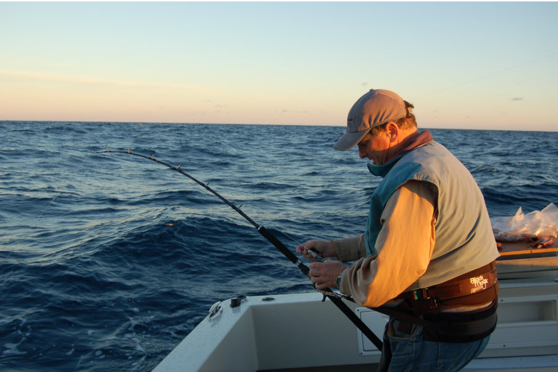
Once largely the preserve of large launches, game fishing, these days, is more commonly carried out from trailer boats in the six to eight-metre range. For reasons of cockpit space, trailer boat game fishing is mostly stand-up fishing, requiring some adjustments in boat handling technique. Special Projects Editor Sam Mossman gives us a rundown.
Sit down vs stand-up
There are some fundamental differences in technique between fighting gamefish like marlin from a large launch and a trailer boat. A launch is usually fitted with a game chair in which the angler sits, and this is fitted with a swinging gimble which largely supports the weight of the rod and reel. The angler applies pressure with a sit-in or kidney harness attached to the reel. Game tackle for launches was often bulky and heavy, needing larger, heavier reels to provide sufficient spool capacity for thicker monofilament lines. Likewise, chair rods were long and stiff as they needed to keep the line clear of the sides and transom of the launch. This type of heavy tackle really needs the support off a chair to allow the angler to fish effectively.
Advances in materials and engineering have made huge differences to game fishing over the last 40 years. The development of stand-up game fishing saw anglers using shorter, fold-away rods that allow anglers to put much more pressure on the fish. Improved stand-up harness designs, such as Black Magic’s Equalizer, took away much of the angler’s pain. Fine diameter PE lines and a change of regulation on top-shotting meant that smaller, lighter, more angler-friendly reels could be used.
All this has had the effect of bringing stand-up fishing to the fore. Anglers no longer need to be anchored to a chair, but can move freely around the cockpit, working right up to the gunwales and transom wall, more easily keeping the line clear of the hull.
Although there is still plenty of game fishing done from launches, these advances in tackle technology have seen medium to large trailer boats the most common game fishers these days and a six-metre tinny arriving back at the ramp with its cockpit filled by a marlin doesn’t raise an eyebrow anymore.
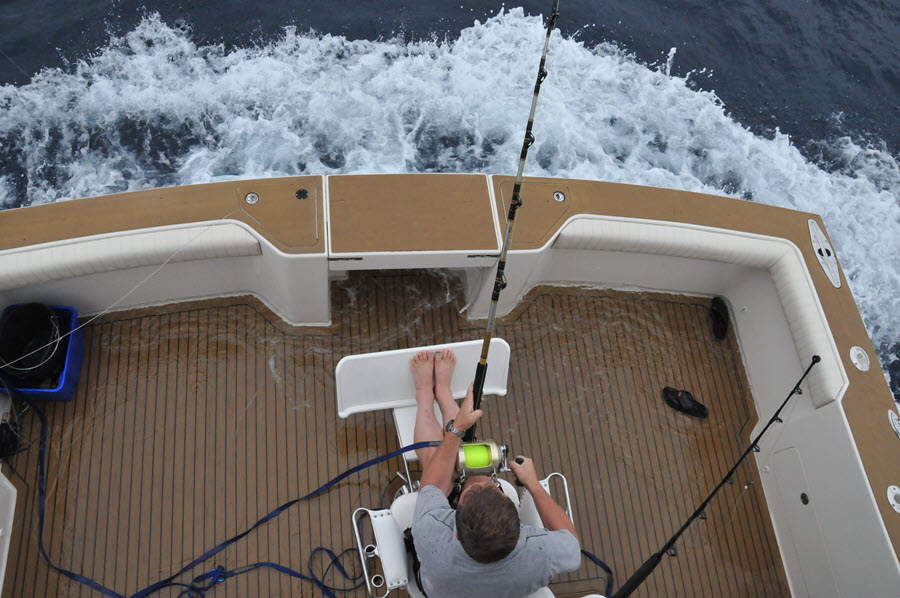
A chair angler is anchored to the cockpit and considerable backing is often called for to release a marlin in good shape
Launch or trailer boat aside, once a big fish such as a marlin, a large shark or XOS tuna is hooked, it is seldom possible for the angler to fight the fish without the use of boat manoeuvring to help contain the fish’s runs. Even were the fish catchable on the line weight and spool capacity being used, some combination of wind, sea and current will often work to move the boat away from the fish, making use of engines necessary.
With the increased line capacities made possible by top-shotting over fine diameter PE braid backing, it is possible to ‘dead boat’ smaller game fish, but this is at the expense of the fish. To bring a marlin to a stationary boat usually involves physically exhausting it to such an extent that its recovery is unlikely, so should only be attempted if the angler intends to keep the fish and doesn’t mind a lot of hard work.
As mentioned, there are two basic ways for an angler to fight a fish: on their feet, or from a game chair. The main difference, as it applies to the use of the boat, is that the stand-up angler has more options than a chair angler, who is nailed to one position, and can only safely work about 180 degrees of the arc astern, while the stand-up angler can work fish in the forward quarters ahead of the boat more easily.
What this breaks down to is that if you are fishing with a cockpit-mounted game chair, you must do a lot more backing down on fish (as opposed to forward chase) than if the angler is fishing stand-up. A stand-up angler is more mobile and can get right up to the gunwale, allowing easier forward chasing, or boat layout permitting, get right up to the bow or even follow fish right around the boat - a useful thing in a multiple hook-up.
The chair angler is heavily reliant on the helmsman to keep the line angles right, and on someone to guide the chair so that the alignment of rod and fishing line are kept correct. If the chair is not kept properly aligned it can become hard for the angler to make headway (especially with heavy tackle), and the line starts to touch the sides of the roller cages (assuming the rod has rollers), increasing line wear.
Backwards or forwards?
It is almost a cliché; a magnificent, white-hulled launch going full astern after a rampaging fish, the air thick with diesel fumes and spray, the drenched angler and crew standing staunch, knee-deep in water and peering astern with squared jaw and a steely glint in their eyes... skippers love it (they call it ‘cooling the crew’) ‑ as long as someone remembered to close the cabin door, and the transmissions hold up! It can be great, exciting fun for everyone, if you don’t mind a drenching, but trailer boats are not designed for this sort of thing, indeed backing up a trailer boat at any speed is often dangerous.
If, for some reason, you wish to back down a trailer boat after a fish, there are a few things to be aware of:
First, if you have trim tabs, be sure to lift them up before backing, or the water pressure will pull the stern down, and may rip the tabs right off the rams and/or mountings.
Second: if you are outboard powered, raise the outboard tilt a bit so that you are pulling the stern up, not under. This could save you a swamping.
Third: Portofino stern configurations can act like huge water scoops and help funnel water into the cockpit. Make sure any transom doors are shut.
Trailer boats are designed to go forwards and this is further facilitated by the mobility of a stand-up angler. Forward chase takes a bit of skill and good communication between helmsman and angler. Initially, let the fish run off astern while the gear is being cleared. It also helps to get the outriggers up out of the way (or at the least, the starboard ‘rigger).
The main purposes of forward chase are to contain the fish’s initial runs, get some line back on the reel (a fuller spool gains more line per handle turn), as well as removing line belly and reducing water drag pressure on the line.
With forward chase, considerable care must be exercised in case the fish turns across the bow and you run over the line. The closer to the line direction you run the boat’s course, the greater the risk is. Any sign of the line converging with the direction of travel must be acted on immediately, and the boat veered away to avoid running over the line. High visibility lines are a big advantage here.
Obviously to chase a fish forward it is necessary for the skipper and the angler to both be on the helm (starboard or right) side of the boat so the skipper can see the line direction more easily. In a trailer boat with a stand-up angler and sloppy sea conditions it is not easy for the angler to keep their balance as well as wind and spread the line and keep tight on the fish. The usual practice is for the angler to park their backside on the starboard transom wall and brace themselves in the corner. To facilitate this, if game fishing is your big thing, you really want any transom door or step-through to be on the port side of the transom wall, on the other side of the boat from where the angler should perch themselves. (If you do a lot of diving, however, it is easier to approach divers in the water with the transom gate and ladder on the starboard side so the skipper can see them more easily).
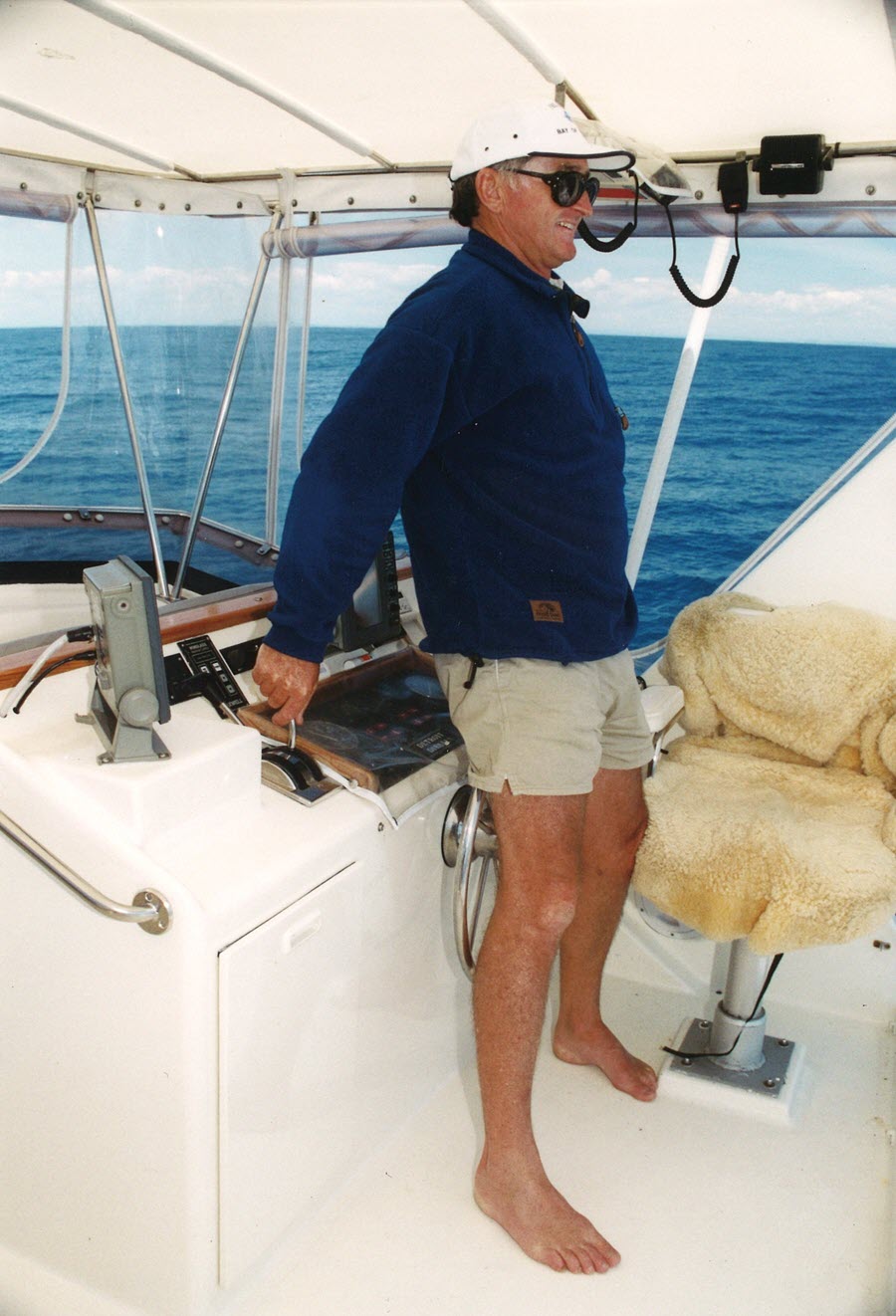
Bruce martin backing down his launch in approved style, holding the rudders centred by leaning on the wheel and steering with throttles and transmissions.
If the worst thing happens when chasing a fish forward and it suddenly changes direction across your bows and the boat runs over the line, the situation can still be salvaged if the angler stops retrieving immediately. It is better yet if they can get to the gunwale and reach the rod out as far as possible. The belly still in the line may allow it to clear the props. If the line is wound in tight, you will cut it off for sure.
It is considered good practice to try and work on one side of the fish as much as possible. There are several reasons for this: one is that you are working more on one set of the fish’s muscles all the time and should tire it quicker. Another is that by reversing the direction of the line, you may pull the hook. This is particularly true of a bill-wrap - the fish may be brought to boat if you stay behind it all the time but go around the front of the fish and you will slip the hold.
Breaking the pattern
Once a fish settles into a pattern, it can be hard to make an impression on it, especially with light tackle. Once you can break it out of what it wants to do, and make it do what you want it to do, you have reached a turning point in the fight. There are a number of tactics that can be useful.
If the fish goes deep, run off ahead off it, sacrificing line as you go. (Anglers hate to see all that hard won line running back out through the guides). While you may not be able to stop a fish from diving when directly above it, if a lower, flatter angle is achieved, they can be turned and planed back up.
Another tactic is to stop and let the fish take up to a couple of hundred metres of line, running directly away from the stern. For some reason, this angle of pull from directly behind will bring them to the surface where you can get at them.
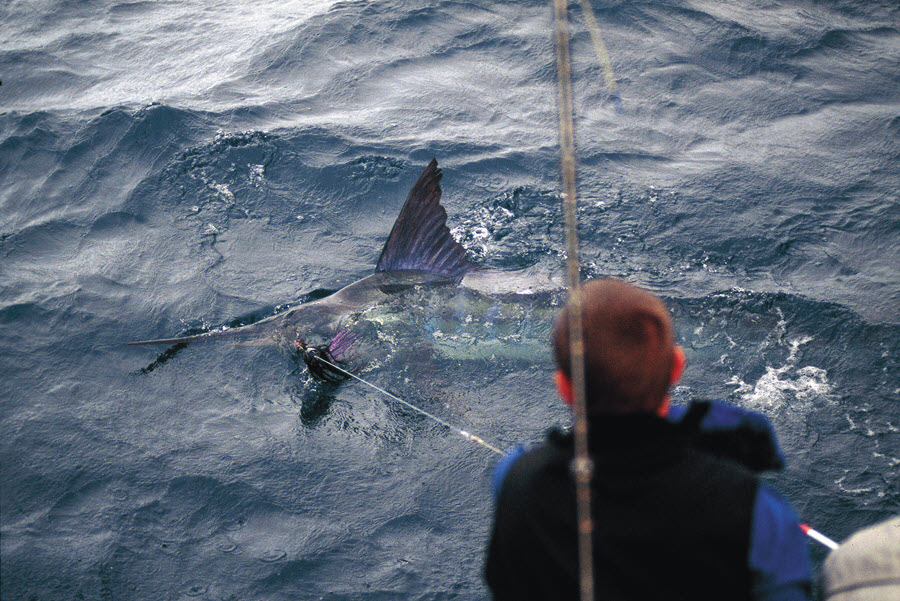
When the fish comes to the boat, it naturally tends to fish to one side, normally decided by the hook placement
A third tactic is to circle the fish rapidly with the boat, changing the angle of pull all the time. This confuses the fish and can bring them to the surface. I don’t do this unless I have to - if the hook hold is insecure you are bound to find the angle that pulls it out ‑ however, this is a tactic to use if you have a fish stuck down deep, and seemingly immovable. In this case it is probably body-wrapped, and circling should roll and unwrap it - this has been the key to getting the fight back on the rails on at least four occasions.
Another move that can short-circuit the final stages of a fight, and get the fish released in better shape (if you are going to), is to ‘head them off at the pass.’ This is especially effective when forward chasing in trailer boats. When the fish is close to the surface, chase it on a converging angle so that you intersect its course and can get the leader. Again, be careful not to run over the line.
When it comes to bringing the fish to the boat, you will find that it naturally tends to fight to one side, normally decided by the hook placement. That is the side of the boat on which to bring in the fish. If the fish is swimming forward, the boat is kept running ahead and the fish is worked to the side where it can be dealt with.
Using the manoeuvres of the boat may be the only way to beat fish on light tackle, and on heavier gear will aid in bringing the fish to the boat in good shape, so that they have the best chance of survival after release. Game fishing is a team sport, and the helmsman is just as much a part of the team as the angler - sometimes more so.

May 2022 -Sam Mossman
New Zealand Fishing News Magazine.
Copyright: NZ Fishing Media Ltd.
Re-publishing elsewhere is prohibited
Fishing Reports Visit Reports
Canterbury Fishing Report - 01/10/26
Freshwater season underway. Wow, it’s October already, and our freshwater season is underway, and the... Read More >
Top of the South Fishing Report - 01/10/26
Snapper about but not yet firing. It’s certainly nice to see daylight savings upon us... Read More >
Hauraki Gulf Fishing Report 01/10/26
Big reds in the shallows. The weather has made getting out on the water challenging... Read More >
Bay of Islands Fishing Report - 01/10/26
Snapper moving in. A few Pacific bluefin are still gracing the weigh stations with last... Read More >


Sunday 11 October 2026
Major Bites
 - -
- - Minor Bites
 -
-  -
- Monday 12 October 2026
Major Bites
- - Minor Bites
- -
Comments