
Gamefishing - Teasers
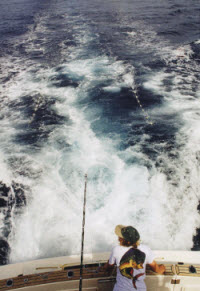 I have tried numerous teasers over the years. They are an integral part of creating a consistently effective lure pattern.
Teasers continue the boat-wash’s excitement into the lure pattern, helping to encourage excited, aggressive bites from the fish so there’s a better chance of hooking up afterwards. Teasers also provide us with the opportunity to run some truly massive lures that may be too large to be trolled effectively on the tackle being used.
These teasers should be very splashy and active, throwing up white water and producing strong bubble trails, as I believe big fish are attracted by such lures. Yes, I know the old saying that ‘elephants eat peanuts’ and I have caught large fish on small lures, but the true monsters I have seen and caught have been brought in by big lures. By running the biggest lures as teasers, we then have the option of running smaller lures in our spread, which offer a better chance of hooking the fish, especially the fickle striped marlin here in New Zealand, as well as big blues.
I take a couple of things into consideration when choosing my teasers. The first is that they must be surface-running, or very close to it, because I like to see them and whatever fish are attracted. That way, I also remember to take it out of the water before I start backing up the boat, as a teaser tangled around a prop is not a good look!
The second factor to consider is that the teaser must be easily removed from the water. By this, I mean if a fish comes on the teaser, you should be able to easily pull it away from it. Too many teasers require the boat to slow down to be retrieved from the water, which is a big problem, as you’re not going to catch a fish on a hook-less teaser. Rather, you’re aiming to get the teaser out of the way as quickly as possible, so you can turn the fish onto a lure or bait with a hook in it.
While there are a number of teasers that can be used which offer widely varying characteristics and attributes, I have a couple of personal favorites that have earned their places through trial and error over the years.
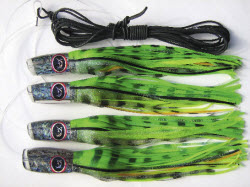 The first style is a large daisy-chain, which tends to be made up of several squids and/or lures. I always have around four to five lures in the chain, with one larger lure as the tailing lure. This could be any large lure you want to run, but must hold your chain in the water, especially if incorporating splashy surface squids in your chain.
Movement is a particularly important property possessed by my preferred teasers. However, I don’t want movement that’s so erratic the teaser races across and tangles the adjacent lure. Instead, just a slight wiggle or weave is great, seeing my ‘pick of the bunch’ teasers being made up of lures with a Kona-head face. This gives the chain a snaking motion and, from what I have seen, drives fish crazy. I think it also stands out very well in the white, turbulent water close to the boat, and looks like baitfish darting in and out of the school.
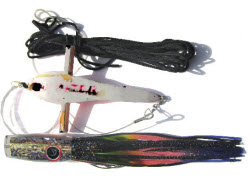 The second teaser I like using consists of a very large lure run behind a surface-splashing bird teaser. This style of teaser is very easy to rig and use and can attract truly massive fish. When setting it up, I like to use an average-size bird around 300mm long. Any smaller and I don’t think it stands out enough, and any bigger sees it becoming a hassle to pull in and store in the boat. For the trailing lure, I try to use a large one that will dive deep. Flat-faced, cup-faced or large angled-face lures with a shallow angle work well, with the latter being my favourite, as it is the easiest to pull in. I believe this teaser works so well with big fish because it offers one big target amongst a ‘school of smaller fish’. Why waste time eating something small, when you can get so much more in one mouthful?
As for rigging these teasers, I initially look at where I want to tow them from. The two teasers I have described are run off hand-lines connected to the transom cleats, as they are too big to run off teaser reels or bridge teasers. So if you want to run them off either of these systems, just scale things down a bit.
Use a decent thickness of cord for the hand-lines, so you can get a good grip of it. You will also need enough line to enable the teaser’s trailing lure to sit on the face of the second wake. You may not always run it this far back, but it pays to have enough line to do this.
As for rigging the teasers, I believe a minimum of 600lb mono does the job nicely. This gives you enough protection when a fish comes and grabs the teaser unexpectedly; anything lighter and a crash bite can easily break you off. Also, leave about a metre between the lures when making up the teasers. This may sound excessive, but it is not very much when the teasers are in the water. This seems to let them run nicely, and also makes them seem bigger than when all the lures are rigged very close to each other.
Once you have your teasers rigged and ready, it’s time to put them out behind the boat. I run two teasers at the same time, one on each side of the boat, with the respective trailing lures positioned on the face of the second wave. Possessing very different attributes, with one being a splashy, weaving teaser and the other a deep diver, they complement each other well. My closest hooked lure is placed on the wave directly behind the teasers, but if only running one teaser, I will position my first hooked lure on the opposite side. This gives the lure pattern a more symmetrical, natural look, similar to that of a group of fleeing baitfish.
Once the teasers are set out behind the boat, you will need to keep a good eye on them. This style of teaser often raises fish directly onto them. Once this happens – even if the fish is not on the teaser – you must pull the teasers out of the water as quickly as possible, as their part in the fish-catching process has been achieved.
Obviously, the use of teasers is just one aspect of setting up a successful and consistent fishing pattern. In later articles I will discuss setting up the rest of the lure pattern so everything works together, creating a winning pattern.
 |
This article is reproduced with express permission of
written by Bonze Fleet - 2011 Originally published in New Zealand Fishing News |
Fishing Reports Visit Reports
Outer Hauraki Gulf Fishing Report 17/09/26
Spring wind the handbrake. Spring is starting to make its presence felt in the outer... Read More >
Top of the South Fishing Report - 17/09/26
Early snapper in Tasman Bay. Well, spring is finally here, and the days are getting... Read More >
Bream Bay Fishing Report - 17/09/26
Good snapper catches reported. After Tangaroa turned off the fish tap for a month or... Read More >
Bay of Islands Fishing Report - 17/09/26
Pacific bluefin tuna for the lucky few. The last fortnight has seen more fishable days... Read More >


Friday 25 September 2026
Major Bites
 - -
- - Minor Bites
 - -
- - Saturday 26 September 2026
Major Bites
- - Minor Bites
- -
Comments