
Gamefishing - rigging swim baits

Swim-bait rigging kit
• Wax thread
• Needle
• Scissors
• Bait knife
• 3-4 ounce teardrop
sinker
While deploying swim baits may not be the best option in some scenarios, it is when decent live baits are hard to come by or you want to remain more mobile than when soaking live baits – and they can be towed or pitched.
Rigging baits can be a lot of fun, especially if you haven’t done much of it before, and it’s a buzz when you catch a nice billfish on something you’ve spent a little bit of extra time and effort rigging.
When starting out, it’s important to understand which baits are suitable to use as swim baits and the ones that are not. A lot of time and energy can be wasted trying to rig a bait that was probably never going to swim in the first place.
A good swim bait should have a streamlined body with strong skin and flesh to hold everything together when towed, and keep well if frozen. It’s also very important that swim baits flex or are able to flex after rigging to provide an exciting swim action. That’s why small tuna such as skipjack or albacore are generally not suitable for swim baits, as their rigid body composition and flaky skin and flesh make them nigh on impossible to swim consistently. They are better utilised as either a fresh-caught live bait or made into bottom-fishing baits.
We’re lucky to have a variety of inshore-caught baitfish that can be successfully rigged as swimmers. Small to medium sized trevally and mullet make great baits, provided they’re not too big (the bigger baits create quite a drag through the water and can be difficult to tow).
Koheru and small kahawai are probably my favourite swim baits in New Zealand waters. They can be a little soft sometimes, especially if not fresh, but both species keep reasonably well, have a great swimming action and, above all else, billfish love eating them.
Preparation
 Before rigging the bait, remove the eyeballs, gut and gills, while leaving the throat-latch intact. Removing the eyeballs ensures the bait is well balanced when swimming (eyeballs regularly pop out due to the water pressure when towed, which affects the bait’s hydro-dynamics), while removing the gut and gills aids the bait’s flexibility and reduces the rate of decomposition.
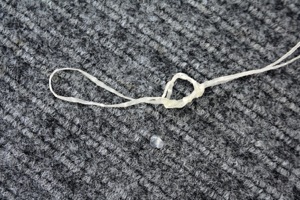
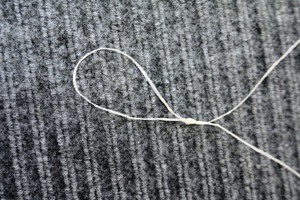 Take approximately 1-1.3 metres of waxed thread, fold the length in half and make a 35-50mm loop by tying a double overhand knot at the fold. This loop is used as the towing connection to the bait, so ensure the knot is pulled up tight.
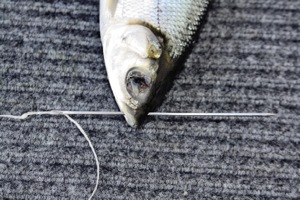
Tie the mouth shut by cutting a short length of waxed thread, threading your needle, and then going up through both jaws before tying them shut with a double overhand knot. Ensure the securing knot sits right on the tip or front of the bait’s mouth or it can cause uneven drag that affects the bait’s performance.
 The next step is important to get right as also determines how well your bait will swim. Place the sinker inside the gill plates of your bait with its loop end facing the mouth. This weight causes a paravane-type effect and enables the bait to swim. By placing the sinker inside the gill plates, it doesn’t affect the bait’s dynamics as some other rigs do.
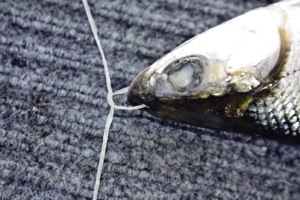 If you rub the top of your bait’s head with the shaft of your needle, you’ll notice a centerline appears that runs the length of the skull. Using your needle, pass the two tag-ends through the bait’s head in line with the front of the eye sockets, and then on opposites sides of the centerline,
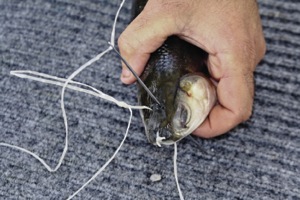
approximately 5-8mm apart. N.B. This is the towing point of the bait and it may vary with bait size, species, towing speed and sea conditions. Generally, in line with the front of the eye sockets is a good place to start, but as you get more experienced you may like to try for a slightly different action from your baits or to have them swim deeper or shallower. I don’t want to get too technical though, so I’ll leave that for you to work out.
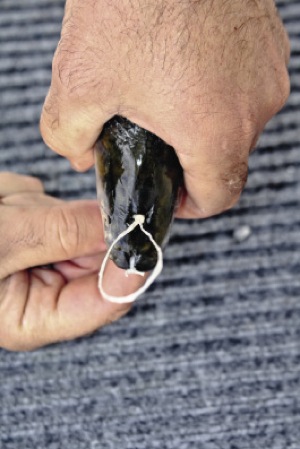
Pass the two tag-ends through the eye of the sinker and out the bottom of the bait’s head so each tag-end is on opposite sides of the bait’s throat latch. Pull the tag-ends through so the knot sits snugly and exactly on the skull’s centerline, remembering that this is the bait’s towing point.
Tie off the two tag-ends firmly with a couple of overhand knots across the top of the throat latch. This holds the sinker and the loop on top of the head in position. It’s important to make sure the loop’s knot sits firmly and exactly on the centerline of the bait’s head when you tie off this knot.
Next, pass the two tag-ends through the bait’s eye sockets in opposing directions and then over the top of the bait’s head in front of the towing loop. Tie the tag-ends off again firmly with a double overhand knot on top of the head. Tying this in front of the towing loop holds it in the correct place and minimises tearing through the head when towed through the water.
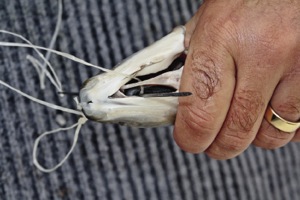
To finish off the head’s rigging, pass both tag-ends through the eye sockets again in opposing directions and then tie them off firmly under the bait’s gills with a couple of overhand knots. As this is the finishing knot for the head’s rigging, make sure the knot is firm as you don’t want it to come undone. Cut off the remaining tag-ends with your knife or scissors.
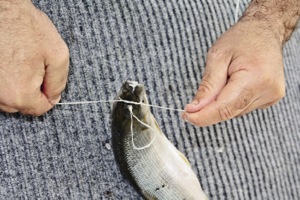 The belly or gut cavity needs to be sewn shut so the bait doesn’t wash out. Cross-stitching is the more common way of doing this, but the method isn’t overly important. Ensure your stitching isn’t too tight though, as the bait needs to be able to flex to swim.
Connect your hook and leader to the loop; at least three or four half-hitches should be used so the hook stays connected and also serves to shortens up the loop length so it conforms to IGFA rules.
Deploying the swim bait
 |
This article is reproduced with permission of |
Fishing Reports Visit Reports
Raglan Fishing Report - 12/11/26
Big spring snapper. With the more settled weather over the last couple of weeks there’s... Read More >
Mercury Bay Fishing Report - 12/11/26
Snapper hit and miss. Most reports have been telling us it’s becoming more difficult to... Read More >
Northland Fishing Report - 12/11/26
The switch has been flicked on! Call it what you want, El Niño, global warming,... Read More >
Tauranga Fishing Report - 12/11/26
Snapper and kahawai in close. Again, we start on a positive note, with some nice... Read More >


Sunday 22 November 2026
Major Bites
 - -
Minor Bites
 - -
Monday 23 November 2026
Major Bites
 - -
Minor Bites
- -
Comments