
Gamefishing - Lure Trolling Basics
In the past I have been a very, very keen lure troller. I saw game lure patterns as a kind of hypnotic television screen, their myriad splashing and bubbling paths appearing exciting, frustrating, entertaining and mind-blowing in turns - and sometimes all at once!
This (almost addictive) fascination served to fuel a long and wide-ranging quest for the secret weapon that no one else had, resulting in the accumulation of literally hundreds of lures. In addition to my own favourite discoveries (which, even now, chop and change all the time), the glittering stash includes a wide assortment of other angler's favourites.
This means I've run a lot of different lures over the years and I've learned a few things - the most important of which is coming to the reluctant conclusion that there is no such beast as a 'sure-fire' lure! Anglers who believe otherwise ('it always get struck, no matter where it is in the pattern!') are people who don't fish frequently enough over several seasons in a variety of locations, or who do not allow other lures to be placed in 'their' spread.
In the disappointing world of reality, the untouchable 'hero' of last season is too often outperformed by 'that ugly lure I found in last year's contest starter pack' or the one my mate gave me 'cause it won't swim right'.
And perhaps the most interesting (and annoying!) aspect of lures is their unpredictability. For example, a lure that might work in a specific position on one boat may not do so well on another (usually due to different trolling set-ups and boat wakes); or a lure that works beautifully with the wind turns into a pig when heading in another direction. And sometimes, a good lure just refuses to swim for no apparent reason! (Maybe it just gets sick of doing the same bloody thing, day after bloody day?)
Weird intricacies aside though, in most instances a good lure placed in its optimum position will catch fish. It's up to the angler to recognise when each lure's time has arrived - and when it has gone again. However, to know the answers of this apparently straight-forward concept demands a never-ending learning experience! (Especially if you're like me and forget some of the lessons learned along the way.)
The following article outlines different lures and where to put them - in my opinion - so far!
What lure should I buy?
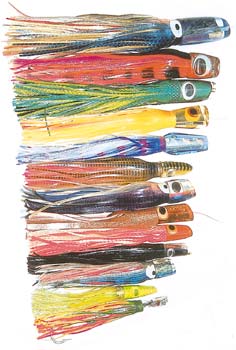
It can be a bewildering experience to walk into a shop well stocked with a wide assortment of game lures. Different head shapes, different colours, different sizes and weights... HELP!
So it's not surprising that the wrong lure often gets picked or is recommended. After all, even fishing shop staff have to spend a job-firing amount of time actually on the water to get a comprehensive grasp on the subject. On a practical note, they are also commercially responsible for getting rid of those dust-covered 'dungers' that have hung around on the walls for so long. For this reason alone, it's best not to be rude to shop staff!
Lure trolling basics
In order to stand a better chance of selecting an effective lure - especially if it's for a specific task - it is in your interests to understand skirted-lure trolling fundamentals.
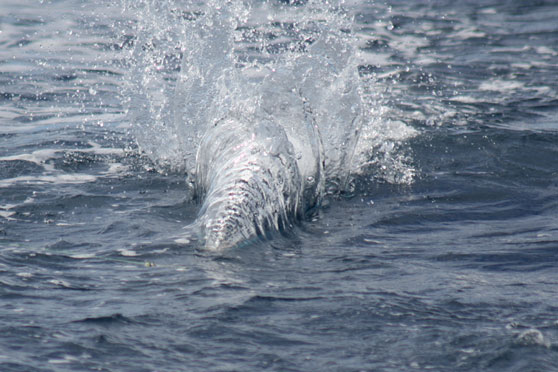
The first rule of an effective pattern is that each lure must 'work' properly in its assigned position. By working, I mean that each lure should be in a constant and alternating state of splashing, wriggling (or weaving) and bubbling as they travel through the water. A good ratio between the time spent splashing on the top in relation to the period spent down under the water and emitting a skirt-wriggling bubble trail should be around 1:4. (In other words, the lure should be on the surface for about a quarter of the time). And the moment the bubbles begin to dissipate completely, the lure should be up on the surface and taking another gulp of air again before heading downwards once more.
If things aren't right, the lure may assume one of three different characteristics. The first results is the lure's bubble trail dissipating prematurely so that the lure is left 'hanging' underwater; the second will see the lure skittering along on top of the water; and the third causes the lure to fire, or somersault, out of the water. And while none of these problems necessarily mean that strikes will not occur, they do make them less likely.
To make things more difficult, the lure's performance is influenced by many factors. These include:
* the head shape (especially the lure's face and position of the tow-point) and its weight;
* the length, weight and composition of the lure skirt;
* the lure's position on the wave face;
* the boat's speed;
* prevailing weather and sea conditions;
* the size, number and configuration of the hooks;
* the thickness of the trace and the material it's made from;
* the amount of distance and elevation given to the lure when setting it.
(Phew!)
As I said, that's a lot of different things to bear in mind, but probably the most important factor on how effectively a lure will perform is determined by where it is (or isn't) positioned in the boat's wake and its associated pressure waves.
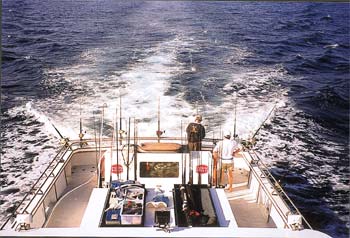
A boat's wake is produced by a combination of the boat's hull and its propellers. The noise of the engine (especially inboards) and the foaming thrash produced by the propeller(s) are very effective fish attracters. It seems likely that the churning foam is suggestive of a school of feeding or panicking fish to predators, causing them to become excited and be on the lookout for potential food. Even better, the bubbles surrounding and partially masking the lure, both from the wake and those generated by the lure itself, can further benefit our efforts to deceive the fish.
Although the churning wake might appear random and ever changing at first glance, some aspects of it actually change a lot less than others. For example, you'll soon notice that the rows of pressure waves radiating out through the bubbling wake do, in fact, push up from behind the stern at particular and reasonably consistent distances. Another constant is that some areas of the wake will remain relatively clear, while others tend to stay covered in foaming bubbles. The reasonably clear patches are called 'windows', and their size and location are influenced by the position and number of the boat's propeller(s), and by the direction that the wind and swells are coming from. Both of these aspects can be exploited to the gamefisher's advantage.
The role of pressure waves
Pressure waves are particularly important because their faces are used to provide the closer lures with the best action possible. This is done by placing the lures higher or lower on the wave face, and/or by increasing or decreasing the angle of the line running to the lure. Most times it's best to use the lower third of the wave face. Here, the angle is not as severe, so lures can utilise the wave-face energy with less chance of propelling right out of it.
This position also enables gamefish to see and take lures more easily, as high-set lures can disappear from view at certain angles. (An exception to this preference is the lure set close-in on the second pressure wave back from the stern. This wave is not very big and is positioned very close. In order to reduce the line angle and let the lure work properly here, the line must be brought down from the rod tip and secured lower down [perhaps to the reel handle or nearby bollard].
Use a #34 rubber band [which is wrapped around the line at least ten times] or Aftco Roller-Troller; both of which will release the line after the strike. In this instance, the extra wave height gives the lure a faster wriggle and the face is not so big that lure visibility is greatly impaired.)
As the distance behind the boat increases, the pressure waves become less obvious and harder to utilise. That's where outriggers and upriggers ('shotguns') take over. The extra elevation they provide helps lift the lure's face so that it can return with a splash to the surface for bubble-trail-replenishing air.
Exactly how we decide to utilise wave faces in a lure pattern is a personal thing, but must still cater to three basic criteria:
- the lures must all be running properly;
- they should not impede possible interest in another lure;
- they should be positioned so they do not tangle with each other when the weather is rough or a sharp turn is made.
For many boats, this equates to an alternating staggered W-spread for five or six outfits, while six or more are often better paired in a V-formation (perhaps with a centrally placed 'shotgun' right out the back), especially if the lures are preferred within the length of the boat's wake.
I won't, however, go into the role of outriggers too much. I'm afraid you'll have to 'cut and paste' our efforts. Suffice it to say, as well as providing some much needed elevation to the more distant lures, outriggers also serve to spread the lures out over a wider area, keep more of the lure's heavy trace out of the water and help to present some lures in 'clean' water. (After all, not every fish wants a lure shrouded in froth!)
Using the windows
Wake 'windows' provide an opportunity for one or two close-set lures to stand out from the surrounding wake's froth. The two most obvious windows generally occur from in between the second and third pressure wave to around the fourth pressure wave. Lures that are set in these two clearer areas have the advantage of being amidst exciting foam while remaining relatively visible.
The two windows will nearly always be different sizes from each other. The prop direction will cause one to be bigger for a start, and whichever is the windward window at the time tends to get more wake-foam pushed into it.
On the other hand, the middle of the prop-wake is a constant mass of foaming bubbles, so close-in lures are hard to see. As the bubbles dissipate further out (generally from five or six pressure waves back), the central position becomes a worthwhile option again.
Fishing Reports Visit Reports
Tauranga Fishing Report - 28/05/26
Tarakihi on the bite Trips are few and far between at this time of year,... Read More >
Canterbury Fishing Report - 28/05/26
Fresh and salt turning it on! It is not very often I get to say... Read More >
Bay of Islands Fishing Report - 28/05/26
Lures paying dividends We finally had a break in the SE winds that have been... Read More >
Manukau/West Coast Fishing Report - 28/05/26
Snapper and gurnard in the harbour The weather has finally taken a turn for the... Read More >


Major Bites
Minor Bites
Major Bites
Minor Bites
Comments