
Gamefishing - Keeping baits fresh
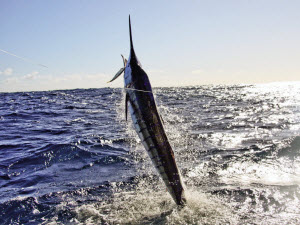 Each game fishing season we see more and more boats, crews and anglers becoming solely reliant on artificial lures. Of course artificial lures have their merits – and how can we ignore the myriad of excellent lures available on the market today?
Trolling artificial lures is an incredibly convenient method for marlin fishing, especially when the exact whereabouts of marlin is unknown; indeed, lures are generally the method of choice in such circumstances. However, when you do know where billfish are congregating in reasonable numbers, natural bait is almost certainly the number one choice of top anglers and crews.
I, for one, have run plenty of artificial teasers and lures over the years, but
simply won’t leave port without a full tank of live bait and/or a good selection of freshly frozen dead baits ready to go. I like to have all bases covered before venturing too far; getting caught in an ‘if only’ scenario is something I try to avoid.
However, not all New Zealand anchorages or stretches of coastline are conducive to catching a regular supply of live bait on a consistent basis; even the humble skipjack tuna can be a little tricky to catch (especially when they’re required most!) and keep alive at times. And even when baitfish are around, they can be hard to catch, with the efforts spent trying to catch them substantially subtracting from the time spent fishing for the targeted species. This can be very frustrating, especially when hoping to make the most of an early morning bite or if planning to fish a specific area during a tide change.
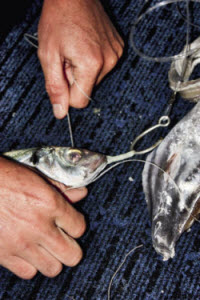 A good example of this frequently occurs at the Three Kings Islands when we’re chasing the often tricky koheru. These little fellas are pure billfish candy, but can be a right pain in the butt to catch some mornings – especially when the resident kingfish start scooting through your berley trail and/or taking any koheru that are hooked. Consequently, this valuable time is sometimes better spent simply straight-lining it to the banks and making the most of the early morning bite. You’re damned if you do, damned if you don’t some mornings though, especially when the skipjack schools inexplicably go ‘missing in action’ and you know a fresh live bait will almost certainly guarantee a billfish bite.
So while nothing beats a freshly-caught live bait, whether it’s destined for pitching or slow trolling, a skipping or swimming dead bait can often be a more than adequate substitute when the former are hard to come by. Indeed, a good dead-bait supply has been our ‘Get of jail free’ card on many occasions over the past ten years or so.
My preference is, of course, for fresh dead bait rather than bait that has been frozen and thawed; while defrosted bait is better than no bait at all, it requires precise rigging techniques and can still come apart on the initial bite, leading to a mashed or broken off bait and a disinterested marlin. On the other hand, fresher baits offer anglers more chances at billfish that aren’t hooked on the first bite.
Baits that have started to rot or decay are of absolutely no value however; my crew disposes of anything remotely soft or smelly for the reasons outlined in the previous paragraph. This is when the processing of freshly-caught dead baits becomes a vital cog in the whole operation, ensuring good hook-up rates and success occur even when dead baits are being used.
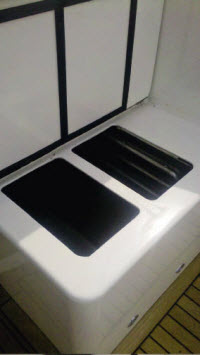 In order to keep freshly-caught baits in pristine condition, it must quickly be placed in a cold brine consisting of a mix of salt ice, salt water, and even extra salt if possible. On board Arenui we’re lucky enough to have a built-in refrigerated brine box that we use to either slurry any table fish or process the large number of dead baits we use throughout a game-fishing season.
Consequently, we certainly don’t leave baits lying on the hot deck in the sun for any length of time, or stewing in the live-bait tank filled with warm sea water. You don’t want any rotting or decaying to start before even beginning to process it.
Common butcher’s salt (sodium chloride) has antibacterial properties that greatly reduce bacterial degradation of the flesh, so liberally add it to an icy brine and apply it directly to fresh dead bait. This toughens baits up and prolongs their shelf life when in an unfrozen state. On occasions we’ll also add a little baking soda (sodium bicarbonate) to the brine, as this helps to maintain the bait’s bright colours for longer periods.
Once the baits have been chilled, they need to be removed from the brine and gutted and gilled, as these parts produce bacteria that will speed up the decaying process, and their removal also allows more flexibility in a skipping or swimming bait.
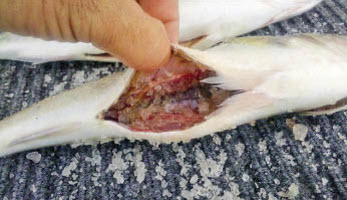 When taking the gills out, the throat latch must be left intact for later rigging purposes, and when removing the gut, a slit along the belly that’s only big enough to empty the gut cavity of all contents is required. (Obviously, when it comes to rigging the baits further down the track, you don’t want to be reconstructing or reattaching any of the bait’s anatomy!) When that’s been done, wash and clean with sea water – not fresh!
When we’ve gutted, gilled and rinsed the baits, we generally let them dry a little and then re-salt the gill and gut cavities, as well as sprinkling some on the outer skin. From here we bag them up, the baits lying flat and neatly – perhaps two or three to a bag – and place them immediately in the freezer. Over the past couple of seasons we’ve even vacuum-packed our baits, and found it works well. This, combined with the brining, salting, treating with baking soda and then snap freezing, results in near-perfect baits ready for use at any time. (The vacuum packing is not essential, but does work pretty well.)
 Most of our dead baits are utilized as pitch baits for switching. They work a treat in this situation and probably account for about 40-50% of our billfish caught each season. We also occasionally utilise them as trolled skip baits when the situation arises, and have even caught a few broadbill swordfish on them by deep dropping during the day over the past few seasons.
However, not all bait species available in New Zealand waters are conducive to being processed and stored. Oily fleshed fish such as skipjack and English/slimy mackerel simply don’t freeze well, despite the best intentions. However, these species obviously make prime live baits, so are probably best kept that way unless rigged and used as dead baits on the day of capture.
Jack mackerel don’t really freeze that well either, as they seem to dry out, making them difficult to rig, swim or skip, even with a minimal amount of salt applied. Again, fresh caught seems the only way to go with jack macks.
The four bait species we most commonly use in New Zealand for dead baiting are koheru, small to medium kahawai, small mullet and, of course, squid. While the gutting and gilling process doesn’t apply with squid, they certainly keep better and toughen up when a little salt is applied. All of these species keep and fish exceptionally well within New Zealand game-fishing conditions.
During the post-rigging stage, baits should be kept chilled if not being actively used; obviously you only have enough bait ready for the day or days of fishing ahead. You will need to have enough rigged baits on hand to replace those that are washed-out or mangled, and these should be well chilled but sufficiently supple so that after a few quick flexes they provide a lifelike swimming action when dropped overboard. If baits are kept too cold prior to deployment, they’ll most likely spin like a propeller, an action that’s not natural or overly attractive to any billfish I know.
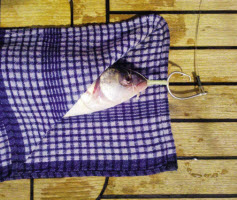 The dead ‘pitch’ baits being used are placed in a wet towel to ensure they stay cool and supple, and are connected to an outfit so they’re ready to go, with the rods generally placed in an easily accessed, central position in the cockpit. (I have kept pitch baits packed in salt ice in the past and can certainly see the benefits of this if fishing in warmer tropical climates.) Regular dousings with salt water keep the covered baits in reasonable condition, although any pitch bait that appears too soft should be discarded and replaced.
While my crewmen may disagree, I don’t think I lose my cool too often – but when I have on the ‘odd’ occasion over the past few seasons, it’s usually been provoked by baits (live or dead for that matter) not being processed or looked after appropriately. Quite simply the difference between catching a marlin on or not, on any bait, has about 80% to do with the quality of bait being presented. As mentioned, that pristine quality needs to be maintained at the initial processing stage and carried on through to when the bait is actually placed over the back of the boat.
Sounds like hard work? I guess it can be if you’re not set up for it with the right refrigeration or cooling facilities. However, it’s still easily viable with just a temporary slurry container for processing bait and a chilly bin to keep your day’s baits cool.
Also, you’ll actually find that rigging dead baits can be a lot of fun and it’s a real buzz when it all finally comes together, leaving you with a leaping marlin and a screaming reel!
 |
This article is reproduced with express permission of
written by Geoff Lamond - 2012 Originally published in New Zealand Fishing News |
Fishing Reports Visit Reports
Raglan Fishing Report - 12/11/26
Big spring snapper. With the more settled weather over the last couple of weeks there’s... Read More >
Mercury Bay Fishing Report - 12/11/26
Snapper hit and miss. Most reports have been telling us it’s becoming more difficult to... Read More >
Northland Fishing Report - 12/11/26
The switch has been flicked on! Call it what you want, El Niño, global warming,... Read More >
Tauranga Fishing Report - 12/11/26
Snapper and kahawai in close. Again, we start on a positive note, with some nice... Read More >



Monday 23 November 2026
Major Bites
 - -
Minor Bites
 - -
Tuesday 24 November 2026
Major Bites
- Minor Bites
- -
Comments