
Fly tying - tips from Gary Kemsley
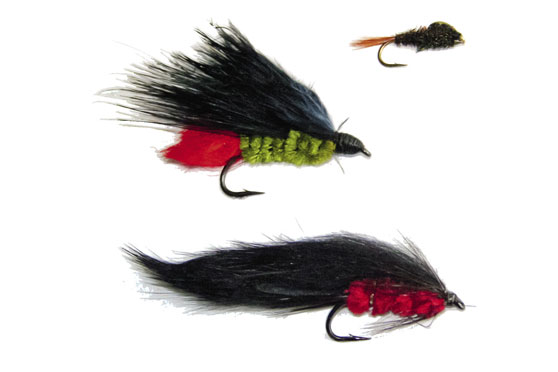
One of the greatest thrills in fishing is creating your own lure and fooling a fish into eating it. It could be a fly to fool a trout or a big trolling lure to fool a marlin. Both give the angler a special feeling of accomplishment.
Over the years I have been involved with the creation of lures for both my own and my clients’ use when guiding trout fishers in the Taupo district.
I needed some reliable flies that could be tied on to keep the catch rate up. Buying flies didn’t work for me when considering the rate at which some clients could lose them.
I decided three patterns were required: one for night fishing, one streamer for daytime river fishing and river-mouth work, and a never-fail nymph for rivers and high-country fishing. The first to evolve was the Sunset Rabbit. It was nothing special and was tied in the same style as the rabbit patterns of the day in Taupo and Hawkes Bay where I fished. The difference was the colour combination. It all came about after a summer of really good fishing in the Waitahanui rip (river mouth) at Taupo. The fish were big and bold that year and the fishing was good. I wanted more though, and recognised that there was a period between sunset and dark when the fishing slowed and only a few fish were caught. I knew the trout were still there – at that time they were there 24/7; I just needed a fly to get them biting.
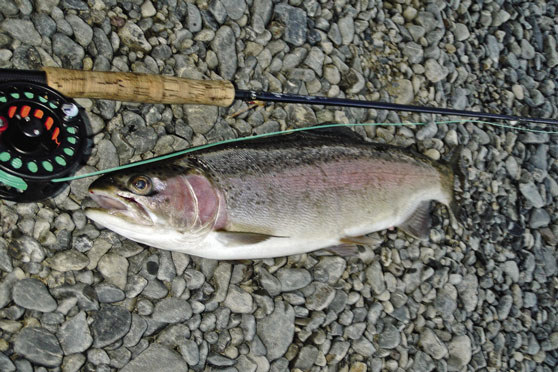 I tried going to night flies while it was still light, but had a little success. Then I tried different colours in rabbit flies. Red and orange caught them, but not really in increased numbers. Then I lucked upon a black rabbit skin from a hunting mate, and quickly tied up some red-bodied rabbit flies with jet-black wings. They looked great, so it was not long before I tied one on and cast it at Waitahanui. I took three fish that first night before it was properly dark, and when similar results were achieved on subsequent evenings, I knew I was onto something good.
This fly pattern also fishes well in dirty water and I caught an Atlantic salmon on one in snow-melt waters. Thanks to the rabbit fur, it possesses great movement and ‘vibes’, with my addition of a sliver of yellow hackle under the rabbit-fur tail seeming to really make it irresistible. Looking through some of my old dairies, I note that this pattern has continued to be a real winner for evening fishing, so mission accomplished!
If I have a claim to any fame in fly-tying circles, it would be for the design and evolution of my Gary’s Green Marabou. This fly evolved over a year of fishing at the Mapara Stream mouth in Whakaipo Bay in Lake Taupo. To fish here I needed a slow-sinking night fly that could be cast and cast without having to check it all the time – especially when the wind was howling. I also wanted a noisy fly that the fish could locate from a distance, and as trout love koura, I figured it wouldn’t hurt if the fly imitated one.
Bill MacBrayne and I fished the Mapara Stream mouth together a lot, and we went through numerous colour possibilities. Eventually, while testing some of the smaller sizes with an olive body and black wing, we experienced quite a bit of success; we guessed it must look a bit like a dragonfly nymph. Better still, the larger model seemed to emulate the koura and worked a treat after dark. This pattern proved itself in spades, with limit (10 trout) after limit at Whakaipo Bay and everywhere else I fished it – a winner right from the start.
Gary’s Green Marabou remains a great producer and is often a ‘go-to fly’ for still-water fishing during the night in Lakes Tarawera, Aniwhenua, Tutira, Rotorua, Otamangakau, Rotoiti and Rotoaira where I fish these days. And if the rivers are a little off-colour, it has its moments in them, too.
Most modern commercial fly tiers have failed to capture the most important element in this pattern, though. As already mentioned, I wanted a noisy fly, and to achieve this I needed the materials to have plenty of movement. My flies therefore have large red tags behind the marabou wing to break the water flow over the fly during the retrieve, giving them a seductive wiggle and also sending out sonic messages to the trout. It is one of the main reasons why some flies fish better than others, even though they look similar.
For river nymph fishing, my requirements for a killer fly to help my clients catch fish included realism (but only in a suggestive form) and durability. They needed to last while being eaten by lots of fish or being smacked on the rocks. It would also be a big advantage if they were an easy pattern to tie.
The Halfback nymph, with a bit of modification, filled those criteria for me. The original pattern, out of Montana USA, was tied with a peacock herl body. That was no good to me as it fell to bits easily, so I replaced it with Swannundaze, a plastic strip that made a lifelike body. It was also used to make a durable wing case.
Prior to tying the fly, I wound on some lead wire so we could get depth in the Tongariro and other Taupo rivers, where the trout hugged the bottom on their spawning run. I added a soft brown hackle at the head to represent legs, and a few wisps of black hackle for a tail.
The improvements created a fly that caught fish for me and my clients in many situations. In the rugged high-country streams of the Kaimanawas, this fly accounted for over 100 double-figure trout. In still waters it was often used as a point fly to take other flies down to depth – and caught its share in that role too, including fish over 10 pounds (4.5kg) from Lake Otamangakau and Aniwhenua. However, for me it was at its most useful when deployed in my bread-and-butter guiding waters of the Tongariro, Tauranga-Taupo and Hinemaiaia Rivers, which all flow into Lake Taupo. Here it really excelled, and my clients benefited from that. In the 1980s I had 30-fish days on the Tongariro, all caught on Halfback nymphs.
While the Halfback Nymph does not imitate anything in particular, it is highly suggestive of many aquatic creatures, which is important for an all-rounder fly such as this one. However, by tying it slimly on a long-shank hook, it makes a fair damsel fly imitation, while it can be a mayfly in smaller sizes. Every fly fisher should have this awesome pattern.
I bet you have flies that you favour above all others. They could be standard patterns that arrived in New Zealand over 100 years ago (like the Blue Dun or the March Brown, which still catch fish) or a product of your own imagination while sitting at your fly-tying desk. Either way, they may well prove valuable to you and the people you care to share them with.
Also, it is well worth looking at your old favourites to see if you can update them with new materials that may have arrived since their inception. You might be able to achieve what I did with the Halfback Nymph and have a super-effective fly for a lifetime.
|
|
This article is reproduced with permission of |

Fishing Reports Visit Reports
Outer Hauraki Gulf Fishing Report 17/09/26
Spring wind the handbrake. Spring is starting to make its presence felt in the outer... Read More >
Top of the South Fishing Report - 17/09/26
Early snapper in Tasman Bay. Well, spring is finally here, and the days are getting... Read More >
Bream Bay Fishing Report - 17/09/26
Good snapper catches reported. After Tangaroa turned off the fish tap for a month or... Read More >
Bay of Islands Fishing Report - 17/09/26
Pacific bluefin tuna for the lucky few. The last fortnight has seen more fishable days... Read More >


Sunday 27 September 2026
Major Bites
 -
- Minor Bites
 -
-  -
- Monday 28 September 2026
Major Bites
- - Minor Bites
- -
Comments