
Fly Fishing - casting techniques
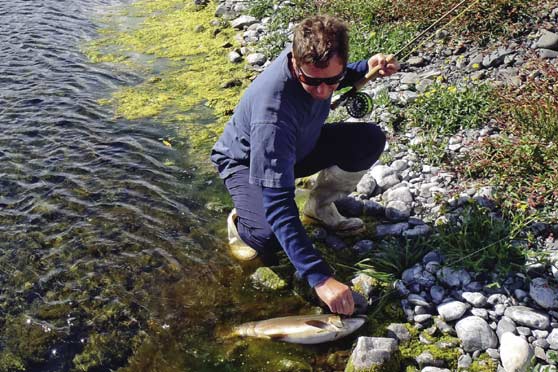
It might seem simple, and it can be, but Gary Kemsley shares a few tips
on a technique that’s as versatile as it is deadly.
These days I see some fly fishers trying to make the fishing look as difficult as possible with specialist gear and fancy names for techniques that have been used since trout arrived in New Zealand.
This month’s feature profiles one of the easiest ways to catch trout whilst fly fishing. Angler input is minimal and the tackle pretty basic. The technique suits targeting trout wherever you find them in bigger rivers, but it’s possible to modify your approach to suit smaller rivers and streams, too.
It involves simply casting across the river and then allowing the fly to swing through likely water below – known as the ‘across and down’ method. When you think about it, it’s a technique that can cover all the fish in the river; you just need to take your time and think about the presentation.
Let’s start at the beginning and check tackle and flies. I like a long rod – 9’6” or 10’ – for this fishing, because it provides better control of the drift and swing. A seven-weight line covers most situations. You want to keep your fly or flies below the surface, so you will need a couple of different sink-rate lines; the faster and deeper the water, the faster the sink rate required. A two-metre leader is fine, allowing the flies to swing around at the end of the drift.
Almost any flies will work with this method, but I like to use either a Woolly Bugger on its own or two wet flies or nymphs.
The Woolly Bugger approach is so good it should be banned. This fly has a very mobile tail and fish can’t resist it as it swings across the river ‘wagging its tail’ at them. In fast water I like a fast-sinking line and a short leader, while slower bodies of water suit a weighted fly and a longer leader attached to a floating or slow-sinking line.
You can manipulate the line to give the fly life by twitching the rod tip, or make the fly look like a scurrying minnow by stripping it fast. Try everything. With two nymphs on the line you can feed out line to dead drift them in likely spots and perhaps cover fish unable to be reached by other methods. Also, you can slow-pull the nymphs or wet flies at the end of the drift to make them look as if they’re rising to the surface to hatch.
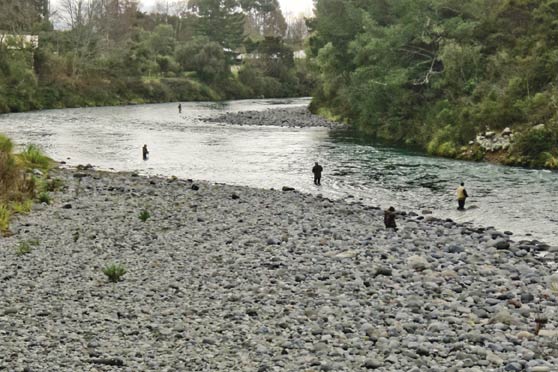
Now for the technique: Strip off more line than you’re going to need, then cast directly across the river using a reach-mend cast. This gives the flies valuable time to sink down initially. Next, follow the line’s entry point into the river with the rod’s tip as it starts to swing back to your side in a smooth arc below you, with no added action imparted to the fly at all, just the current’s natural swing. (If a fish takes, you will feel it, and just need to lift the rod.)
Once it’s made it back across, do not rush to lift the flies and cast again, instead letting them hang below you for a while. It may look to you as though the line and flies have swung right across into the shallows, but that’s often not the case; there could be quite a time lapse between the line straightening and the following flies straightening out below.
So, after a couple of minutes’ waiting, make three quick strips and stop again. You’ll be surprised how many times a take is enticed by ‘hanging’ your flies. Keep in mind, too, that if the flies are drifting towards a very good looking spot, it’s possible to feed some of the surplus line out to keep the flies drifting naturally down the river. Once all the line is out for that cast, hold the line and let the current straighten everything out. Watch out for a take, and if it doesn’t come, wait some more.
The best water is shallow, ripply stuff about knee-deep over gravel. These are prime feeding areas for rainbow trout, but can be difficult to fish thoroughly with other methods.
Another advantage of this method is that it’s possible to fish multiple flies; if you keep changing them, you’ll find what the trout want on any given day. You can also confidently walk away knowing you’ve shown your flies to most of the fish in that part of the river.
Other methods, such as upstream nymphing, will have you hitting the best looking spots, but overlooking other potential spots.
You will find browns hanging out in the tail of pools, particularly in the evenings. They will sit back in very shallow water at times, and it is hard to get a fly to them without scaring them. The across-and-down method is a great way to cover these fish, and often they respond well.
I like to use a long leader – four metres or so. This presents the fly without the fly line intruding. Set your gear up with a floating line and two small wet flies – perhaps a size 14 Green Caddis Emerger on the point and a darker Dad’s Favourite on a dropper 40cm up the line. Such patterns work well for Hawkes Bay waters, but any flies could work, so just use ‘wee wet’ patterns favoured in your area.
Now take time to really study your water without disturbing it. Sit and watch the very tail of the pool for 15 minutes. If getting on towards dark, any fish in the area will move in and take up station. Look for them making wakes as they move around, poking their tails out as they grub for nymphs, making little swirls as they change their position. A short time after arriving there, the browns in particular will set up in one position and stay there until after dark.
Now you need to work out your strategy. Find a spot (preferably out of the river) where you can cover such fish from well back, keeping disturbance to a minimum. Once you decide to try for them, move into position (like a cat after a bird). Start fishing well short of the fish you’ve seen, so you can get the right length of line out when making your play. It will also cover any fish you haven’t seen. Be ready for surprises.
Your money shot should have the fly landing well away from the trout and swinging across on a tight line. Try a straight swing first, but if there is no response, give the flies a wriggle by jiggling the rod tip once they’ve reached the fish. If that doesn’t get your quarry going, try the dead-drift method mentioned earlier. If that doesn’t work either, I usually leave the fish (if it is not disturbed) and return later with different flies.
During the day, try the Woolly Bugger approach. You can fish the entire river, searching under trees, along rocky shores, in the depths of pools, and through the rapids. The Woolly Bugger will catch fish in all those spots and others as well. Be versatile and change lines to suit the water you are fishing.
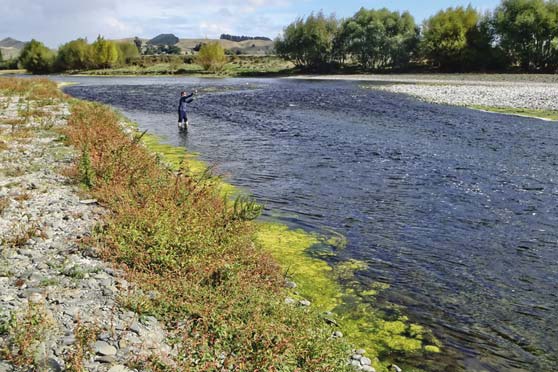
Try and keep the fly near the bottom all the time. I like a fast-sinking line or add a looped-on sinking head to my floater for this. Takes are usually savage, and small fish will be all over it as well as the bigger ones. In addition to just swinging the Wooly Bugger, try a fast retrieve across the current. You will be surprised by some dramatic strikes and perhaps catch fish that you didn’t know lived there, such as sea-run browns and estuary rainbows.
There are plenty of ways to approach your river and its fish, and this is just one. It is, however, a very successful fishing method. I know anglers who have been so into nymph fishing that they wouldn’t even give this a try, but that’s their loss. Once you have nymph-fished up a river, there is no better way to work your way back down, hitting spots you missed on the way up, than with this method.
I also know a New Zealand fly-fishing team member who was a master of this art and used it regularly. He was very hard to out-fish in competition; that should say enough about the across-and-down method.
Fishing Reports Visit Reports
Outer Hauraki Gulf Fishing Report 17/09/26
Spring wind the handbrake. Spring is starting to make its presence felt in the outer... Read More >
Top of the South Fishing Report - 17/09/26
Early snapper in Tasman Bay. Well, spring is finally here, and the days are getting... Read More >
Bream Bay Fishing Report - 17/09/26
Good snapper catches reported. After Tangaroa turned off the fish tap for a month or... Read More >
Bay of Islands Fishing Report - 17/09/26
Pacific bluefin tuna for the lucky few. The last fortnight has seen more fishable days... Read More >



Friday 25 September 2026
Major Bites
 - -
- - Minor Bites
 - -
- - Saturday 26 September 2026
Major Bites
- - Minor Bites
- -
Comments