
Flounder on Soft-Baits

Catching flounder on rod and reel may sound like an impossible task, but as Alistair Arkell recently found out, it is actually quite straight forward. He was lucky enough to be given a crash course in flounder fishing by Albert Lyu – a seasoned US bass fisherman and expert in fishing ultra-light tackle.
The art of catching flounder is quite similar to stalking trout in the wild: you see a flounder from a distance, approach with stealth, cast a baby soft-bait, and then wait for the strike. The moment I saw the first flounder was akin to seeing my first crayfish underwater – there was a lot of excitement, and my heart was pumping. Then boom! In a flash, the flounder had spotted us from four metres away and was gone with a puff of sand. Under Albert’s experienced guidance, I crouched low and waited for it to return. Sure enough, the flounder returned within a few minutes to within six feet of the riverbank. Albert then presented the softbait within a metre of the fish and gently, and oh so slowly, the lit-up flounder stalked the lure like a cat. Then as it got near the lure, the fish came in hot and smashed the bait! Wow! Albert expertly flicked the fish onto the bank and although well legal, he was keen to release this fish in favour of a larger one. Any doubts I had about catching flounder on rod and reel well and truly went out the window after watching this process. That morning we stalked six flounder and managed to catch two fish. Albert indicated this was quite slow; catching five or six fish is normal and if it’s hot, up to 10 fish is not out of the question.
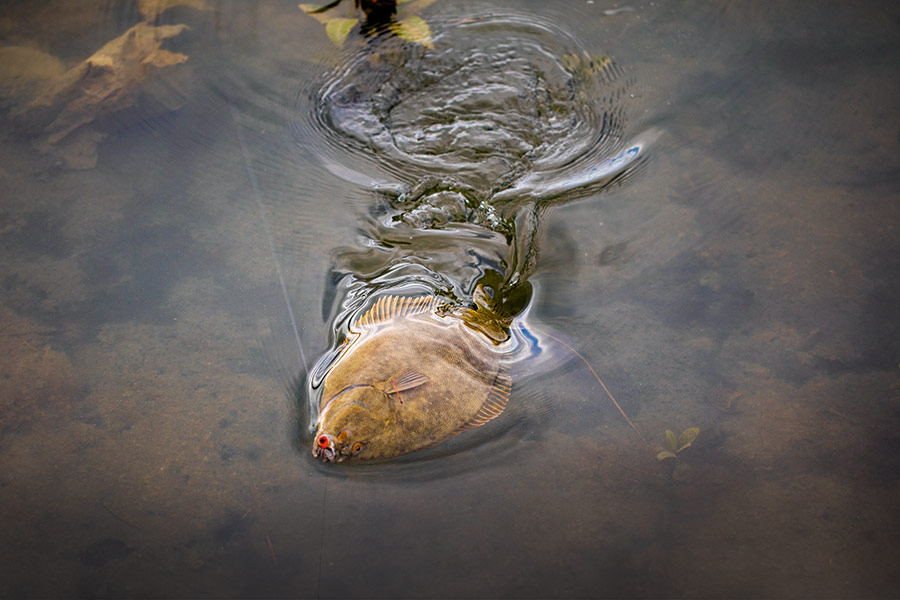
A flounder ready to be flicked up onto the grass.
How?
You’ll need ultra-light tackle. Forget your soft-bait rod – it’s not even close to what you need. We were using specialist Abu Garcia rods from Japan with bait cast reels. The rods are not yet available in NZ as, up until now, there’s been no market for them. Luckily, we have a canal fishery, which provides rods capable of casting weights in the 1-3 gram range, which is the weight of jig heads we used.
The rods are a bit long at 8-9 feet as you are only casting 4-5 metres at the most, often less, but given they are what is readily available, you will have to make do. Fit them with the appropriate 1000-2500 size spin reel and you are in business. Braid strength is not critical, but anything thin and 8-10lb is fine. Leaders are where we get a little more serious. Fluorocarbon in the 6-8lb range is perfect, with no more than 10lb at the max.
For jig heads, small is the ticket. We used Berkley Nitro Breams in the 1-3g size range. They’re ultrasharp, strong and, most importantly, the right size for the job.
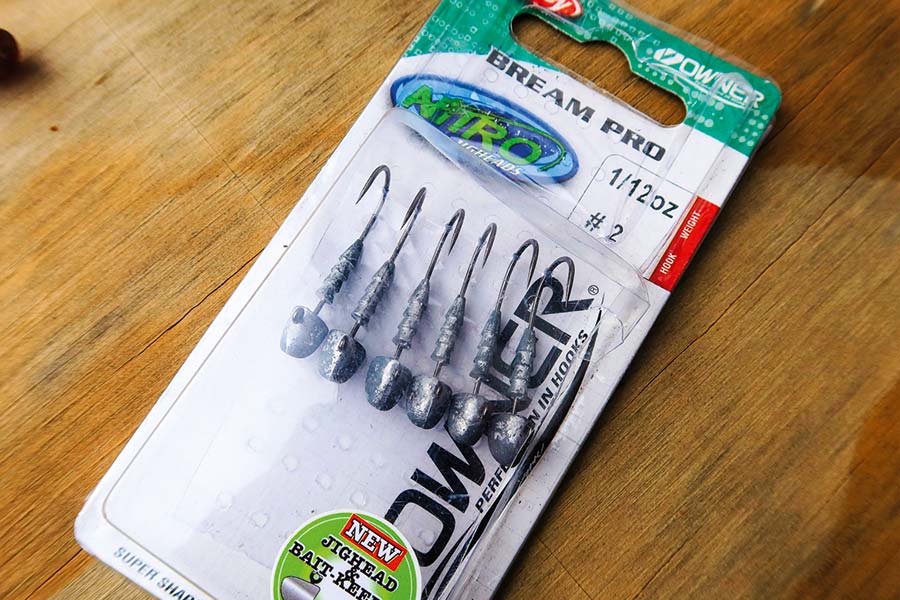
One to three gram jigheads are ideal.
At the business end of things, soft-baits are the key and we have found Berkley Powerbaits get the most bites, and in particular, the 2.5” Grub in Bloodworms and Mousetails. However, even at this tiny size, they are still too big. You will need to trim the soft-baits down to about half the size.
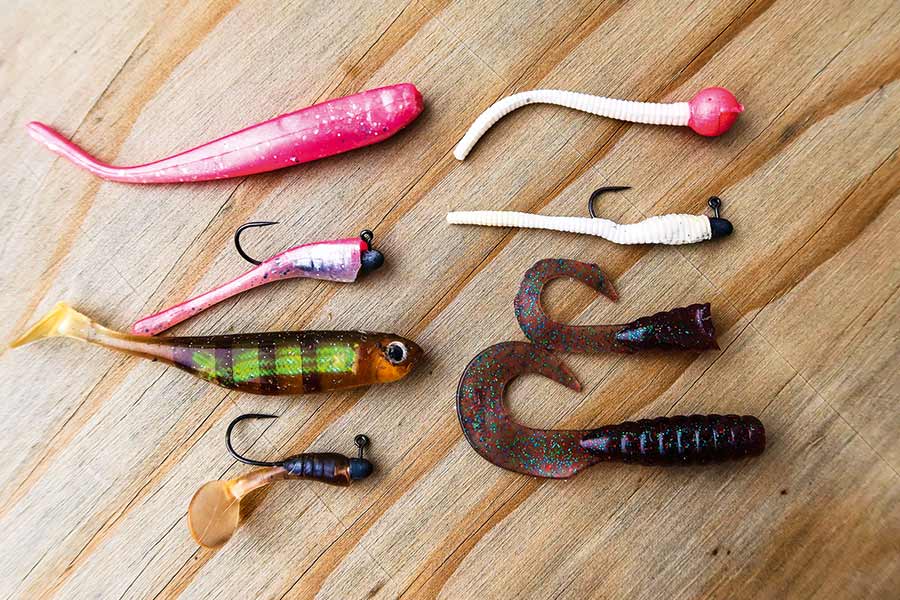
Sometimes a soft-bait will need a little doctoring. Fortunately many of your existing soft-baits can be trimmed down to make them suitable for targeting flounder.
Tackle wise, you are now set to go. It is a simple setup but going ultra-light and small is key. Anything else is a waste of time.
Where?
NZ is full of harbours and estuaries with flounder in them. From Parengarenga in the north to Bluff at the bottom of the south, flounder abound in NZ, so it is about time we started fishing for them. You will find flounder or variants of them on open sand beaches and harbours, as well as in estuaries right up to where the freshwater meets salt. Depending on your location, the yellow belly flounder is probably the species you are most likely to encounter and this is the one I will focus on here.
You will need to find a muddy bottom with an ample crab supply (the muddier the better). This is where it gets tricky, however, as walking in mud is difficult and potentially slightly dangerous. So, you need to find a location – think the upper reaches of a harbour – that has easy fishing access without you needing to venture onto the mud. If you are clambering around in the mud, the only thing you are going to do is scare the flounder away. A grass bank (often overgrown) is the perfect vantage point to stalk and cast at flounder. To be clear, this style is 100% sight fishing – spot the flounder in the water, get into a casting position, cast your soft-bait within range of the fish, slowly retrieve and you should be rewarded. By slowly retrieve, I mean ultra-slow. Albert recommends not even winding, but rather just slowly moving the rod back with the tiniest of twitches to give the soft-bait some action. If in doubt, go slower.
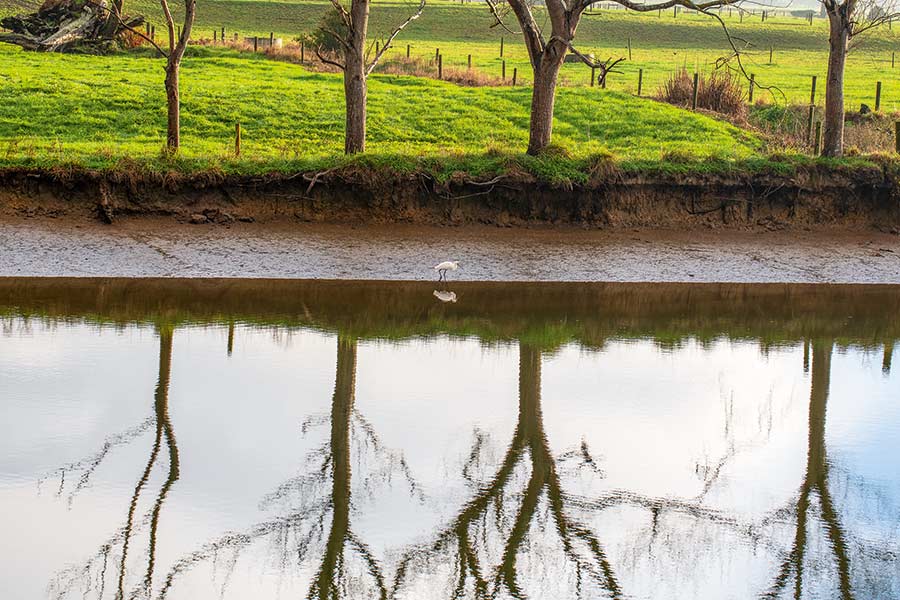
This is the perfect terrain – a nice high grass ledge and a gentle mud bank for flounder to rise on with the incoming tide.
When?
Forget night-time flounder missions! This is a day-time activity. There are some requirements, however, and the first is no wind. Any wind will make ripples on the water and in turn make the flounder hard to see. Polarised glasses are a must-have. The incoming tide is what you need as the flounder creep up on the banks to eat food that pops up out of holes on a rising tide. The first trickle of water down a crab hole is all the invitation a crab needs to venture outside. All the flounder we sighted were either swimming in a foot of water or gently sitting on the bottom waiting for prey. On the rising tide, flounder are in hunting mode, and they are very cagey with outstanding eyesight. The higher the sun, the better the water visibility, which makes them easier to spot. One thing to remember is that the tide table will indicate the tide at the entrance point, and the low tide could easily be an hour or more away further up the estuary. So, some local knowledge is a big help and will save some waiting around.
Still unsure or have some doubts? Perhaps leave the fishing gear at home and go for a scoping mission on some likely areas and see if you can spot any flounder. Given that you need to access the potential fishing zones, the key is finding an area where you can walk the shoreline with some height and spot fish on a rising tide. The other option is a small inflatable with an electric motor that you can cruise up the river on – this way you can access virign waters!

July 2021 - Alistair Arkell
New Zealand Fishing News Magazine.
Copyright: NZ Fishing Media Ltd.
Re-publishing elsewhere is prohibited
Fishing Reports Visit Reports
Outer Hauraki Gulf Fishing Report 17/09/26
Spring wind the handbrake. Spring is starting to make its presence felt in the outer... Read More >
Top of the South Fishing Report - 17/09/26
Early snapper in Tasman Bay. Well, spring is finally here, and the days are getting... Read More >
Bream Bay Fishing Report - 17/09/26
Good snapper catches reported. After Tangaroa turned off the fish tap for a month or... Read More >
Bay of Islands Fishing Report - 17/09/26
Pacific bluefin tuna for the lucky few. The last fortnight has seen more fishable days... Read More >


Friday 25 September 2026
Major Bites
 - -
- - Minor Bites
 - -
- - Saturday 26 September 2026
Major Bites
- - Minor Bites
- -
Comments