
Fish deformities – some background
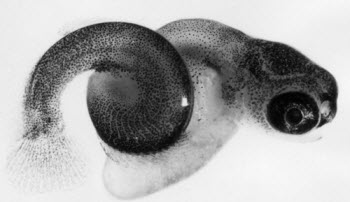 Who amongst us anglers has not landed the occasional fish that either looked different from the norm or exhibited an obvious defect in some part of its physical anatomy?
Deviations from what is considered ‘normal appearance’ are well documented in both marine and freshwater fishes. In fact, they occur quite commonly in most species and we just tend to overlook them when the action is good or the catch is growing.
Deformities in various parts of a fish’s anatomy can occur in just about any part of the body, but they are mostly associated with the calcified skeletal structures. Thus, those structures which commonly exhibit defects include the vertebral column (backbone), the skull and various fins.
To a lesser degree, defects are evident i n the internal organs. Whereas it is quite common to find a number of external deformities associated with each other, it does not necessarily follow that because an animal has external defects it has internal defects as well.
The question as to whether most deformities arise as a result of a genetic deficiency (congenitally) or as a result of some environmental pathogen (post-spawning) is open to debate. The answer is that deformities arise as a result of both. In the case of the former, fish hatch manifesting the defect and a certain percentage for which the defect is not lethal survive to exhibit the abnormality. Hence, deformities of this type tend to decline from the time of hatching. In the case of the latter, the fish can acquire a deformity at any time during its life and the chance of acquiring such a defect increases as the fish ages. Thus, deformities of this type tend to increase from the time of hatching.
With respect to the abnormalities associated with skeletal structures, most scientists would probably agree that they are linked to a deficiency in the metabolism, transport or deposition of calcium. Other factors such as nutritional deficiencies, pathogens, toxicants and environmental contaminants have also been linked to higher incidences of deformities in fish.
Whereas changes in water temperature at the time of spawning can lead to anomalies in the fish’s external anatomy (especially vertebral-related anomalies), the vast majority appear to be the result of environmental contaminants. Among the most effective toxic agents are the chlorinated phenolic compounds (eg. DDT and its derivatives), various heavy metals (as found in anti-fouling paints) and chlorinated hydrocarbons. All of these compounds are known to interfere with calcium metabolism in the fish body.
A Blast from the Past! This article originally appeared in NZ Fisherman magazine – June - 1998
A Blast From The Past!
|
June 1998 - by Laith Jawad |

Fishing Reports Visit Reports
Outer Hauraki Gulf Fishing Report 17/09/26
Spring wind the handbrake. Spring is starting to make its presence felt in the outer... Read More >
Top of the South Fishing Report - 17/09/26
Early snapper in Tasman Bay. Well, spring is finally here, and the days are getting... Read More >
Bream Bay Fishing Report - 17/09/26
Good snapper catches reported. After Tangaroa turned off the fish tap for a month or... Read More >
Bay of Islands Fishing Report - 17/09/26
Pacific bluefin tuna for the lucky few. The last fortnight has seen more fishable days... Read More >



Sunday 27 September 2026
Major Bites
 -
- Minor Bites
 -
-  -
- Monday 28 September 2026
Major Bites
- - Minor Bites
- -
Comments