
Expert Tips for Topwater Fishing
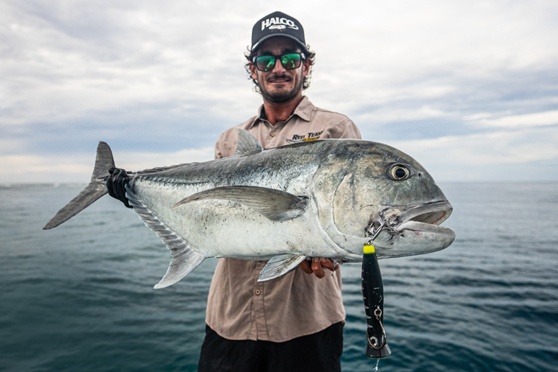
Grant Dixon talks to the experts about their tips and tricks for topwater fishing...
Along with switch baiting for billfish, topwater lure fishing is one of the most visually exciting ways of fishing available on the planet. There is something about peeling out that near-perfect cast into crystal clear waters, only to see it smashed by a marauding predator on touching down.
When I was first introduced to casting poppers and stickbaits it was in the South Pacific waters of Fiji. Former NZ Fishing News manager Mark Airey and I were doing a promotional feature for Musket Cove which at the time offered ‘sportfishing’ for its guests in a very primitive form.
Given free rein to explore the fishery and lacking any specialised tackle and lures, we tossed 200g Raider jigs along the outer reef with some spectacular results. Fishing 10kg mono and 60lb leader we divested ourselves of almost all our lure options as one GT after another plundered our offerings. We did have some successes with the bluefin trevally and coral trout being small enough for us to pull off the reefs. A Kiwi staying at the resort, Nic Du Pain, came with us and was the first one to land a GT, a modest fish a little over 10 kilos that made the mistake of following us out into the deep.
What amazed me then, and still does to this day, was the innate ability of the reef fish to spot an incoming lure and then position themselves underneath the falling target, not unlike a good rugby fullback, to gather the prize offering up.
Among the shallows fraught with sharp coral bommies, the hook-up was often the easy part. Unlike a kingfish caught on a livebait, there was no finesse involved, no ‘walking’ it out to deeper water. This was stand-and-deliver stuff – 20 plus kgs across the rod tip – going toe to toe with some of the strongest fish, kilo-for-kilo, on the planet.
If you survived the first blistering run there was some hope of turning the fish and skull-dragging out into deeper waters less fraught with danger. But even when there was no guarantee of success it was a great test of tackle, knots and angler stamina.
After that first encounter in Fiji, I had added a GT to my bucket list. Next sojourn into the Pacific saw me much better armed. I had purchased a Daiwa Expedition 6500 reel spooled with 37kg braid on a Shimano two-piece topwater rod. I still fish that gear today and while drag systems and bearings have been replaced and the reel model long superseded, the gear is still fit for purpose today.
You never quite know what you are going to catch casting lures around the shallows. Apart from the usual suspects – the trevallies, Napolean wrasse, coral trout and the like, I caught my first sailfish on a popper thrown in the vicinity of a bait ball in Vanuatu’s northern Banks Islands. The sailfish missed the lure which foul hooked it in the base of its dorsal. With the other two anglers aboard hooked up on more conventional gear I was left to my own devices. Fortunately, my sailfish was not a big one at around 45kg and the treble hooks on the Halco 180 held. The local village ate well that night!
On one Vanuatu trip, I came across an ‘alternative’ way to fish a stickbait and that was to troll it way back in the spread. On that trip, we caught several billfish and plenty of tuna that way. We were sworn to secrecy at the time by the skipper, but during my next visit 12 months later I noted it was a technique being widely used!
I don’t fish topwater lures very often these days as age has caught up with me, but this style of fishing has left me with many memories of some great scraps won and lost throughout the Pacific and beyond.
As a tribute to topwater lure angling, I have reached out to a number of our successful topwater lure anglers to get their take and tips on this demanding piscatorial pursuit. They were asked to nominate their favourite species to target, their top lure to catch them on, and the techniques to fish and rig them.
Joe Edlington
Joe Edlington (JE Wilds) is a highly accomplished topwater angler, specialising in casting for big kings in remote landbased locations.

The species: Kingfish
Definitely, without a doubt, it has to be NZ Kingfish and of course, landbased.
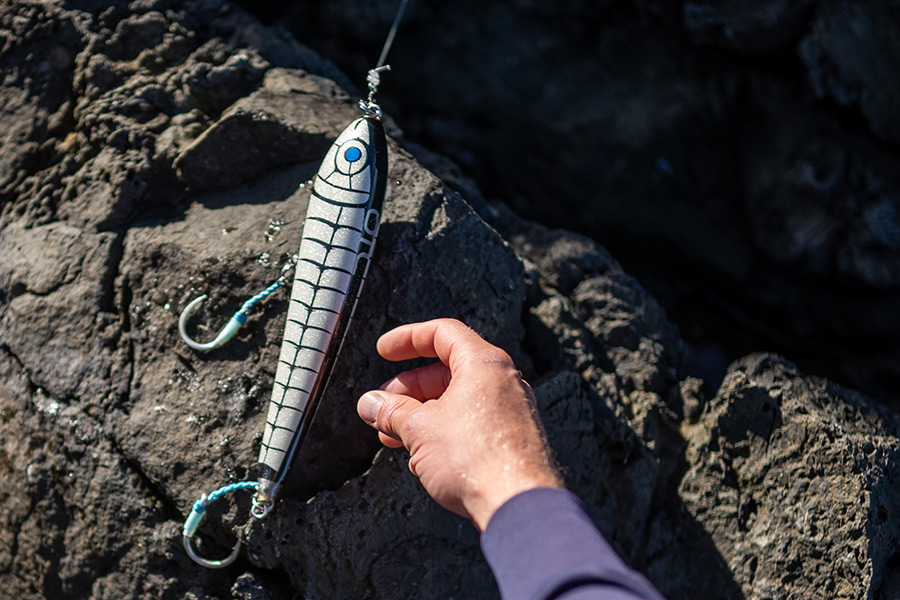
The lure: OTL 130g Blackjack stickbait
For me, this lure has proven itself repeatedly. I call it my ‘big fish lure’ as it has earned its reputation repeatedly over the years.
Rigging and technique:
I would be targeting large, older kingfish with this lure and these fish tend to be relatively finicky with their bites. They can be hard to fool at times, even with the best gear on hand. The approach I have found to be successful at triggering bites is a particular technique I like to call ‘porpoising’, the corresponding rod action is a mechanical pump action. It is a relatively difficult style to master but when done correctly it is incredibly effective. The 130g Blackjack is the perfect lure for this style of fishing because of its size, shape, weight, and colour pattern. You can see examples of the swimming technique in action over on my JE Wilds Fishing YouTube channel.
I would rig it with single assist hooks, BKK SF8090 HG to be exact, and I would have a 9/0 on the belly and a 10/0 on the tail with the point up. Both these hooks would be attached to the lure with a size 10+ BKK split ring.
Jake Pyne
The man behind Lo-Cab International, a New Zealand-based online lure shop, and line of fishing clothing inspired by hip hop streetwear, Jake Pyne is adept at casting surface lures around.
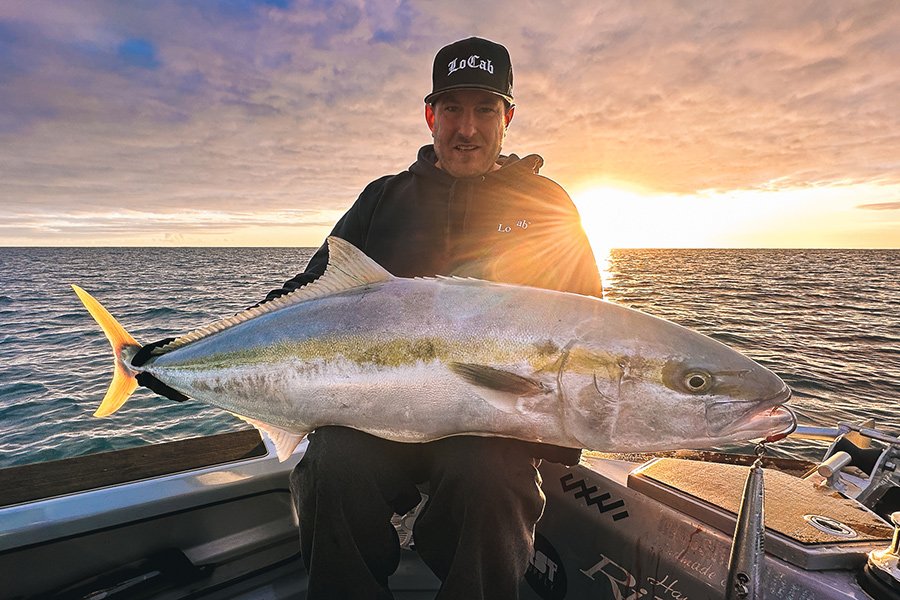
The species: Giant trevally
My favourite fish would have to be giant trevally (GT), followed closely by kingfish.
I’m sure if I lived in the tropics, and I got to chase GTs all of the time, I would probably rate kingfish as number one. They are both similar in the fact that they pull hard and fight dirty. GT are dumb boofheads that hit harder than anything, and they generally live in sharp terrain, so that’s a big part of the appeal. Big kingfish are smarter, and they are trickier to get the bite on topwater, so it’s a huge challenge to nail a big resident king.
The lure: Hammer Head Cherry Pai 250
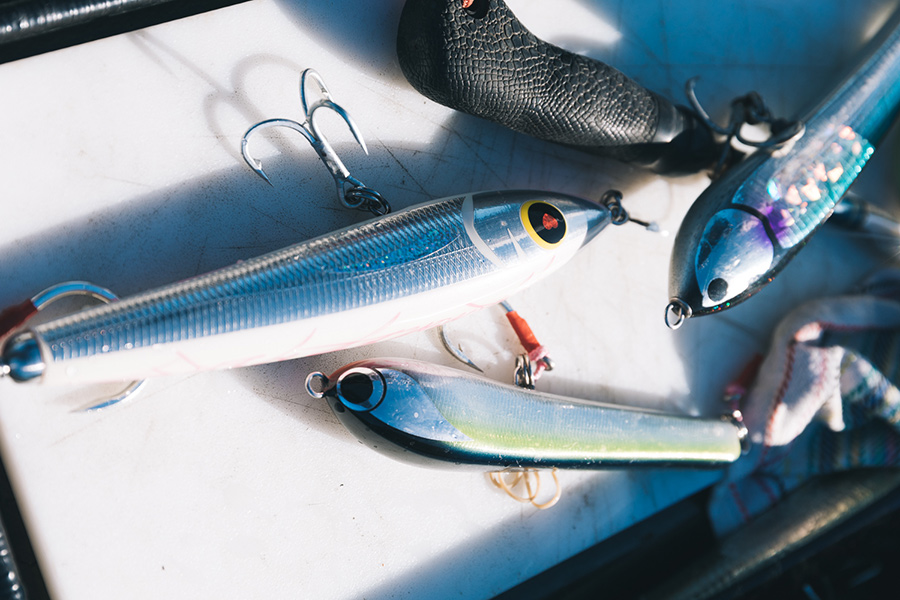
If I had to choose one lure for both kingfish and GT, it would have to be the Hammer Head Cherry Pai 250, with a CB One Zorro 240 second and an Extreme Dekageroo 220 third.
Rigging and technique:
This lure does it all. Slow, fast, big drifty sweeps, short stabs, splash and swim. I think the best way to fish any lure, is to do all that that lure can do. For example, for one cast you might let it hit the water, and pause it for five seconds, then burn it skipping across the surface. A second cast may be a combination of big drifty sweeps followed by short stabs with pauses. Basically, I try and imitate flying fish behaviour.
The Cherry Pai is a high float lure, so I rig it with a barbless treble on the belly, with a heavy gauge Suteki Crafters single hook on the tail. The great thing about bigger lures like this is they cast well on heavy gear, they have a big presence in the water, and most importantly they can run big hooks.
Tony Orton
Tony Orton and partner Bea have for many years run Offshore Adventures, a company that, as the name suggests, hosts anglers to less well-known fishing destinations such as Oman, Mexico, Costa Rica and Guatemala. Until recently they also ran a successful charter business and fishing lodge out of Mangawhai.
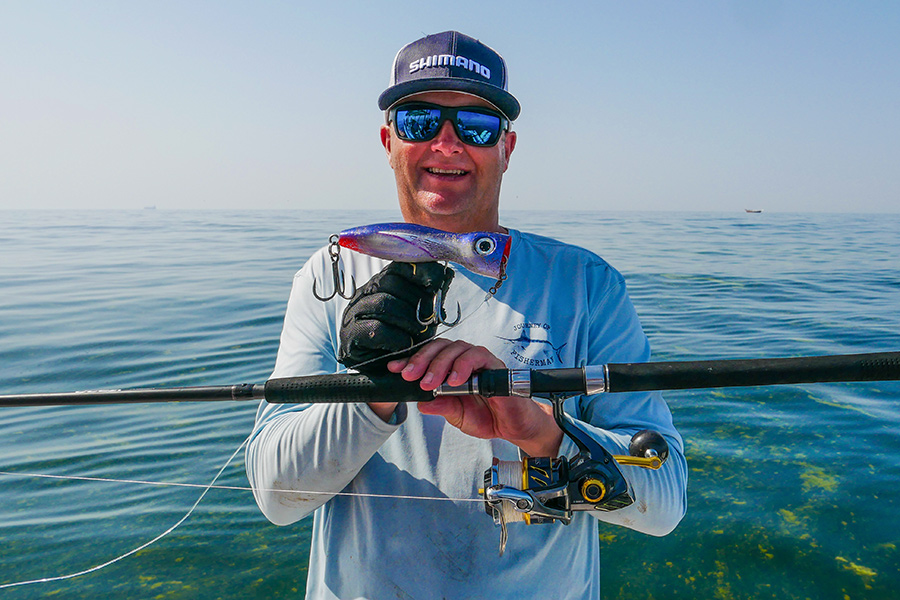
The species: Yellowfin tuna
If I could pick one species to fish on topwater it would have to be the yellowfin tuna. Watching them feed sure gets the adrenaline flowing. They are a fast powerful fish with explosive bites, and generally, we are fishing for them in warm climates or tropical locations!
The lure: Rapala X-Rap Xplode 170
My favourite lure for yellowfin is a popper and my best performing to date has been the Rapala X-Rap Xplode 170. It is easy to pop in all conditions, casts well and is most likely the most cost-effective popper you could ever buy.
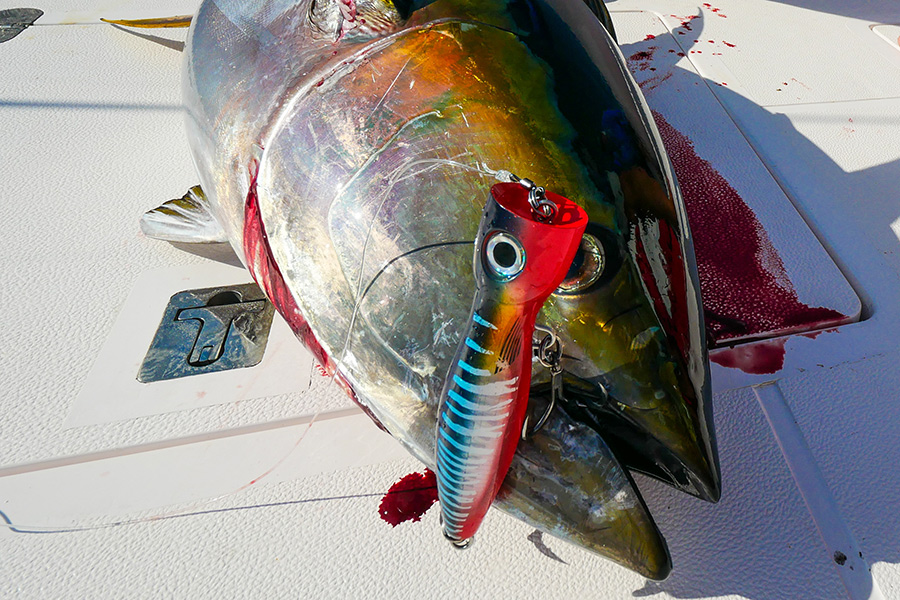
Rigging and technique:
My rigging includes PE 6/8 Ocea 8-strand braid connected via an FG or PR knot to a 1.6m long 140-170lb mono casting leader. The lure is attached to the leader via a size 1 S/S NT Swivel and a 200lb quality split ring. I always use a swivel to lure connection as this takes the pressure off the knot and adds a little bit of protection from teeth. A swivel can also help keep the nose of the lure down a little and reduce line twist over a long day of casting. Finally, don’t ‘over-hook’ your lure.
A slow retrieve is preferred, followed by a pause. I find a good percentage of bites come when the lure is ‘dead’.
Ben Starns
Shimano NZ’s Marketing Manager Ben Starns knows a thing or two about topwater angling, having spent much of his free time tossing the morning wood around NZ’s offshore islands.
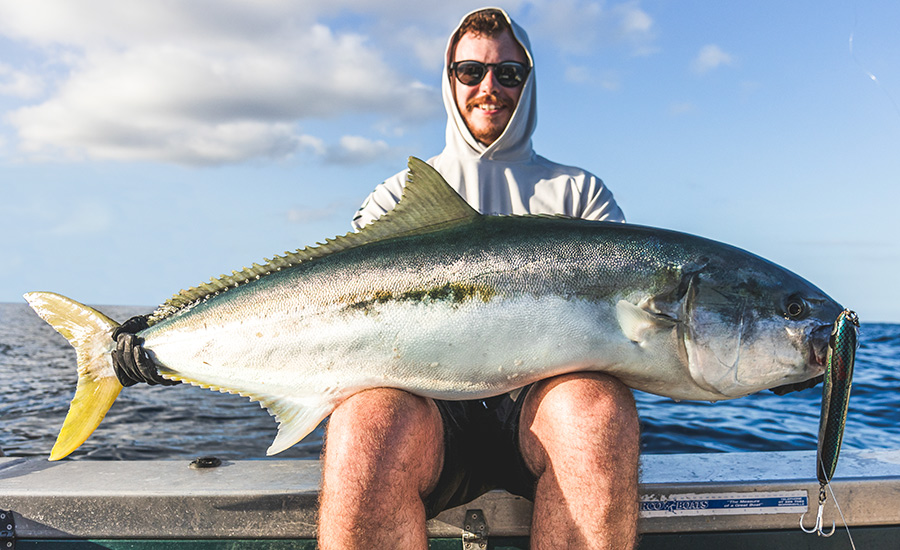
The species: Kingfish
My favourite species to target on topwater is the yellowtail kingfish. Kingfish have an incredible amount of sheer power which results in some explosive battles using heavy topwater equipment, with high drag settings, and often in very shallow water. When combined with stunning visual bites on the surface, they offer a unique and exciting challenge.
The lure: Carpenter GT-y (Gamma) 140H
Regarding lures, I find that everyone has one they are particularly comfortable with. It gets tied on first, used the longest, and reverted back to at the end of the day. For me, that decision is easy – the Carpenter GT-y (Gamma) 140H.
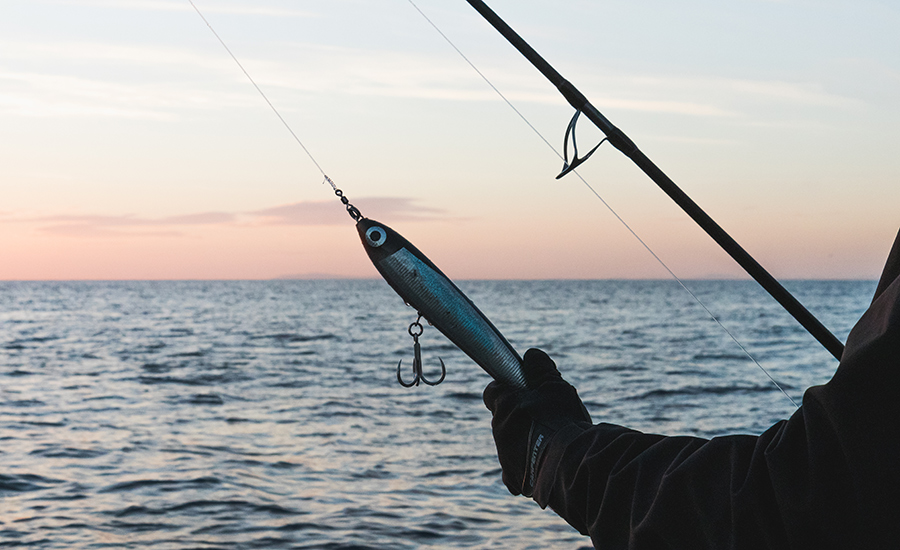
Rigging and technique:
The Gamma is a sliding lure that is designed to create a dramatic slashing motion across the surface of the water. When worked properly it displays an irregular S-action, creates a good amount of commotion, and leaves behind a decent bubble trail. To achieve this, correct timing on the sweep is very important. The sweep itself should start with a relatively firm stab and then transition into a long stroke maintaining consistent pressure throughout. Within reason, the faster you can pull a Gamma across the surface without ripping it out of the water the better.
To preface my response to rigging, I prefer using treble hooks on all my lures (barbless or crushed barbs). This is just a personal preference. That being said, the Gamma itself is particularly sensitive to rigging and correct balance is critical to achieve optimal lure action. I would advise selecting treble hooks and split rings in line with the manufacturer’s recommendation. For the GT-y 140H this is 5/0 and 350lb. If you are competent at swimming a Gamma (there is no substitute for practice) it is possible to use treble hooks one size smaller than recommended. This will result in the lure being noticeably more responsive, however, it will be equally more demanding to manipulate effectively.
Nick Jones
Current NZ Fishing News Editor-in-Chief, Nick Jones is passionate about his surface fishing. Nick has been a contributor to this magazine for several years and before taking on his current role worked part-time as a charter skipper with Hauraki Express, an operation specialising in lure fishing around the Hauraki Gulf.
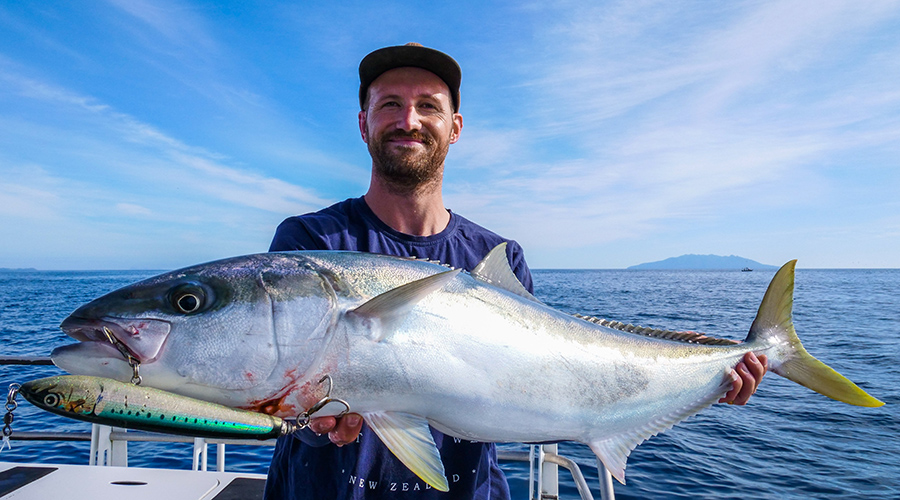
The species: Kingfish
I love kings! They’re very accessible year-round for northern Kiwi anglers, fight like demented dogs, are great candidates for catch-and-release, and make pretty good table fare.
The lure: Carpenter BC-y (Gamma) 75-190 in pilchard colour.
These lures aren’t the easiest to get your hands on, but they go off like a frog in a sock. I do a lot of spring/summer casting in the Hauraki Gulf – a time when the pilchards arrive en masse and matching the hatch seems to reap the rewards. The first one I owned became so beaten up that it had to be lovingly retired. These guys also catch kings around offshore islands and larger bait schools (kahawai/trevally), so they’re a versatile lure.
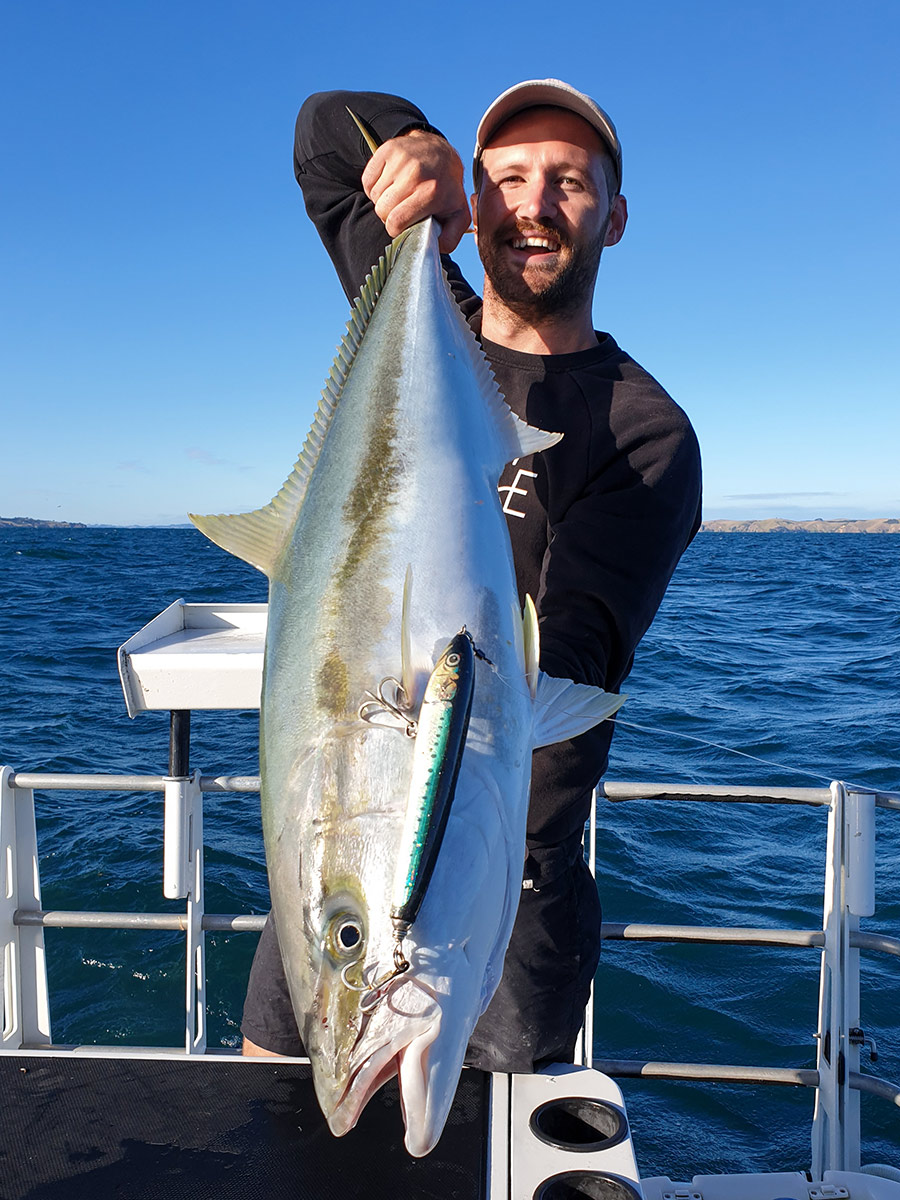
Rigging and technique:
Get up in the dark so you arrive at your spot before the sun has risen. Work the upcurrent side of the structure and any bait schools or working birds you can see. The Gamma has a sharply turning, zig-zag swimming action. I normally fish them with long, slow rod sweeps, but do mix it up with shorter, quicker jabs on occasion to get the bite, too.
Although trebles are a bit trickier to deal with and are harsher on fish, I find the Gammas are perfectly weighted and have good hook-up rates when paired with trebles. For the 75-190 size lure, I use barbless Owner STBL-66 3/0 treble hooks. I like to fish 100lb shock leader on PE4-6 gear when casting them in the Gulf – the fish generally aren’t huge and I cherish the skirmish.

November 2023 - Grant Dixon
New Zealand Fishing News Magazine.
Copyright: NZ Fishing Media Ltd.
Re-publishing elsewhere is prohibited
Fishing Reports Visit Reports
Tauranga Fishing Report - 28/05/26
Tarakihi on the bite Trips are few and far between at this time of year,... Read More >
Canterbury Fishing Report - 28/05/26
Fresh and salt turning it on! It is not very often I get to say... Read More >
Bay of Islands Fishing Report - 28/05/26
Lures paying dividends We finally had a break in the SE winds that have been... Read More >
Manukau/West Coast Fishing Report - 28/05/26
Snapper and gurnard in the harbour The weather has finally taken a turn for the... Read More >


Major Bites
Minor Bites
Major Bites
Minor Bites
Comments