
Eating Seaweed

Foraging for seaweed is an activity that the whole family can participate in, providing a good way to fill in half an hour after a day’s fishing. After all, seaweeds are easier to catch than fish and, unlike mushrooms, there are no poisonous seaweeds in NZ, making experimentation relatively harmless.
The tides need to be favourable, though. Extremely low tides are best, with snorkelling increasing the diversity of seaweeds available.

Wakame
Overall, one of the most common and harvestable seaweed species found throughout New Zealand is wakame. This species’ spores spread like wildfire, enabling wakame to establish anywhere where there has been significant boating traffic. This has seen its roots spread widely throughout our waters, from Auckland down to the sub-Antarctic and even out to the Chathams. Initially seen as an invasive species in a negative way, the tide has turned, and now wakame is valued for aquaculture production and is harvested commercially here for significant economic value.
Wakame is a tasty seaweed that can be used in many ways. It has a rich flavour, is not too salty, and has a soft texture - the ultimate sea vegetable. Wakame has a distinct frill like base to its stem and just one large central blade.
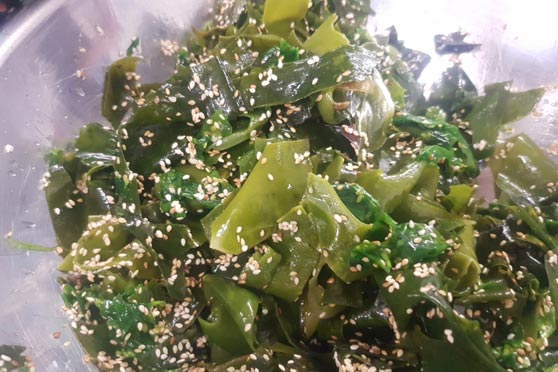
Once heat is applied, its colour transforms from a dense green-black to a bright green, making it more appealing to look at. Its soft texture means the stem and fronds can be finely shredded, with sesame seeds and oil then added to make a tasty seaweed salad.
Bladder kelp
Bladder kelp is another very tasty seaweed when fresh and cooked, although its flavour is much saltier than wakame’s. Bladder kelp is generally found from Wellington southwards, where it forms dense forests in places and is a prized food of butterfish. The fronds (leaves) can be dried and oven baked with olive oil to make kelp crisps - a healthy alternative to potato chips and very tasty.
The fronds can be shredded when steamed and, like wakame, turn a bright green colour. Also, the bladders can be jarred and marinated, adding a crunchy element to salads.
Bladder kelp is a great seaweed to put in the smoker with your fish, or wrap around a whole fish in the oven, acting like an oven bag to help seal in the moisture and infuse the seaweed’s flavour (a natural salty seasoning). Also, dried ‘leaves’ of the bladder kelp can be dried and ground into a power to make a seaweed sprinkle (which has a slight peppery flavour) that adds flavour to a wide range of seafood dishes.

Karengo
Karengo overall is one of our tastiest seaweeds with a strong umami flavour comparable to bacon. It really is superb when dried out and then fried in a pan with butter and some lemon juice. The karengo is widespear and is best harvested in the spring time.
Neptune’s necklace
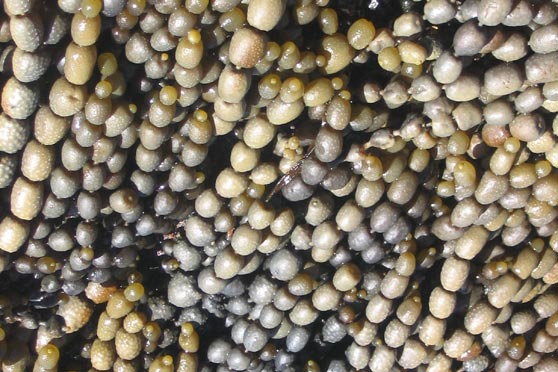
Neptune’s necklace is easily identifiable - as its name suggests, it consists of a series of light-brown beads. This seaweed is ideal for pickling in a jar with vinegar with some seasonings added. When lightly heated, it turns a bright-green colour. Freshly grown Neptune’s necklace makes the best eating; its crunchy texture is a great addition when combined with roast vegetables or mixed in a salad.
Bull kelp
Bull kelp is a predominantly southern seaweed; it’s better to gather it freshly beach-washed though, as this saves you from having to take the wild plant.
The fresh bull kelp’s blades can be cut into seaweed chips and then oven roasted. Bull kelp is also used as an ‘oven bag’ when cooking a whole fish or shellfish, infusing a very pleasant roast-seaweed flavour into the items. Meats can be covered in bull-kelp (or kombu in northern New Zealand) frond wraps to add flavour, too.

A few last tips
• You can recreationally harvest seaweeds throughout most of New Zealand (just check that you are not in a marine reserve).
• Choose areas of clean water when gathering seaweeds for best results.
• Once harvested, seaweeds need to be processed quickly, because they will break down in three days. I suggest air drying initially, then placing in a dehyradator is the best way.
• Once dried, store the seaweeds in an air-tight jar or vacuum pack so they do not reabsorb moisture and go stale.
• Seaweeds can be pickled (Neptune’s necklace is ideal), while bladder kelp and wakame are ideal for steaming and then shredding, then adding to a salad when fresh. As already mentioned, some seaweed is tasty when smoked.
• Many of the brown seaweeds will transform from a dull brown to a vivid green when cooked - a cool trick for the kids.
• The health benefits of seaweed are amazing; in many ways seaweeds are a super food.
So next time you’re out near the coast or back from fishing, diversify the flavours put on the table by taking a moment to grab some seaweed.
Fishing Reports Visit Reports
Saltwater Fishing Reports
Raglan Fishing Report - 12/11/26
Big spring snapper. With the more settled weather over the last couple of weeks there’s... Read More >
12 Nov 2026
Saltwater Fishing Reports
Mercury Bay Fishing Report - 12/11/26
Snapper hit and miss. Most reports have been telling us it’s becoming more difficult to... Read More >
12 Nov 2026
Saltwater Fishing Reports
Northland Fishing Report - 12/11/26
The switch has been flicked on! Call it what you want, El Niño, global warming,... Read More >
12 Nov 2026
Saltwater Fishing Reports
Tauranga Fishing Report - 12/11/26
Snapper and kahawai in close. Again, we start on a positive note, with some nice... Read More >
12 Nov 2026



Saturday 21 November 2026
Major Bites
 - -
Minor Bites
 - -
Sunday 22 November 2026
Major Bites
- - Minor Bites
- -
Comments