
Dragging soft-plastics
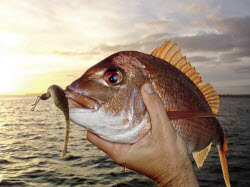 For those of you who don’t know, I’m a skipper for Wave Dancer Charters, which specializes in catching snapper on lures. We often have beginner lure fishermen on the boat, and the easiest technique for novices to master quickly is dragging soft-baits along the seafloor. Having said that though, for many years I wondered why sometimes this method would work and sometimes wouldn’t.
Finally, this season, I really started putting some effort and thought into the concept, especially in situations when encountering quite strong currents with some wind around. The most important aspects in such instances appear to be the need for the dragged soft-bait to be hard on the bottom and being pulled through the sand or mud so you can feel the seafloor contact bumping through your rod tip. This is because the snapper are mostly feeding on crabs and worms in this territory, with their heads down and tails up, so they’re less likely to come up off the bottom to grab your soft-bait.
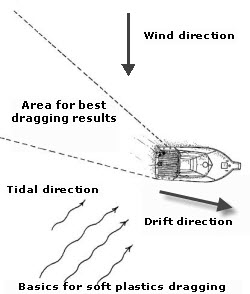 I often notice customers saying they’re getting lots of little bites, then wham, they hook a fish. However, I know they’re not actually getting lots of little bites; rather, the lure has simply been bumping along the striated bottom, making the rod tip go tick, tick, tick and feeling like a whole lot of little bites. But it was still a good thing, as when this was happening they would often hook up soon after. On the other hand, when there was no tick, tick, tick of their rod tip, the hook-ups slowed right down or even completely stopped. Interestingly, some days this tick-tick action would happen easily with only a light jig head on, and on other days it would not matter how much weight I used. This lack of tick-tick action generally happened in wind-against-tide situations, and also when there was very little wind but good amounts of current. I eventually theorised that maybe the lures were actually drifting in the current faster than the boat was moving, with the lure even tumbling along the seafloor at the same speed or possibly faster than the boat was drifting. I still don’t know this for sure, but it makes sense.
It therefore seems you must get your lure dragging along the seafloor in a forward movement to achieve the tick-tick action, which in turn helps to ensure success. This has spawned a new saying on Wave Dancer: “Tick, tick, tick, BANG!”
 Next, I started playing around with which way the lure should be lobbed out from the boat to get it dragging along correctly, as it’s often hard to tell which way it will move along the bottom, thanks to the infinite combinations possible from the varying strengths and directions of the wind and tide. However, I soon found that when these two forces oppose each other, a sideways type of drift usually occurs, making it quite hard to determine in which direction the boat’s moving, especially if the drift is slow. Whichever direction it is moving, it’s important to get your line deployed from the correct side of the boat, with the best angle being 180 degrees to the drift direction. The easiest way to figure out your drift angle is by consulting your GPS chart-plotter. If you have your track plotter turned on, this will give you the drift angle. Once you can see which way you’re drifting, it becomes a matter of lobbing a lure out in the opposite direction and letting out enough line until it’s possible to feel the tick-tick motion of the lure bouncing along the bottom.
Sometimes tying off your sea anchor to a different part of the boat so it hangs at a more favourable angle will help. All boats drift differently, so to get this right it’s simply a matter of trial and error.
Getting the right angle is critical though; if you cast your lure out in the wrong direction, you’ll generally end up with a lure that’s tumbling along the seafloor or a lot of belly in your line. In such instances it can take a long time for the lure to naturally swing into the right angle for a good drag, slowing your catch rate dramatically.
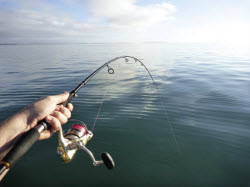
Once you have the angle right so the lure is being dragged forward by the boat’s movement, accompanied by a tight line, you need to ensure there’s enough weight in the lure’s head to get down and stay there – although letting out the right amount of line also has quite a bit to do with your eventual success, too.
Start with a ¾-ounce jig head, and let at least 50m of line out. Then, if you’re not getting the tick action happening, use a heavier jig-head and perhaps let a little more line out until you get it right. Some days on Wave Dancer we can have up to 2oz of lead on and 80 metres of line out before we have things set up right.
 As far as lures go, we are currently finding that the smaller 4” lures with wiggly bits near the rear end work best. Classic lures to use include Gulp! 4” Jigging Grubs, Zman 4” Curly Tails, and our favourite, Zman 4” PaddlerZ. We find dark and/or natural colours work better than the bright colours – try colours such as Shiner, Sapphire Shine, Smokey Shad and Rootbeer-Gold (my favourite).
Scent often makes a big difference when dragging soft-baits along the seafloor too, and the two most popular scented baits are Gulp! and Zmans. Otherwise, squirt some Secret Sauce on whatever you’re using.
The best areas for dragging soft-baits seem to be high-current areas, typically channels in 10-18 metres of water. Classic places around Auckland for this technique include the Rangi’ and Motuihe Channels, along with the areas south of Crusoe Rock and the expansive territory between Waiheke and Rakino.
So make sure you get your lure bouncing along the seafloor, use small, darker-coloured lures with scent, and go fishing when the tide is running.
 |
This article is reproduced with express permission of
written by Paul Senior - 2011 Originally published in New Zealand Fishing News ----- Advertisement -----
|
Fishing Reports Visit Reports
Outer Hauraki Gulf Fishing Report 17/09/26
Spring wind the handbrake. Spring is starting to make its presence felt in the outer... Read More >
Top of the South Fishing Report - 17/09/26
Early snapper in Tasman Bay. Well, spring is finally here, and the days are getting... Read More >
Bream Bay Fishing Report - 17/09/26
Good snapper catches reported. After Tangaroa turned off the fish tap for a month or... Read More >
Bay of Islands Fishing Report - 17/09/26
Pacific bluefin tuna for the lucky few. The last fortnight has seen more fishable days... Read More >


Friday 25 September 2026
Major Bites
 - -
- - Minor Bites
 - -
- - Saturday 26 September 2026
Major Bites
- - Minor Bites
- -
Comments