
Dragging Soft-Plastics

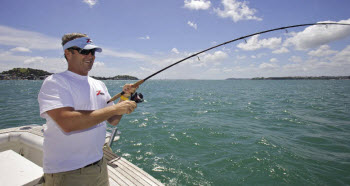
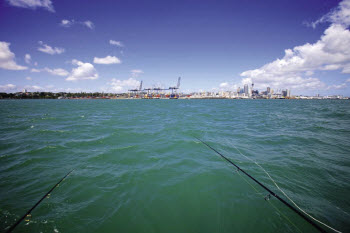
Often when dragging my soft-baits along the seabed in the inner harbour I’m in sight of Auckland’s Queen Street. To catch a haul of good-sized snapper so close to the major metropolis of Auckland is nothing short of fantastic.
Last season, about this same time, we had tonnes of snapper move right into the waters pushing up against lower Downtown, and the good news is they’ve moved in again. These fish are foraging along the seafloor, feasting on worms, crabs and baby shellfish. We know this because these tasty morsels are often being spewed out as we’re lifting the snapper into the boat. Interestingly, my wife commented the other day how good the snapper tasted, which was not what I expected from ‘downtown fish’. I suspect the added flavour is due to their diet of crustaceans.
I have been taking charter groups ‘downtown fishing’ over the past month. I do get a few strange looks when I steam out a few hundred metres from the marina and say, “Let’s give this a try.”
I can hear the minds churning away: “Is this guy for real? Is he trying to save money on fuel? He normally travels out miles chasing work-ups...”
However, it often only takes a few moments for them to hook up, and their looks of disdain soon change to smiles as they start catching nice snapper. I then like to ask, “Do you want to move?” and the answers will now be “No, no. It’s alright – let’s stay here.”
Usually just before Xmas, I hear anglers scratching their heads and wondering why the out-wide work-up fishing has suddenly closed down; upon hearing these comments I move inshore and start dragging soft-plastics along the seafloor.
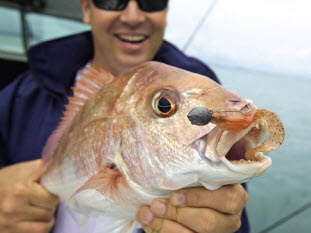 I believe the deeper water fishing slows down a lot at this time due to the fish spawning; unfortunately, when the fish are doing this it’s almost impossible to catch them on a hook. However, I believe they don’t spawn as much inshore (if at all), so when frustrating fishing is experienced out in the deep during spawning time, it often means the inshore fishing is firing – almost a game of opposites. So if you hear reports that it’s slow out wide, save some fuel, stay inshore and persevere.
If planning to fish the inner harbour, there are two important variables to take into consideration: one, the current, and two, the wind direction.
Dragging soft-baits works much better when the wind and tide are going the same way. So a good rule of thumb for the Waitemata Harbour is to fish the outgoing tide in a southwest wind, and the incoming tide in a northerly wind.
The second very important variable is current flow. It’s quite basic really: when the current is flowing, the fish will feed; when there is no current the fish stop, too. My theory on this is that it’s easier for the fish to forage in the mud when there’s current flow, as the moving water carries away the uplifted sediment from where they’re foraging, providing better visibility, exposing potential prey, and enabling more effective feeding.
The catch rate often increases after the current flow has peaked around mid-tide and starts to slow down towards the bottom or top of the tide. I believe that the fish have a bit of a panic feed before the current stops.
In short, if you plan to fish when the wind and current are going the same way, and avoid fishing the slack-water periods, you’ll catch more fish.
I have been dragging soft-baits for some years now and often find this technique works much better in the inner harbour than the traditional cast-ahead method of soft-baiting. This really became apparent to me in the early days of soft-baiting, when I often took my wife out fishing. The funny thing is, she would end up out-fishing me most outings, which was not much fun – especially as she would also dish me out a good ribbing in true fisher-folk style, and tell any of my fishing buddies whenever she could!
Typically, I would be casting out and then twitching my lightly weighted jerk-shad back to the boat. Meantime, she’d be dropping her lure straight down, letting out a bit of line, and pretty much just sitting there and waiting for a fish to come along.
Because she was the ‘amateur’ and would not be able to tell when her lure was on the bottom, I always put a heavier jig-head on her rod. I noticed that when her lure was bouncing along the bottom and her rod tip was going rat-a-tat-tat-tat, she would often catch fish. This spurred me on to try harder, casting further, twitching more, changing baits and piling on the Secret Sauce – but she would still end up out-fishing me.
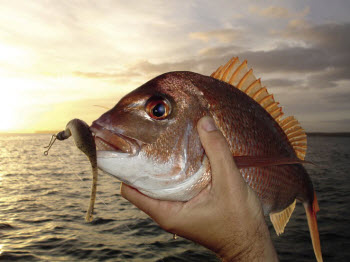 I lay awake at night wondering what was going on, and that’s when it came to me. If we first consider how snapper feed, we can get some idea of what is probably happening. For me, snapper feed in two different ways. One is to feed on baitfish, which means they come up off the seafloor and chase these small fish down, much as kahawai and kingfish do. The second way is to forage along the seafloor, digging up tasty morsels with their mouths and noses – which means they need to be feeding at an angle so the swishing of their tails drives their noses into the seafloor. When doing this their eyes are fixed on the bottom, so when I was twitching and hopping my soft-bait along the seafloor, the only time I’d hook a fish was when my lure touched down in front of a snapper’s nose. My wife, on the other hand, had her soft-bait hard on the bottom all the time, increasing the number of instances it went past a snapper’s nose, resulting in more fish biting and being hooked.
So next time out I tried dragging and caught just as many fish as my wife. Thank goodness.
I’ve been using this technique for several years now, and it’s not quite as simple as I first thought. The most challenging part of this style of fishing is getting your soft-bait to stay on the bottom and drag through the mud.
So, first up, buy a decent fishing drogue, as this will make getting to the bottom much easier. Be aware that the cheaper funnel-type drogues do not work as well as the parachute types, which take a bit more time to set, but are well worth the extra effort and cost. Use your drogue at all times, except if there is no wind. (An exception to this is when you can’t seem to get the lure dragging along the bottom; sometimes pulling in the fishing chute allows the lure to start dragging.)
Keep in mind that in all cases the boat has to be moving – either due to the wind, the current or both – so your lure is getting dragged along the bottom. Also, the line must be tight enough to pull the lure through the mud. Sounds simple enough, but what if the tide is pushing your lure along faster than the boat is moving and your lure is just tumbling along?
This is something few anglers ever consider. Have you ever wondered if your lure is at the bottom? Does it never seem to hit the bottom and your line never really comes up tight? This is due to the effect the current is having on the lure and line; the current can create a belly in your line, and if the line isn’t taut, forcing the lure to be pulled along headfirst, it ends up tumbling along the bottom instead – and you won’t catch anything. The simplest way to prevent tumbling is to use enough weight to counteract any undesirable effects the current might have on your line and lure.
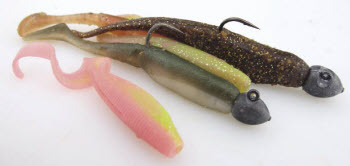 I use 3/4oz and 1oz jig heads on 4-inch and 5-inch soft-baits in the channels, which are usually around 10m deep. Some may say this is overkill and a lighter jig head should be used, but weight is your friend when dragging. You will know when you’ve got it right, as you’ll feel the lure going tap-tap-tap as it bounces along the bottom. If it’s not and everything feels very smooth, with no bumps being transmitted up the rod, increase the weight of your jig-head.
So what else can you do to get the rat-a-tat going on your rod tip? Sometimes it’s simply a matter of letting out more line – the further out your line is, the shallower the angle between your rod tip and your lure, which means you’ll be pulling your lure along rather than up. Sometimes I can let up to 70m of line out in 10m of water before the lure starts dredging along the bottom.
Try to fish in areas that have the wind and tide going in same direction; I don’t know why, but this seems to make it a lot easier to get your soft-bait dragging properly. You can also go down in braid and fluorocarbon leader diameter. I mostly use 3kg braid and 7kg fluorocarbon, but will even go down to 4.5kg fluoro to get the lure down. That’s because the thinner the line, the less the drag created when it’s slicing through the water, so less weight is needed to get the lure down, and this also enables your lure to retain more action.
The best lures to use are 4-inch soft-baits with wiggly tails – my favourite is my own Z-Man 4-inch Curly Tail, followed by the 4-inch PaddlerZ. Dark colours seem to work better, and the most effective seems to be Root Beer Gold currently, but any dark or natural colour seems to work well.
 It can be hard to find jig heads that are suitable for these smaller baits, as filling your nice wiggly soft-bait with a stiff, metal hook shank is obviously not ideal. So try and find a jig-head where the point of the hook exits the soft-bait somewhere near its middle, enabling more of the lure’s natural action to be retained. Three-quarter-ounce and 1oz jig heads rigged on 3/0 hooks are best, and if you can find a model with a short-shank hook, so much the better.
Obviously it won’t hurt your chances if your offering smells like food, too. While brands such as Gulp! incorporate smell within their construction and can work very well, the downside is that they are not that sturdy. Z-Mans, on the other hand, are much tougher, but once their initial scent becomes washed out (usually after 6-8 fish or so), they need regular applications of Secret Sauce or a similar scent additive for their full potential to be retained.
This method of catching snapper is well proven – we use it charter fishing all the time and we very rarely use the cast-forward technique. Dragging really does work well when the fish are feeding hard on the bottom. Give it a go, the fish are right on your doorstep.
Disclosure: Paul Senior is a charter skipper in the Hauraki Gulf, and importer and distributor of Z-Man soft-plastics and Secret Sauce.
 |
This article is reproduced with express permission of |
Fishing Reports Visit Reports
Outer Hauraki Gulf Fishing Report 17/09/26
Spring wind the handbrake. Spring is starting to make its presence felt in the outer... Read More >
Top of the South Fishing Report - 17/09/26
Early snapper in Tasman Bay. Well, spring is finally here, and the days are getting... Read More >
Bream Bay Fishing Report - 17/09/26
Good snapper catches reported. After Tangaroa turned off the fish tap for a month or... Read More >
Bay of Islands Fishing Report - 17/09/26
Pacific bluefin tuna for the lucky few. The last fortnight has seen more fishable days... Read More >


Friday 25 September 2026
Major Bites
 - -
- - Minor Bites
 - -
- - Saturday 26 September 2026
Major Bites
- - Minor Bites
- -
Comments