
Downsizing Your Gear Part 2

In the first part of this series, writer Mark Kitteridge looked at the benefits of reducing the size of soft-baits. This time, the focus is on tiny jigs...
Micro-Jig, Maxi Power!
I have a love-hate relationship with small jigs, especially micro-jigs.
While it’s true that almost any suitably sized predator will eat a small, injured baitfish – and that’s what a small jig imitates – there are way more little fish than big fish in the sea, so chances are...
I can’t tell you the number of times I’ve picked up a micro-jigging outfit armed with a tiny tungsten jig and proceeded to hook a succession of small snapper, mackerel, and kahawai. Then, just as I’m about to give it away, something hefty grabs my lure and tears away; the first of several lovely fish that end up filling the bin!
This is also why so many anglers arm their kids with micro-jigs: the little lures will regularly attract bites from all sorts and sizes of fish, keeping youngsters involved, excited, and happy for longer. The light gear makes it so much fun, too.
But I can also understand why these diminutive jigs might appear to be a waste of time to many staunch anglers. So, I suggest considering them as fancy chocolates: even when your belly’s full, it’s still hard to resist having one when offered (admittedly, some brands and designs are more effective at achieving this than others).
My regular fishing buddy, John Eichelsheim, is a great believer in the power of small jigs while fishing near small baitfish feeding activity and when cooler water temperatures are slowing snapper feeding enthusiasm. He always brings along a micro-jig outfit designed for 15-40g lures, and it’s helped him out on countless occasions when other lures fail to fire.
He often uses the tungsten Fleas in 21-28g (Shimano Metal Shots and Daiwa TG Bait SLJ would be two other potential candidates) and the more traditional fluttery-type jigs in 25 and 40g weights, especially those incorporating a lumo finish.
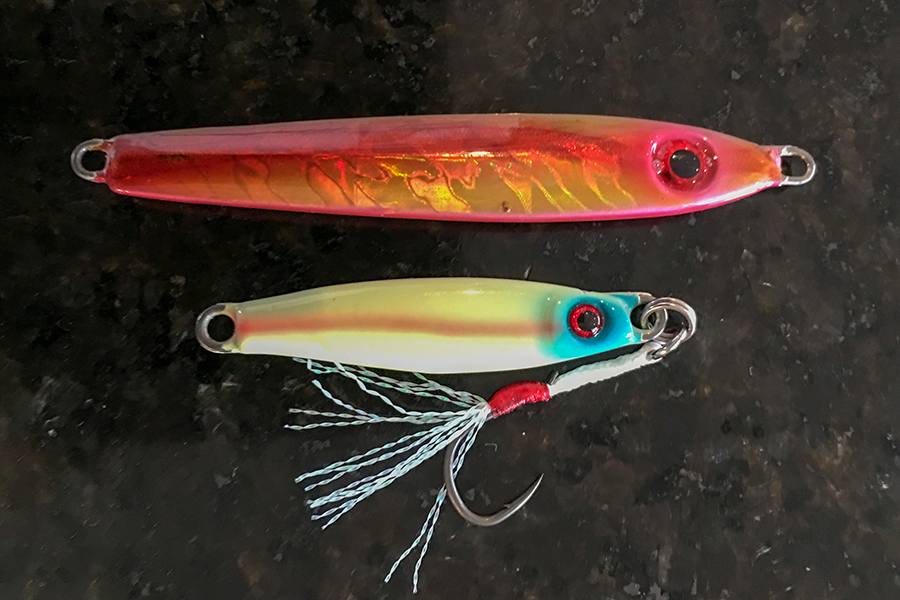
This shows the dramatic difference in size between jigs made from tungsten (top, 28g) and lead-composite (bottom, 25g)!
The gear:
The rod: A very light, whippy rod with 3-6kg capabilities will help the cause. It’s especially important for the forgiving upper section to readily bend so the lure’s small hook/s are less likely to rip or bend out during battles. So, if you have a bendy soft-bait or spinning rod, start with that, then get more specialised if you enjoy the technique.
The reel: Look for a size 2500-3000 reel with around 200 metres of 4-6kg braid. A smooth drag is a big plus.
The trace: Around two metres of 10-20lb fluorocarbon, depending on the size of the lure, will do the job nicely.
The techniques
A simple lift-and-drop (yo-yo) action usually does the job; the smaller the lure, the smaller the actions imparted, with the lure’s size making it easily lost from sight, especially in murky water.
Personally, I find simple yo-yo-ing tedious (and the fish seem to agree at times, too), so I often intersperse these movements with some reasonably slow mechanical-jigging motions.
Keep in mind that lifting-and-dropping actions suit a reasonably vertical presentation, not a more horizontal one, so if struggling to get to the bottom and stay there for any length of time, it pays to lob your lure well ahead of the boat. By the time it gets down, the lure will be just ahead of the boat or directly below, enabling it to flutter and flash nicely when lifted and dropped for longer.
You might be interested to know that it’s no problem to get tiny tungsten-made lures down surprisingly deep (i.e., 40- to 50 metres plus) on a calm day. Nor is it hard to attract plenty of rod-buckling action, with even snapper over the magic 20lb mark somehow detecting these small lures and eating them!
On the other side of the coin, micro-jigs can also be cast out into shallower water and gently worked back along the bottom, much like a soft-bait. The variety of fish that eat them is impressive – everything from the ‘usual suspects’ through to trevally and gurnard.
Mini-Knives: Hard To Beat In The Deep!
I love this form of fishing as snapper and kingfish often find smallish knife-type jigs irresistible, and some of the fish attracted can be very big!
Even better, the relatively light 6-10kg tackle suited to this fishing style means that the battles are not too wearying, enabling anglers to drop straight back down again after each catch. As someone who’s getting older and less fit, this aspect is becoming increasingly attractive to me.
Before we go further, though, I’d like to reiterate that I’m only a fan of light tackle if it’s used responsibly. Light line shouldn’t be used if the fish are likely to break off in an unforgiving reefy area.
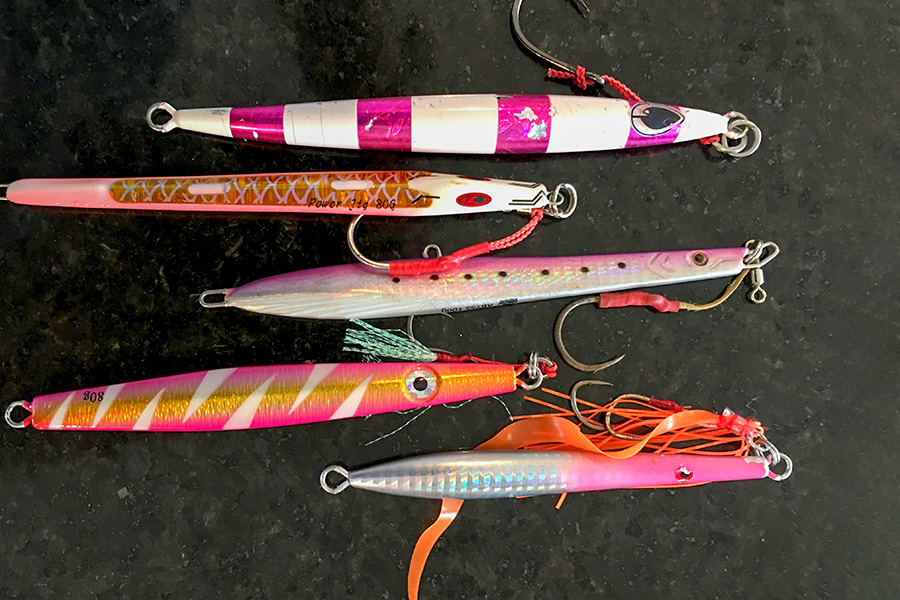
A selection of small knife jigs: Note the small, dual-hooked assists on the bottom two lures, ideal for targeting all species over clean ground, while the upper three have much heavier single-hook assists, making them better options for slightly stronger tackle over foul territory.
The gear
The rod: This style of fishing suits a 6-10kg rod with a light, whippy upper section. Again, a soft-bait rod can get you underway – but a little gruntier this time – before perhaps progressing to a light jig rod that utilises this technique’s full potential later on.
The knife jigs used typically weigh from 60-120g. Please note that although many rods may have recommended lure-weight capabilities that would make the heavier ones apparently unusable, provided you only drop them down or gently lob these larger lures out, a decent quality rod should still handle them (after all, they may need to bring fish weighing many kilos to the boat!).
The reel: Look for a reel that holds at least 200-300 metres of 12-20lb braid (3000-4000 size reels usually do the job nicely).
The trace: Two to three metres of 25-30lb fluorocarbon usually does the trick.
Suitable lures: There are many good knife-jig examples out there, and their attributes vary widely. However, in all cases, the shape is reasonably long, slender and streamlined.
Tail-weighted knife jigs
Tail or rear-weighted knife jigs are arguably the most popular type of knife jig shape and are well-proven. These lures make the most of their long, slim form to cut through the water efficiently on the descent, aided by their slightly heavier rear end.
Traditionally these are the lure type of choice for kingfish hunters, who mostly use them in 200-350g weights. However, I have been using them in just 80-150g when fishing over a relatively clean sea floor for some time now. Not only do these lure weights still attract decent-sized kingfish (typically 6-12kg) in 35-55 metres of water, but they are also perfect for snapper, especially those rigged with modest-sized (but still strong) twin assist hooks.
What I especially like, though, is that they can be deployed on compact PE2 or 3 jigging outfits all day without raising much of a sweat – and it’s so much fun when hooked up!
I find 80-100g weight lures are especially good for targeting snapper; while the 120-140g models often attract bigger fish. The snapper’s tendency to shake its head against the fixed weight of these heavier lures means it’s more likely to rip free if not securely hooked. No such potential problems with hooked kingfish, though!
Generally speaking, I tend to start off with slow-motion mechanical-jigging movements (successive lifts and drops of the rod while simultaneously making single reel-handle rotations) from five to 10 metres off the bottom in 35 metres plus of water when snapper appears to be present on the fish-finder. But if kingfish are seen on the fish finder (often off the bottom and tend to assume a more vertical schooling formation), speed those movements up and retrieve the lure further up the water column.
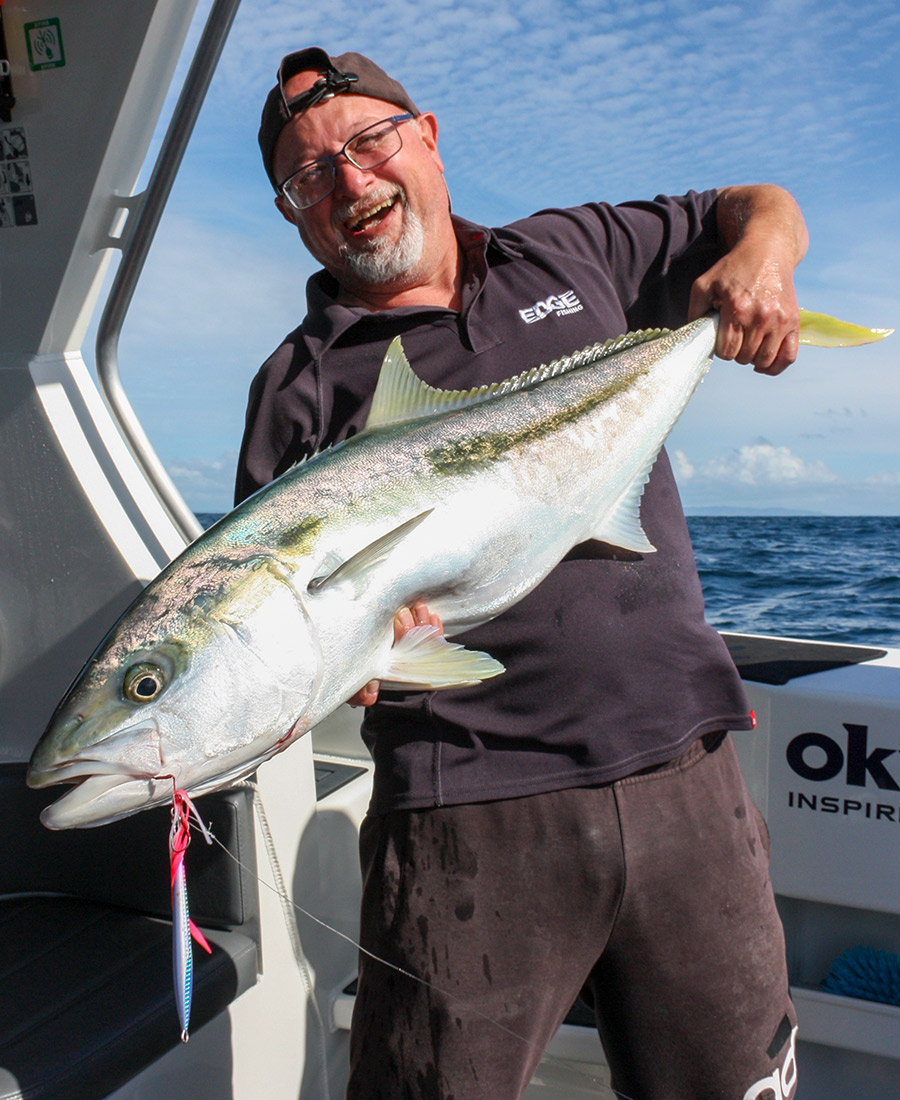
‘Mini knife’ type lures like this one are equally effective on snapper and kingfish alike.
Centre-weighted knife jigs
Some inherent movement can be incorporated into knife jigs by adding some flattish surface area (but not too much, or it ceases to be a knife jig) and perhaps making them more centre-weighted.
I often use a reasonably centrally weighted jig that, unsurprisingly, is simply called ‘knife Jig’. Although nothing especially radical in design, this 80g lure is slim enough to get down fast but has just enough surface area to create some exciting flutter as it does so, as well as offering an enticing weaving and flashing action when retrieved.
For similar reasons, I have also used the very effective Shimano Colt Sniper in the past (it might just sneak inside the knife-jig description if we’re in a generous mood), and I suspect the Ocean Legacy 90g ‘Long Contact’ might offer similar attributes, too.)
I also like the extra challenge that such lightly weighted jigs offer. Their lack of real weight means they can be easily swept away on an ineffective angle if simply dropped down in wind-against-tide situations, so I cast mine about 20 metres ahead of the drifting boat’s direction, especially when fishing in the 40- to 55-metre depths typically encountered out from Auckland.
It then pays to watch the line on the way down, as strikes often occur during this phase, with the line suddenly stopping or streaking away. Time to engage the reel and strike!
Once on the bottom, ‘yo-yo’ lift-and-drop motions generally produce snapper, as do short spells of slow-motion mechanical jigging. Once the line assumes a 35–40-degree angle behind the boat, wind in and start again.
As you might expect, kingfish (along with trevally, gurnard, and john dory) are a common bycatch. But for anglers keen on targeting them, a change to a reasonably nippy mechanical-jigging retrieve for around 10-15 metres off the bottom will likely attract crunching hook-ups – if the kings are down there.
And as Hauraki Gulf kingfish tend to be around eight to 12 kilos, especially when fishing areas of feeding activity in 35-to-55-metre depths, a good scrap is assured!
So, more fish, greater variety, easier on the body, more fun - why wouldn’t you downsize when jigging?!

April 2023 - Mark Kitteridge
New Zealand Fishing News Magazine.
Copyright: NZ Fishing Media Ltd.
Re-publishing elsewhere is prohibited
Fishing Reports Visit Reports
Outer Hauraki Gulf Fishing Report 17/09/26
Spring wind the handbrake. Spring is starting to make its presence felt in the outer... Read More >
Top of the South Fishing Report - 17/09/26
Early snapper in Tasman Bay. Well, spring is finally here, and the days are getting... Read More >
Bream Bay Fishing Report - 17/09/26
Good snapper catches reported. After Tangaroa turned off the fish tap for a month or... Read More >
Bay of Islands Fishing Report - 17/09/26
Pacific bluefin tuna for the lucky few. The last fortnight has seen more fishable days... Read More >


Friday 25 September 2026
Major Bites
 - -
- - Minor Bites
 - -
- - Saturday 26 September 2026
Major Bites
- - Minor Bites
- -
Comments