
Downsizing Your Gear Part 1

Mark Kitteridge looks at smaller lure options and techniques to make the most of the available fishing action.
Ihave rarely chosen to go small throughout my fishing life. Nothing beats ‘bigger is better’ as far as I’m concerned, with much of my pleasure stemming from having a wrenched-over rod and line haemorrhaging from the reel as a large, powerful fish steams away!
But what happens when the fish are feeding on tiny baitfish (i.e. anchovy season), or maybe the cold has slowed their metabolism (i.e. snapper over the winter months)? Maybe they’re not really hungry, or continual fishing pressure has seen them wise up to the more usual offerings? Or, from a purely physiological (and perhaps personal) point of view, possibly old age and lack of fitness or strength mean the bigger gear usually required is beyond the angler’s capabilities!
In all the above cases, it’s time to go smaller and/or lighter in order to succeed.

Micro-baits are lethal during the anchovy season, but they seem just as effective throughout the year in very different situations.
The case for a more specialised outfit?
In this article series, I will discuss the tackle and tactics required when ‘downsizing’ your gear to attract more hook-ups – not to mention the extra fun enjoyed whilst doing it!
Unfortunately for most anglers, going smaller often demands lighter fishing equipment, so continuing to use your standard lure-fishing outfit will likely result in reduced casting distances, less and slower depths achieved by descending lures, and pulled or bent-out hooks during battles.
So, believe me, using a lighter, well-suited outfit will make a massive difference to the overall performance and success when fishing mini lures (but until you’ve actually tried such an outfit, it’s unlikely you’ll fully appreciate this point!).
By all means, start with what you have already if you must; a light soft-bait rod often does the job initially, especially with small jigs and soft-baits. But if you find yourself getting excited by the possibilities and potential, consider visiting your local fishing tackle shop for some advice and options, so you have the right tool for the job.
There is one proviso to this light-tackle suggestion: please don’t use light gear and small lures to target big fish in unforgiving territory, as leaving fish trailing broken-off tackle is not a responsible or desirable outcome.
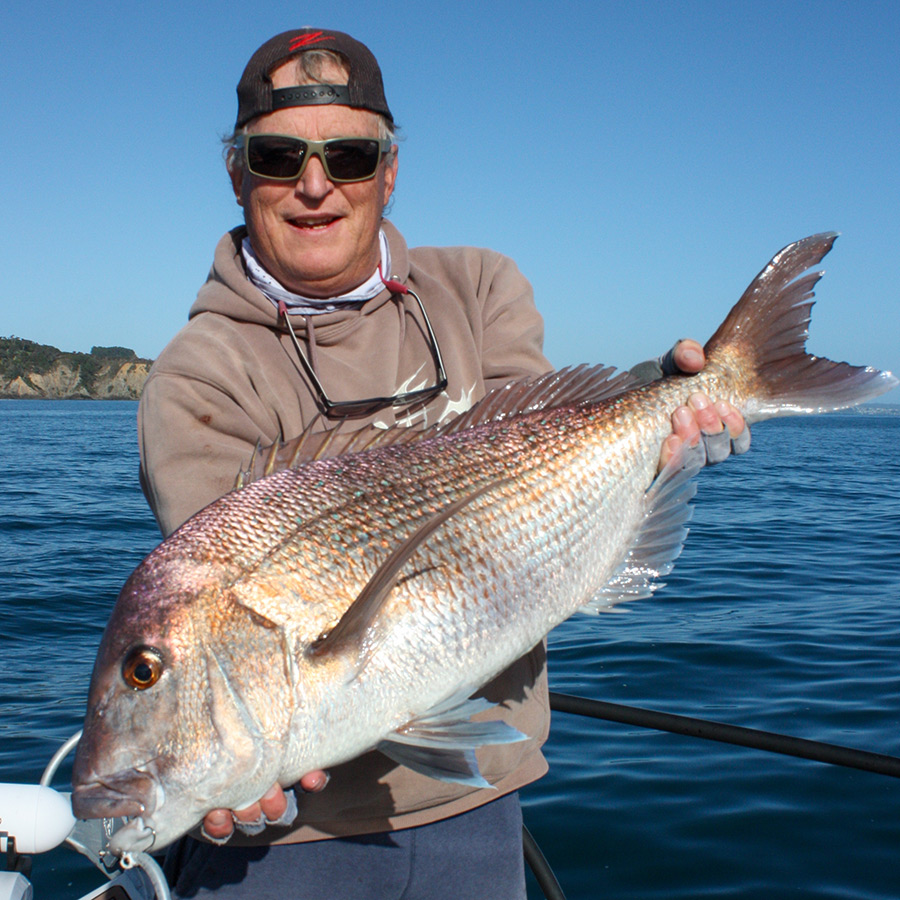
These products might have been brought in to catch trout, but the snapper really like them, too!
Soft-plastics
As already mentioned, the way snapper feed (or won’t feed!) can be influenced by many factors. For example, at this time of year small baitfish abound, often making the nearby snapper focused on them and tempting bites with larger offerings challenging. Or, during winter, the colder temperatures can slow their metabolism, making them less hungry.
Whatever the reason, I’ve found that 2.5” to 3.5” ‘freshwater’ soft-baits often get fish biting when nothing else will. It seems the more realistic jig-heads with various wriggly little baitfish patterns attached are almost impossible for predators to resist, aided no doubt by a length of light, hard-to-see fluoro leader and the jig-heads’ small, sticky-sharp hook.
The size range and variety of saltwater fish species attracted by these tiny soft-baits’ diminutive charms have been truly stunning, and they often continue to produce when nothing else will. Better still, these ‘toy lures’ excel at both ends of the temperature spectrum, making them excellent options during the depths of winter and through the midst of summer!
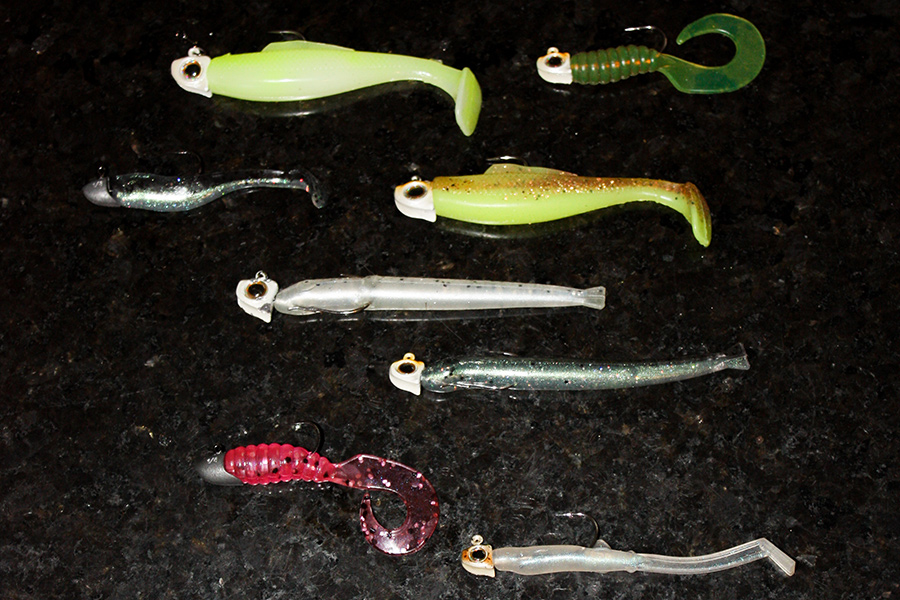
A selection of Berkley (unpainted) and Z-Man jig-heads armed with 2.5-3” soft-plastic tails. Note how the longer, narrower TRD MinnowZ (middle rows) are hooked differently, with the hook point exiting the ‘chin’ and being reinserted through the entire body further down, leaving the shank to run along the soft-bait’s belly.
The gear
To get the best from these tiny baits, I use a specialist 8’6” rod designed for fishing the Mackenzie Country canals and squid. It’s made for casting weighted soft-plastics into large rivers and lakes, yet has the low-down power to take on surprisingly big fish, and is teamed with a 2500-sized spinning reel with a smooth drag.
I fish this with 5kg braid, which is still a bit on the heavy side; the lighter the braid used, the further the lure will cast and the more efficiently it cuts through the water and any annoying wind, enabling the lightly-weighted offering to get down deeper more quickly and for better contact to be maintained. I suspect 4kg will be ideal.
The braid should be connected to around 2.5-3m of 12lb fluorocarbon trace, a poundage that plays a role relative to the 20lb trace typically used with the more traditional size and weight soft-baits.
I don’t recommend much heavier than 12lb, as much of the small soft-baits’ success stems from the ‘complete deception’ the lighter leader helps to achieve, with the virtually invisible leader often attracting savage strikes and making the fish apparently happier to hold the soft-baits in their mouth for longer afterwards. Also, the thicker the leader, the more the lure’s descent is slowed through the water column, as well as dampening the lure’s natural action.
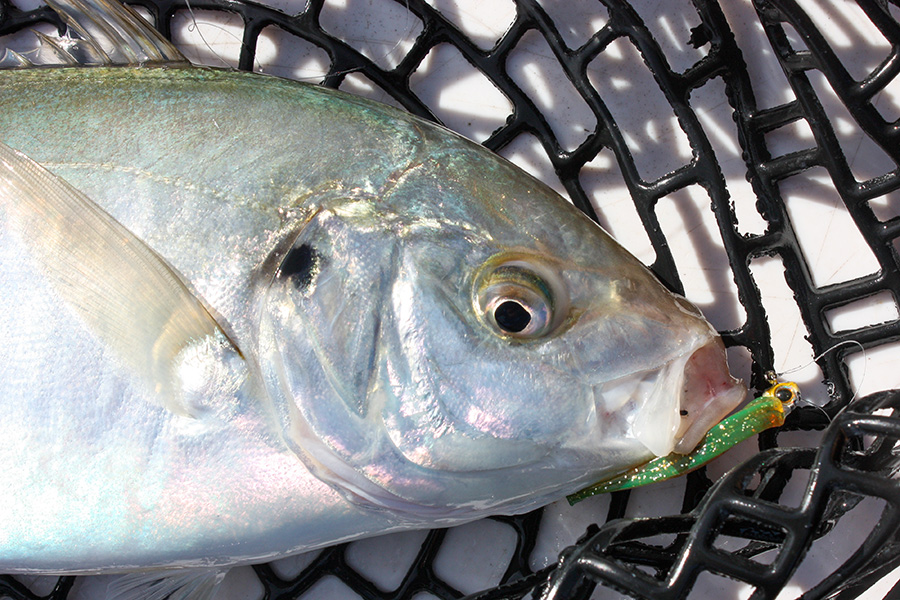
Trevally are a common and welcome bycatch on tiny softies.
The right jig-head is important too, and fortunately for micro-baiters the choices are rapidly increasing. I use Z-Man ‘Finesse EyeZ’, but other options are offered by: Savage Gear (‘Ball Jig Heads’); Nitro (‘Bream Pro’); TT Lures (‘Demon’); and BKK (‘Silent Chaser’). As to which one suits you largely depends on the soft-bait brand preferred. If the product concerned is very stretchy and supple (i.e. Bait Junkie and Z-Man), use jig-heads fitted with welded tangs or relatively large lead ‘ribs’, as they hold the baits on more securely. However, denser composition soft-baits such as Gulp! are better accommodated by jig-heads incorporating smaller ribs, making them easier to slip on.
Whatever the choice made, the jig’s hook needs to be in proportion to the soft-bait’s size. Ideally, the exposed hook point should be positioned reasonably close to the soft-bait body so it’s likely to be eaten along with the lure. However, the more elastic soft-baits are more forgiving than those made from denser materials, as they become compressed when bitten, opening the hook gape to secure a better hook-up.
The range of jig-head weights typically vary from just 1/20th to 1/4th of an ounce. These tiny weights may have you wondering how they will get down, but I’ve regularly (and successfully) fished the 3/16oz model to 25 metres in the sea and to over 40 metres in the lakes with just 1/20oz! But again, this will only be possible if everything attached to the jig-head is appropriately scaled right down too, so very little drag is created as the lure descends. And achieving the best possible casting angle can be critical too.
The technique
Micro-baits are fished virtually the same as regular soft-baits, but achieving the best possible casting angles is possibly even more critical – the wrong direction may see your small lure held up off the bottom by the current. As the various wind and current directions dictate the best casting angle(s) and are infinitely variable and forever changing, it pays to regularly experiment with your casting angles, especially if bites are not forthcoming.
It’s also important to attentively watch the line’s behaviour following the cast, as the whole water column can be productive – that little lure looks tempting right from the moment it splashes down. And even though it might be bitten just seconds into the descent, that hungry predator could still be a snapper – or a mackerel, trevally, kahawai or even a decent kingfish. They all love these little softies!
While the lure is sinking, I use the reel to wind out any slack, with the rod always pointing along the line. Very often I will wind and find the rod loading up with a fish on the end.
Avoid using the rod too actively when manipulating these micro-baits, as the long rods ideally suited to fishing them can easily whip them out of sight of interested predators, especially if the water is murky. Concentrate on creating smaller but erratic movements.
When a fish bites, you’ll see the line jolting, whipping tight or suddenly slackening. Respond with a quick turn of the reel handle, and if the rod tip starts to load, it’s time for a steady lift of the rod.
At other times, as mentioned earlier, you’ll wind the reel handle to remove some slack line, or lift the rod to manipulate the lure, and a fish will be on the end. Too easy, huh?
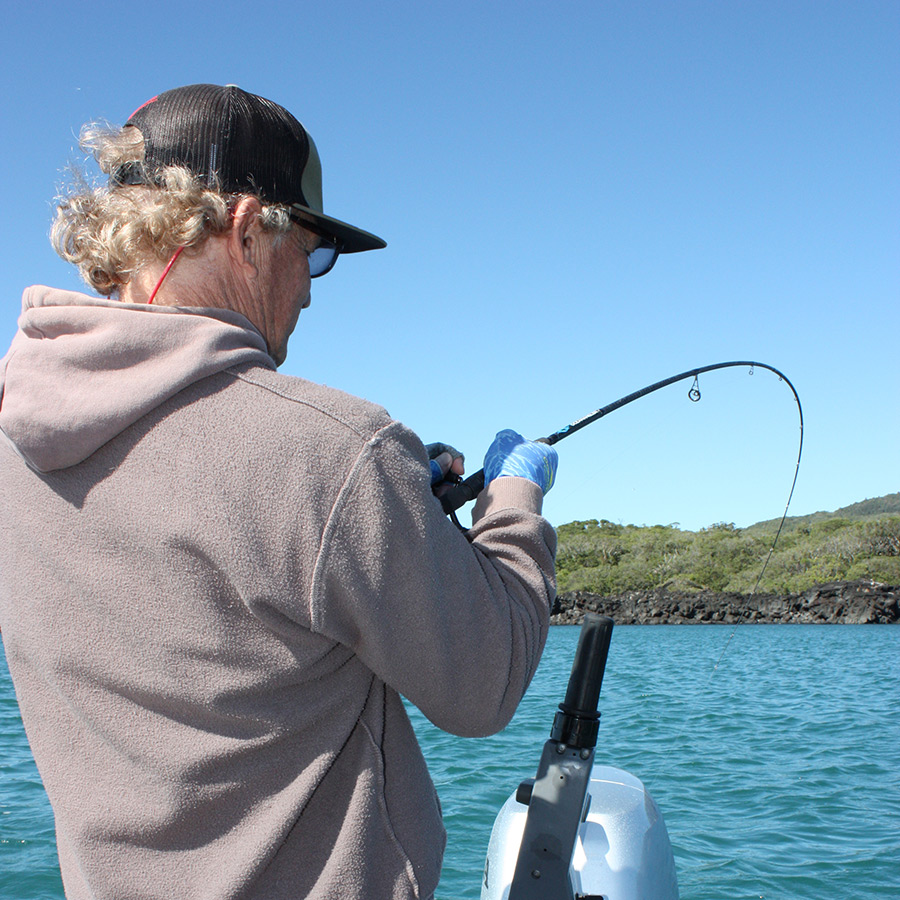
A long, light-tipped rod is ideally suited to fishing micro-baits; having the rod tip buried in the water is a common occurrence!
The scrap!
Now it’s time to fight your fish. Your very light spinning rod should readily bend and act as a shock absorber, but the drag set on the reel still needs to be pretty forgiving or the hook could bend out, especially on big fish. At a guess, I’d say mine would be set to around a kilo of pressure. I treat my line as if it’s just 3kg and find that keeps my hook unbent and my reel screaming!
If you have a mate on board, you might need to act as a team at times, especially if the fish is obviously large and the seafloor is not as clean as you’d like it to be. Having someone at the helm chasing the fish and trying to keep the line reasonably vertical (so it’s less likely to come into contact with structure) will make a huge difference to a successful outcome. The helmsman can also take a share of the angler’s glory!
In the next part of this series, I’ll be sharing the good reasons to downsize your jigs!

March 2023 - Mark Kitteridge
New Zealand Fishing News Magazine.
Copyright: NZ Fishing Media Ltd.
Re-publishing elsewhere is prohibited
Fishing Reports Visit Reports
Outer Hauraki Gulf Fishing Report 17/09/26
Spring wind the handbrake. Spring is starting to make its presence felt in the outer... Read More >
Top of the South Fishing Report - 17/09/26
Early snapper in Tasman Bay. Well, spring is finally here, and the days are getting... Read More >
Bream Bay Fishing Report - 17/09/26
Good snapper catches reported. After Tangaroa turned off the fish tap for a month or... Read More >
Bay of Islands Fishing Report - 17/09/26
Pacific bluefin tuna for the lucky few. The last fortnight has seen more fishable days... Read More >



Sunday 27 September 2026
Major Bites
 -
- Minor Bites
 -
-  -
- Monday 28 September 2026
Major Bites
- - Minor Bites
- -
Comments