
Combating swell when surfcasting
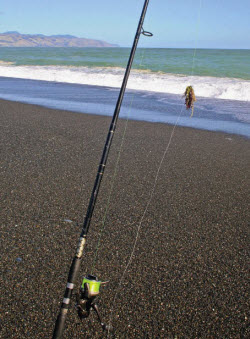 A heavy swell is perhaps the biggest challenge Mother Nature throws at the surfcaster.
Of course there is a point where too much swell will write off fishing altogether, but up until then there can be very good reasons to fish, because a good ‘stir up’ will often bring fish on the bite.
In particular I think of the spotted smooth-hound, a tough-fighting customer that comes right into shore in dirty, heavy surf to feed on dislodged paddle crabs. Kahawai and snapper will also feed freely in a swell, so long as the water stays clean. I’ve also been lucky enough to land a fat quinnat salmon in these conditions.
Keeping a hook, line and sinker ‘out’ in water resembling a washing machine presents obvious challenges, but on some days having the skills to overcome the difficulties will mean the difference between fishing and not fishing at all. Many times I’ve seen fellow surfcasters leave the beach, frustrated by the conditions, and end up missing some first-class fishing. With a few tricks and attention to detail, they would have been just fine.
Here are a few techniques I employ to combat heavy swell on steep beaches (although some tactics are equally applicable on shallower surf beaches) such as Whakaki in Hawkes Bay, Hawai in the Bay of Plenty, South Island east coast beaches, and Palliser Bay in the Wairarapa. With a few smarts, these steep sand and gravel beaches can be fished in up to three metres of swell. In such conditions the two main factors to overcome are weed and current; I’ll deal with each in turn.
Dealing with weed
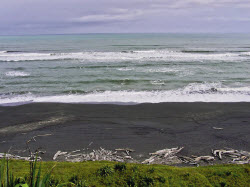 Big swells remove weed from adjacent reefs and wash it into the surf zone. There it plays havoc with your fishing efforts, catching on line and anything irregular, such as leader knots, swivels, clips and hooks. Before long you can have several kilos of weed wrapped around your gear and no chance of catching fish. Sometimes you can’t avoid weed, but you can take steps to minimise its effects and buy yourself a little more effective fishing time.
•Cast long – weed tends to concentrate right in the wash zone, so a long cast into deeper water will help you stay out of trouble. This is not dry-land casting either, often it’s casting on a steep gravel incline with white water washing around your knees, so grit your teeth and punch into it!
•Avoid slack line – leaving slack line in the water is a sure-fire way to tangle up in weed or have your line buried in the shore dump. My normal approach to this is to stay in my casting position (down at the water’s edge) until I feel the sinker on the bottom. I then re-engage my reel’s gears or bail-arm, raise my rod tip and start winding up slack line. When I come up hard against my sinker, I will then ease off my drag and slowly walk back to my rod spike, all the time keeping my rod tip high.
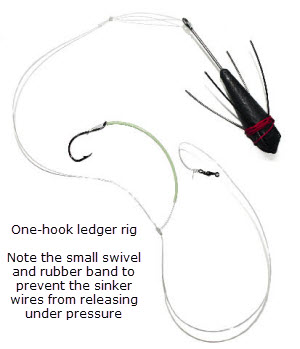
•Streamline and simplify your tackle – as noted above, weed quickly catches on anything irregular, so it is worthwhile minimising the number of swivels, hooks and clips on your rigs. I favour a basic one-hook ledger rig with a short dropper and smaller than usual swivel: swivels made for 2-4kg line are ideal (remembering this is not the breaking strain of the swivel). Under normal conditions this would not be my chosen fishing rig, but in heavy seas beggars can’t be choosers. Conversely, I don’t recommend the use of long distance ‘clip-down’ or ‘pulley’ rigs, because the advantages they give you in terms of added casting distance will be quickly cancelled out by weed catching on the extra clips and appendages associated with these rigs.
Dealing with current
 Current requires a wider range of techniques to overcome. It tends to drag horizontally on your line and will wash everything up the beach along from your position if you don’t combat it effectively. Particularly important is your approach on the beach and choice of rod and line weight.
Here is what I do:
•Fish straight – fishing directly into the swell (i.e. at 90 degrees) is critical to minimising the amount of drag the swell imparts on your line and gives a better chance of keeping your bait stationary. Precision is the key here, and often a margin of error of no more than five degrees is what’s required. Too much line presented across the angle of incoming waves will see you swept up the beach very quickly. If you have trouble achieving this sort of accuracy with your casting, you can move your rod spike so that it is directly behind your sinker. You will also often find that a horizontal current will move your sinker left or right before it hits the bottom, so your casting angle should take this into account.
•Stay anchored – break-out sinkers are a must, but you may also have to wrap your sinker wires with a rubber band to prevent them releasing under pressure (as they are designed to do). Ultimately, this means that prising your sinker off the bottom can take a lot of effort, but that’s better than not fishing at all! I would also recommend a 6oz sinker; I normally use 4 or 5oz, but the extra weight really helps in heavy seas.
•A high, soft tip – keeping your rod tips high above the surf is important, so pay special attention to setting your rod spike vertically to maximise height. For the same reasons I’d also recommend a minimum rod length of thirteen feet (3.97m) and a nice long rod spike. To keep your rod tip reasonably still, you will need to wind up tight on your break-out sinker, so I firmly recommend rods with soft tips. This helps absorb the energy of incoming waves, stopping your sinker from ‘popping’. Stiff, performance-casting rods generally don’t perform well at this.
•Medium line weight – some people prefer using 15kg line in heavy seas, arguing that its thick diameter is needed to survive the inevitable sand and gravel abrasion. My view is that the extra diameter reduces casting distance and increases drag, two things you don’t want. I prefer 8kg line with a short 40lb shock leader. This gives me some protection at the ‘business end’, but a thinner line diameter to minimise drag. I can honestly say this has never cost me, including during several drawn-out fights with spotted smooth-hounds over 10kg.
•Rotate baits regularly – successfully casting bait into fish holding water and keeping it there is an achievement in heavy seas, but unfortunately it’s not enough to rest on your laurels once this is done. Baits wash out very quickly in these conditions, and on top of that your sinker may become buried if you leave it out too long. I’d recommend winding in and recasting every 10-15 minutes, although the exact time will depend on the beach and conditions, so you need to monitor this on the day and adapt as required.
It goes without saying that the right attitude is important. It takes persistence and physical effort to fish into a swell. Even if you employ all the tactics above, you will still have to spend time removing weed from your line and you’ll be constantly winding in casts that never settled on the bottom. But the rewards are there for those who persevere.
My best memories of fishing in heavy seas are of hook-ups on big spotted smooth-hounds. These fish suck in and out on the big swells, taking up to twenty minutes to land, and give the angler a real workout.
 |
This article is reproduced with express permission of
written by Andy Macleod - 2011 Originally published in New Zealand Fishing News |
Fishing Reports Visit Reports
Outer Hauraki Gulf Fishing Report 17/09/26
Spring wind the handbrake. Spring is starting to make its presence felt in the outer... Read More >
Top of the South Fishing Report - 17/09/26
Early snapper in Tasman Bay. Well, spring is finally here, and the days are getting... Read More >
Bream Bay Fishing Report - 17/09/26
Good snapper catches reported. After Tangaroa turned off the fish tap for a month or... Read More >
Bay of Islands Fishing Report - 17/09/26
Pacific bluefin tuna for the lucky few. The last fortnight has seen more fishable days... Read More >


Saturday 26 September 2026
Major Bites
 - -
- - Minor Bites
 - -
- - Sunday 27 September 2026
Major Bites
- Minor Bites
 - -
- -
Comments