
Choosing the Right Bait for Surfcasting
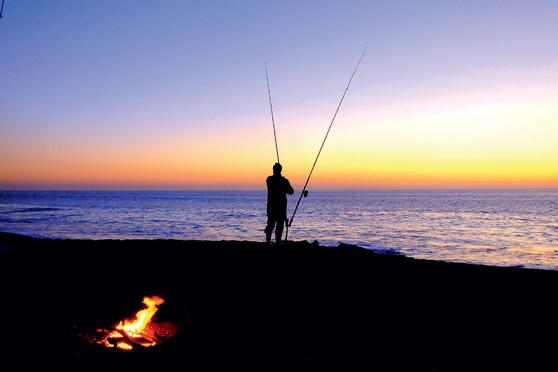
Bait choice, whether you are land or boat based, can make the difference between putting a good feed in the bin, or heading home empty handed. Bruce Basher shares three of his favourite baits when surfcasting the big beaches…
Let’s say you’ve arrived at your favourite big beach and it’s pretty much devoid of any other human presence. You’re in your 4WD vehicle loaded with all your surfcasting gear and heaps of bait, so you can claim just about any spot you like.
The weather and sea conditions are perfect for a good day of loading up your chilly bin with fresh fish. The holes and channels, as they have done many times before on this beach, are just screaming out for a bait or two.
Because you have fished there a number of times you know the fish usually move about a lot in their hunt for a feed. At other times they’ll hang about at a certain spot and the world is your oyster if you can find it.
It’s a situation where bait choice could be all the difference between a big grin and a big drop lip on the journey back home. It needs to be something that fish will spot easily or is smelly enough for them to hunt down.
Berley deployment is just about useless because the currents and wave action disperse it about as randomly as Uncle Don’s “fake news!” With a quiet nod of your head you agree with yourself that the right bait choice today will be paramount to success. Luckily, you’ve brought along a big variety, and plenty of it!
However, bait choice isn’t the only thing to think about – how the bait is placed on the hook or hooks is just as important, and can make all the difference.
Choosing and presenting your bait
On big open beaches I like to start off with big baits – great big stonking smelly ones, like mullet guts if you can get it, and with some sort of bling as well! Fish baits such as mullet guts, pillies and tuna only stay out about 20 minutes or so to lessen the chance of rays and sharks picking up the scent and finding the bait. I drop the next cast in a different position to break up the scent trail.

A big open beach just waiting for a surfcaster to take advantage of it.
If your target species is “on the take” right from the start then you can change baits to suit that species. For instance, if the desired species is snapper and the first one grabbed a pillie, you know you can change the bait to octopus or squid to lessen the ray and shark uptake.
For larger bait presentation I prefer a trace with two fixed hooks. One is right on the end as usual and the next snelled on further up the trace. This is often referred to as a fixed keeper and is the “go to” when using whole pillies, anchovies or strip baits.
With two hooks spaced out along the bait there is a better chance of a fish getting pinned by at least one of them. The point and gape should be well clear of the bait, especially if you use circle hooks.
If this beach has a solid resident population of shellfish then it would make good sense to utilize something the resident population of fish are used to eating. This sort of bait appeals to the moths in my wallet too as it’s free!
If you are able to score some before fishing time, shuck the shellfish and put the ones you don’t immediately eat into an ice cream container with plenty of sea salt. The salt draws out a lot of moisture from the shellfish which toughens them up for a more secure placement on the hook.
I like to use either Bait Buddy or sewing cotton to bind them on. You can use this to bind on any sort of bait but don’t overdo it. Use just enough to hold it onto the hook without making it look like an Egyptian mummy!
Octopus or squid baits are the way to go when you decide to “set line” your bait for a while, especially on an incoming tide. Do this if you find you’re only just able to cast to that hole or channel, or if the incoming tide will soon make this impossible.
These baits are tough and will resist the attacks of small fish. If you’ve skinned the octopus beforehand – and you really should have – it’s white colour is an attractant in itself. Add some way of making it a little buoyant and this bait will just scream out “mealtime” to a big fish.
Making any bait, not only octopus, more buoyant is easy but requires a little bit of prior preparation. Remember Steve Bryan’s six “P’s”: “Prior Preparation Prevents Piss Poor Performance!”
Bind a piece of closed cell foam to the underside of the shank of the hook. This does need plenty of bait elastic to stop it swivelling. Pushing the eye of the hook hard down into the foam helps with this too.
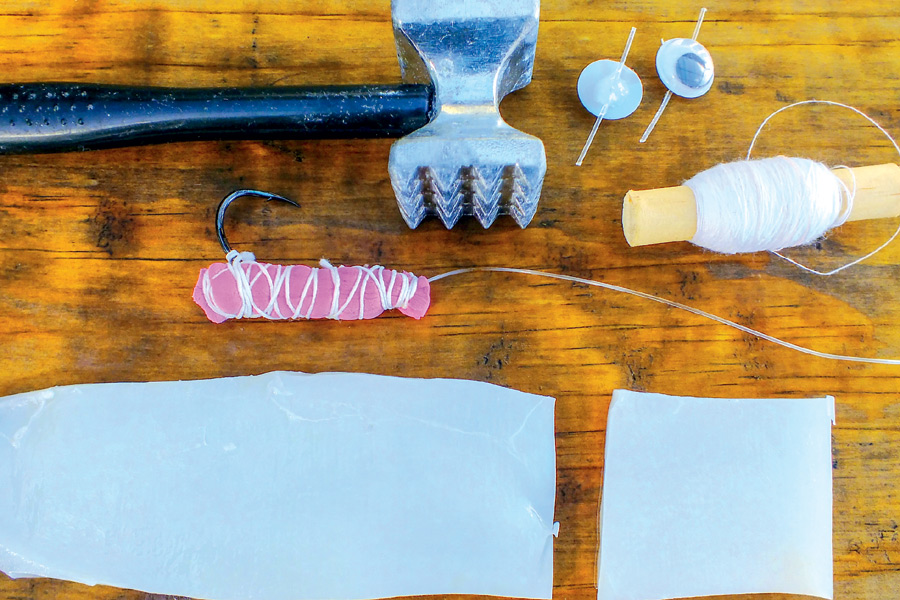
Binding a piece of closed cell foam to your hook makes the bait more buoyant.
The foam I used was cut from one of my wife’s gardening kneeling pads. I had to do a quick stealthy trip to Mega 10 to replace it before she found out – such are the dangers of being a dedicated surfcaster!
All you need to do now is bind your bait on over the foam, making sure to keep the hook gape and point well clear of it. In the water the foam should make the bait move about a bit more, just enough to catch the eye of something that might just make your day!
Fillets of pilchards, placed skin- side in, work well when bound onto the foam. Because a lot of blood and fish oil comes out of the flesh remember to change this bait regularly unless you want to tangle with rays and sharks.
Flatten out octopus or squid baits a bit with a meat hammer before placing on the hook. This makes it a lot easier to wind around the hook without blocking the gape of the hook. Little bits of flesh will break away in the water, creating a small berley trail.
My favourite baits for a big beach are therefore pillies, anchovies, squid, octopus, shellfish, mullet guts and strip baits of trevally, mackerel, mullet, tuna and fresh kahawai. These are probably no different to what most surfcasters use but, as with a lot of things in life, it’s what you do with it that counts.
If you find binding a bit of foam to a hook a bit tedious or you’re using strip baits, try adding some small, round, coloured floats to your trace. Not only does this add movement, but it also adds some eye catching “bling” to the bait.
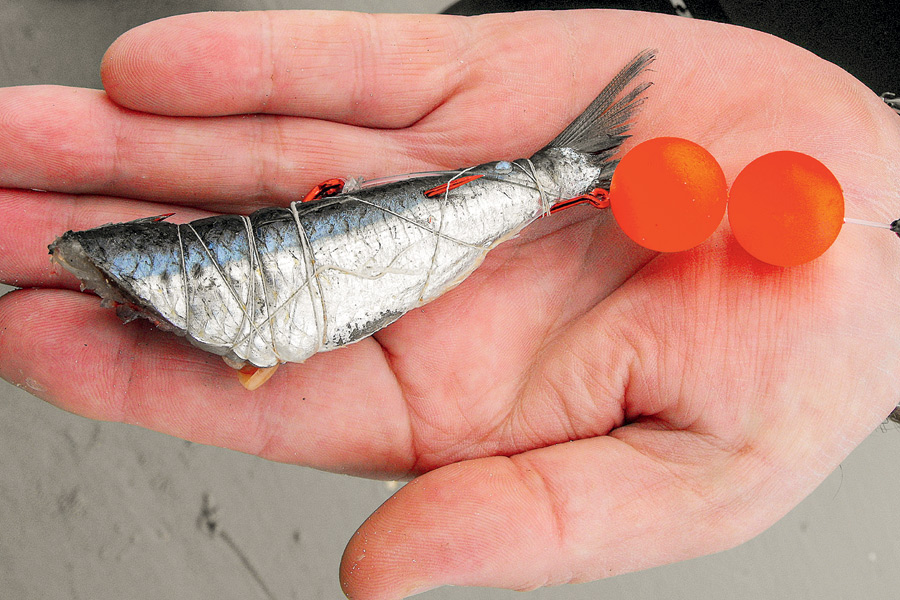
Coloured floats add buoyancy and bling to your bait.
Adding other types of “bling” will make your bait more noticeable. Bright coloured beads and little octopus imitations are all the rage these days. If you think about it, the options are just about endless. Remember though, leave some fish for me! I had my three score and ten just over two years ago, so father time has slowed me down a little! “Just a little,” I said!
|
|
|

Fishing Reports Visit Reports
Tauranga Fishing Report - 28/05/26
Tarakihi on the bite Trips are few and far between at this time of year,... Read More >
Canterbury Fishing Report - 28/05/26
Fresh and salt turning it on! It is not very often I get to say... Read More >
Bay of Islands Fishing Report - 28/05/26
Lures paying dividends We finally had a break in the SE winds that have been... Read More >
Manukau/West Coast Fishing Report - 28/05/26
Snapper and gurnard in the harbour The weather has finally taken a turn for the... Read More >


Major Bites
Minor Bites
Major Bites
Minor Bites
Comments