
Choosing a surf rod
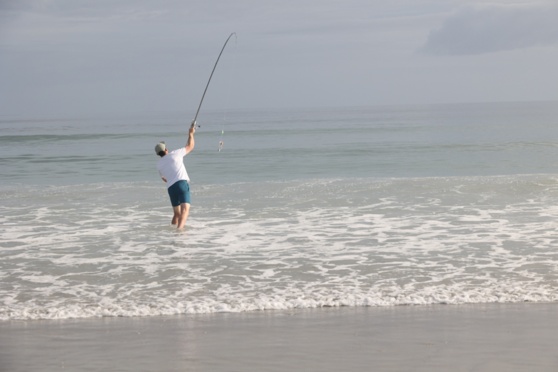
I'm currently in the market for a couple of new surf rods. My trusty 14-and- a-half footers (4.42m) have given me great service over ten years, and having spent so much time with them, they’ve come to feel like an extension of my arms on the beach. The idea to replace them has therefore come slowly and reluctantly.
But needs must, so I’ve dipped my toes back into the market, resulting in a useful re-education regarding the ins and outs of surf rods for New Zealand conditions.
I fish fixed-spool (spinning) reels, but my observations below apply broadly to freespool fishermen, too, with the main difference between the two types being guide diameter and configuration.
Rod length
I don’t consider anything under twelve foot (3.66m) in length a true ‘surf rod’ for New Zealand conditions. Ten and eleven footers have their place from reclamations and wharves, but simply aren’t long enough to hold the mainline above oncoming waves in open-coast situations. Indeed, even twelve footers don’t cut the mustard in anything much more than than pancake-flat conditions.
At this short end of the range, there isn’t a wide range of quality rods available here, but they aren’t unheard of. Conversely, there is a wide range of cheaper rods available at this length. A couple of important aspects to take into consideration include the recommended casting weight (twelve footers are often rated to cast only light weights of 100g, say, which can be very limiting when attempting to cast big baits into the tide), and the fact that most are two-piece rather than three-piece rods, presenting potential difficulties for storage and transport.
The majority of mid and highend surfcasting rods in New Zealand are in the 13–14.5’ (3.96–4.42m) length range and three-piece in construction. These lengths suit most opencoast scenarios in New Zealand – long enough to keep line above oncoming waves, but not so long they are cumbersome to cast. The only limitation worth mentioning is that at the bottom end of this length range (thirteen feet), they won’t be quite long enough to cope with swelly conditions.
Rods of fifteen feet and over are relatively rare in New Zealand, but can be picked up in stores specialising in surfcasting. The main application I can see for these rods is keeping a high rod tip on shallow surf beaches where your fishing position is only slightly higher than the waterline – places such as Ninety Mile Beach. Serious dryland casters tell me there is no casting advantage to be gained from such long rods, and I’m inclined to believe them. Also, at this length I struggle to wield them in a co-ordinated fashion.
To my mind the main considerations to balance include: sufficient height to keep the line above the oncoming waves typical in your area, and having a rod length that you feel comfortable casting with. I’m personally attracted to something as short as I can get away with in the conditions – the longer rods get harder to co-ordinate during the cast and when feeling for biting fish prior to striking. A third consideration concerns the rod’s section lengths for easier storage and transport, so whether it comes in two or three pieces can make a big difference. For this reason, onepiece surf rods are rare these days.
Action
The rod’s action (i.e. whether it is stiff or soft and how the blank bends) determines whether it is a good casting rod or ‘fishing’ rod or both. Carbongraphite dominant rods with thick walls possess the power to cast long distances, which is critical if you want to become a serious surfcaster and reach deeper, fish-holding water. By comparison, cheaper, glassdominant rods return to shape very slowly after the cast and severely limit casting distances.
However, it’s not all about power. It is also important to put a discernible bend in your rod when set in the rod spike, so you can detect slack line should a fish pick up the bait and swim towards you. Ideally, you have a rod with plenty of power down low in the blank to aid casting and apply pressure to big fish, and a softer tip for applying that discernible bend. The softer tip also means you can set the rod against a sinker (normally a break-out sinker in surfcasting) without tightening the line up like a guitar string, which is beneficial for hooking wary fish. Rods that achieve all the above are genuinely ticking both boxes and are more expensive – generally above $700 in New Zealand.
If your budget is a bit limited, my advice would be to buy a stiff rod – you can get a powerful, robust graphite rod for around $200. You might lose the odd fish because you fail to detect bites or, conversely, the fish detect too much tension, but you will be able to reach the fish in all surfcasting scenarios here.

Rod design
There’s only so much room for design flair with something so utilitarian as a surf rod, but the main one involves the blank diameter. The main innovation over the last ten years has been the use of high-tech materials that allow genuinely slimline blanks to still possess good casting and fish-hauling power. These contrast hugely with the fatter blanks that preceded them, offering real advantages over long sessions because of the reduced weight and ease of swinging them around in windy conditions. They are also less affected by the wind, so stay stiller in the rod spike than fatter blanks (extremely useful for spotting subtle bites).
Componentry
Like all other types of fishing rods, be sure to look closely at the componentry – the guides and reel seat especially – before buying. Componentry on surfcasting rods can be of the cheaper, lower quality variety, even on expensive rods in this country. Whilst surfcasting is not tough on componentry relative to other fishing styles, quality componentry is still worthwhile. (I have been known to have new guides put onto off-the-shelf surf rods.)
The butt section is also worth checking, as this area comes into contact with rod spikes, generally resting heavily against them when the rod is pulled up tight against a breakout sinker, as well as having to absorb heavy runs from big fish. Nowadays, some rods have rubber protection around this area, but some don’t; wrapping it up with duct tape or an old bicycle tyre tube is recommended to prevent gradual blank damage.
Rod care
Quality surf rods are fairly robust, but can get bashed around a bit during transport. They also get plenty of dunkings in salt water, especially in wading scenarios. Of course, even in good conditions the returning line sheds saltwater around the guides, and failure to rinse them can see them corroding in short order. I’m pretty rough and ready with my rods, but do a few things that prolong my rods’ life, including:
• Washing them down with fresh water to remove sand and salt from the guides, reel seat and inside the blanks.
• Occasionally using CRC to remove moisture and prevent guide corrosion.
• Taking care not to damage the rod-blank walls during transport and in storage.
• Regular removing the reels from the rod and screwing the reel seat back and forth to prevent seizure and damage.
• I’ll give my rods a proper soap and scrub now and again, but when they are in constant use I’m not concerned about dried fish scales etc; they can wait for winter. My maintenance and care are purely about keeping the rods in functional condition and preventing longer-term damage.
Rod availability
New Zealand has a small and widely dispersed surfcasting fraternity in international terms, and this is reflected in the limited range of quality rods available in most fishing stores. For this reason, many serious New Zealand surfcasters import quality rods and blanks – particularly brands like Daiwa, Century and ZZiplex – from the United Kingdom and South Africa. However, I don’t think this is really necessary; a bit of shopping around and checking what’s available in New Zealand via the internet will get you what you need. My own new rods will probably be thirteen-foot rods sourced from a local retailer.
I suspect this article might be of greatest interest to people who are looking to move into serious surfcasting for the first time, so here’s my recommendation for you: get yourself a pair of basic, stiff, carbon-graphite rods of thirteen-foot length. These will allow you to reach more fish, more regularly, and should only set you back about $200–250. A couple of rods in this category include the Okuma Solaris (a popular model for ten years or so) and the more recent Abu Garcia Veritas.
Later, if you achieve some success and want to move up in quality, you won’t have spent a fortune and may even be able to sell them second hand to get some of your money back.
|
|

Fishing Reports Visit Reports
Bream Bay Fishing Report - 29/10/26
'Softly softly' approach to workups. Now is the time most inshore snapper fishers dream of... Read More >
Rotorua Fishing Report - 29/10/26
Fantastic fishing set to only get better! The fishing around the Rotorua region has been... Read More >
Eastern Coromandel Fishing Report - 29/10/26
Kingfish, snapper and crayfish on the menu. The anticipation is building as we find ourselves... Read More >
Tauranga Fishing Report - 29/10/26
Fishing and diving heating up. Let’s start on a positive note this week, as water... Read More >


Monday 2 November 2026
Major Bites
 -
 -
Minor Bites
 - -
Tuesday 3 November 2026
Major Bites
- - Minor Bites
- -
Comments