
Chasing big fish on live baits

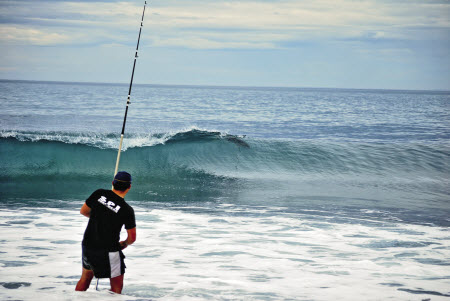 The most important part of slide-baiting is being able to accurately read the water and pinpoint where certain species are likely to pass through or hold at certain times of the tide and day. This sounds difficult, but once you start understanding a few basic aspects and how they interact, it will just be a matter of time before your reel starts screaming and indicates it’s time to put the nerves aside and saddle up!
I will start off by saying this is a great way to target sharks – bronze whalers in particular. Catching big sharks is not really my thing, though – I don’t eat the buggers, so they don’t interest me. However, for those of you who wish to target sharks using this method, I will cover this towards the end.
Target species
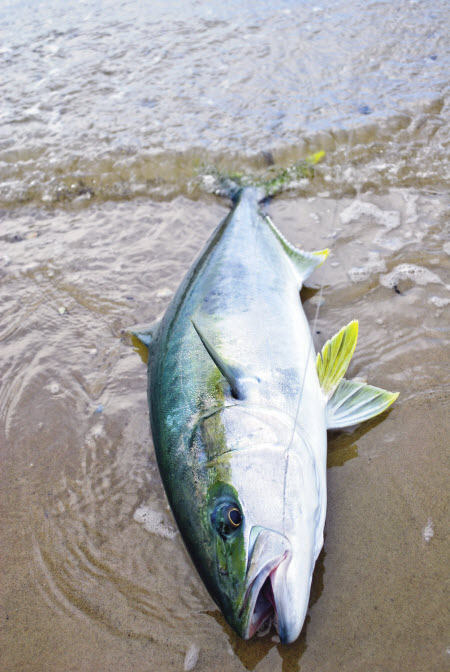 Obviously predators will gobble live baits if they get the chance, but some species are more likely to take certain live baits.
The most prolific live-bait snatcher is the yellowtail kingfish. They are found all over the North Island and around the top of the South. Providing you’re using a suitable live bait, there is every chance of a hook-up; you may well be surprised at how many years you have been fishing around kingfish and never hooked up using conventional surf rigs and baits.
Kahawai are right up there on the list of live bait munchers as well. You guys may be thinking, “You can catch them on bait, too!” but for years I have been slide-baiting competitions and hit the prize list catching the bigger kahawai on decent live baits – they just cannot resist a small fish swimming freely, tucked in behind the waves.
John dory, one of the best eating fish in the ocean, also swim past strip and dead baits all the time. However, this same species can rarely resist an appropriately-sized live bait set in the right place. Known for the distinctive black spot in the middle of their sides, as well as a telescopic-type mouth that extends to inhale surprisingly big live baits at times, this fantastic table fish is one of the most prized species in NZ waters.
Snapper caught on a live bait remains a dream of mine. While I have caught a good one on a ‘live’ bait off the beach, I believe that particular bait died and ended up on the bottom, so it was kind of cheating. However, I have taken some huge snapper off boats on live baits, so it’s just a matter of time before a good one comes along and sucks up a slide-baited live bait.
These four species are the main ones to smack live baits, but there has been plenty of by-catch over the years, too, including huge rays, conger eels, stargazers, barracouta and sharks – to name but a few.
Harbour entrances and river mouths
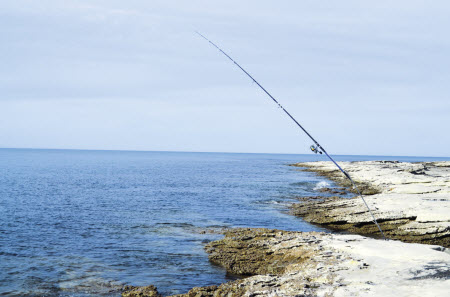 There are several advantages to live-baiting from shore using slides over conventional methods like balloons. In the past, putting live baits out in the surf was nearly impossible in rough conditions – the line got caught in the current or dumping swells and your live bait ended up on the sand pretty smartly.
Using a slide keeps the line out of the current and allows the live bait to get out without much stress, aided by minimal drag being placed on the leader.
Admittedly wind can be a factor when blowing strongly onshore, but with experience you’ll find ways to overcome this challenge.
Fortunately, all the target species can be caught in the same areas when fishing off beaches; the key thing to look for in this instance are concentrations of baitfish. Baitfish tend to consistently congregate in close along the inner channels whenever freshwater is present. Scenarios that fit this description include river mouths and harbour inlets. Good currents are present in such places, and baitfish tend to accumulate in amazing numbers at certain phases of the tide.
The top three hours of the tide, when the current is in full cry, is the optimum time to catch kingfish.
Kingfish can also be caught on the outgoing tide, positioning themselves in the calm water of eddies for when baitfish such as kahawai and mullet run the gauntlet towards safety. Such locations offer the best places to set live baits.
Also, over the change-of-tide period, an hour either side of high tide, other species such as snapper and john dory start feeding more actively, slipping into these areas which are less accessible when the current is zipping along.
Slide-baiting from wharves
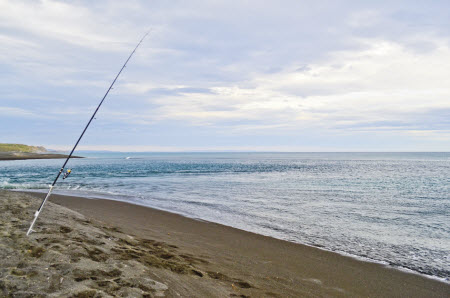 Harbour currents can be immense at times. In some cases over 60% of the water’s mass leaves a harbour, which can make live-baiting very difficult. Using slides in this situation eliminates most of the problems associated with current and can even be used to your advantage, enabling reasonable control of the depth of water your bait sits in, as well as allowing you to place it with great accuracy in the strike zones.
Wharves are very interesting; they are similar to river mouths in that eddies are the key. The still water around wharves is created naturally on the down-current side of the wharf. Baitfish sit in good numbers behind wharves in the still water created by the piles. Kingfish, kahawai and john dory in particular hunt their prey by tracking in close to the banks and striking the fish in the eddies created by the wharf. Therefore it is important to position your livies reasonably close to where the bulk of the baitfish are sitting. The stragglers at the back are always particularly vulnerable, so this is an excellent place to position your bait.
Slide-baiting off the rocks
While slide-baiting from rocks over sand is great, if it’s foul a little bit more attention is needed. Conventional methods – like a balloon – are an option in this situation, but you spend a lot of time holding the rod, so lose valuable snapper-fishing time!
The key is to use a ‘rotten bottom’ between the split-ring and sinker. A rotten bottom is the term used when a lighter line than the mainline is used to attach the sinker. Then, if the sinker snags up and won’t come free, you can break it off and still land the fish.
This is one of my favourite ways to fish off the rocks, placing my live bait exactly where I want it and continuing to fish for snapper while waiting for that kingfish to come along.
There are several key locations to fish. Bays are one, especially sheltered, clean bays where baitfish sit out of the current and hold in good numbers. These places often attract good numbers of predatory fish such as dory, kingfish and kahawai.
The second key area to look for is a point with good water depth and current passing through it. This will also attract kingfish, and by using slide-baits your live bait will be held right in the middle of the current, in the critical strike zone.
The third place to look for is my favourite: fishing over a shallow rock shelf, where baitfish sit out of the deep water over the high tide to hide from predators. Kings come rocketing up and over these shelves to smash the bait when the tide is right, providing awesome surface action!
In the next instalment, we’ll take a look at rigs, how to place your live baits in the critical areas, and explain how to catch and care for your live bait. This is important, because without them, you’re not going to catch much!
 |
This article is reproduced with express permission of |
Fishing Reports Visit Reports
Outer Hauraki Gulf Fishing Report 17/09/26
Spring wind the handbrake. Spring is starting to make its presence felt in the outer... Read More >
Top of the South Fishing Report - 17/09/26
Early snapper in Tasman Bay. Well, spring is finally here, and the days are getting... Read More >
Bream Bay Fishing Report - 17/09/26
Good snapper catches reported. After Tangaroa turned off the fish tap for a month or... Read More >
Bay of Islands Fishing Report - 17/09/26
Pacific bluefin tuna for the lucky few. The last fortnight has seen more fishable days... Read More >


Saturday 26 September 2026
Major Bites
 - -
- - Minor Bites
 - -
- - Sunday 27 September 2026
Major Bites
- Minor Bites
 - -
- -
Comments