
Casting to feeding fish

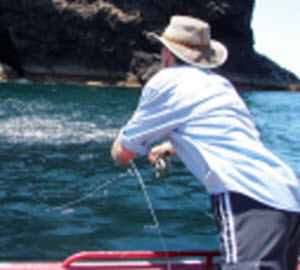 It was a Gary Kemsley article from the halls of antiquity written when yours truly was still a child (and Gary could still remember having been one). Nevertheless, it was an article that delivered great inspiration, especially for a developing kingfish dreamer.
The article was simple enough: Gary departs from Taupo to toss great chunks of metal (the fabled ‘Irons’ were hot lures in those days) at kingfish feeding around a Coromandel Peninsula harbour-mouth. Yet there was something in it that struck a chord: the escape from inland hills, the excitement of casting to baitfish-chasing predators, and the thrill of landing a decent kingfish on a lure off the beach.
I was to emulate these actions for many years following. Nothing – but nothing — could dull the excitement of casting to feeding fish. Kingfish were preferable, but kahawai were by no means sneered at. Even barracouta got the blood running, especially when rare schools of snakes were found feeding close inshore.
From a boat the trend continued: trolling left me a little cold, and bait-fishing tested my patience, but show me a school of feeding anything and I’d soon be casting myself into a lather. And they didn’t have to be baitfish-munching predators. Some of the most exciting school fish are the big pods of large slimy mackerel that exist offshore. These guys erupt on the surface with a roar, and churn the water to foam. I have never bothered to find out what they are feeding on as they are suckers for any sort of artificial lure cast in their midst – any small chrome casting bullet does the trick. The skill is in manoeuvring around a slimy school without putting them down.
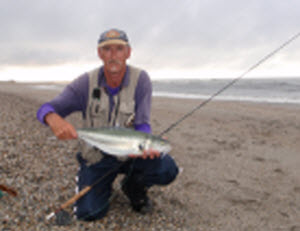 And albacore were pretty cool too. I haven’t seen any great albacore action since the cool El-Nino years of the mid-nineties but remember well the small groups of squawking muttonducks cart-wheeling over vertically stacked schools of flying albacore that were keen to munch on a well-placed jig. In those offshore waters I was always far keener to throw hardware at smaller schooling species than bore the day away dragging plastic. And so it remains.
These days I find myself wading local mudflats trying to put ‘smelt’ flies over the top of feeding kahawai. This is torrid stuff, and every bit as exciting as any kingfish teasing session I may have enjoyed from the shore in years past. The reason lies in the fishing style (saltwater fly-fishing or ‘swoffing’) and the way the kahawai hit the bait. The water is extremely shallow and quite dirty, so the kahawai hang back in deeper water to make lightning raids on the baitfish schools huddling in the shallows. When this happens, all Hell breaks loose. Kahawai erupt everywhere – to my left, to my right, fair in front of me and I end up casting like a madman and invariably put the fly in the wrong place. A rapid strip of the fly-line sees the fly airborne and repositioned in a flash. Often it doesn’t help; the fish shift fast and your fly can easily be in the wrong spot again. Because the shallow mudflat water is quite turbid, your fly has to be right on the money in order to be seen. However, if you do miss out another baitfish carve up won’t be far away.
The first night I found these fish there was a howling easterly wind blasting straight across the mudflat. The wind pushed into one corner of the mudflat and trapped the baitfish there. The kahawai had a ball feeding along the edge of the muddy water and occasionally blasting into water inches deep and the colour of chocolate. The fish on the edge of the clear water were a likely target, but I couldn’t hook up. By mistake I’d packed my trout fly box and subsequently found myself throwing everything from Fuzzy Wuzzies to bead-head nymphs at fish that wanted something that was silver and fast moving. In the end I found a gold-bellied Gambusia fly that I ripped the dark body off. This got knobbled at my feet — but only after a huge amount of frustrated casting into a thirty-knot wind (you have to cast low and get ‘under’ the wind). Then, as if to rub salt in my already visible wounds, that fish dropped off and took the fly with it. I discovered later that a locked blood knot should not be used for tying flies to fluorocarbon leaders — it slips; better to use a uni-knot.
I gave up after that, vowing to return the next night with appropriate flies. This I did, hooking two beautiful kahawai that bounded, leaped, and ran all over that mud, restrained only by the ineffectual pressure of my little five-weight rod. They made some quite torrid runs, pulling line well into the backing, despite being only 1.5kg in weight. They were fat fish, and beautifully conditioned. The remnants of juvenile ‘kopapa’ markings could still be faintly seen along their deep-sided flanks. They were bright silver sportfish that I’m sure any foreign visiting fly-fisher would absolutely die for. And the shallow wade-able environment in which they could be stalked and cast to was something else.
The trouble was I couldn’t repeat my early success over the next few days. The wind changed and I spent fruitless evenings chasing momentary boil-ups that were fast and fleeting over the mud. Plenty of kahawai could still be seen feeding actively out in the bay. Obviously, there were specific tide and weather conditions that encouraged good shallow water activity. At this moment I didn’t know what those conditions were, but I guessed that a decent wind pushing baitfish in the right direction had a lot to do with it.
My suspicions about wind-driven baitfish were further strengthened by a boat-fishing experience later that week. We had been livebaiting around the inner islands with only moderate success when a very large work-up materialised on the outside of Tapeka Point. This was a serious affair: thousands of muttonducks worked the water hard while dozens of gannets plummeted in from above. My mate Vance was with me and he quickly hooked up on an Angler jig. I went to work with the big fly rod and kingie popper flies. Very soon there were large explosions all over the fly – big three-kilo kahawai, and lots of them.
Vance held his fish in the water while I teased strike after strike out of the following fish. There was explosion after explosion all over the fly, but few hook-ups. I think I hooked up three times, but every fish quickly dropped off. It’s a bit of a problem with big popping flies on kahawai and no doubt there is some better hook format out there. But then, seeing fish like this boil up behind the fly is half the fun. We weren’t really interested in the kahawai either; snapper and kingfish also had to be associated with this work-up, it was just a matter of finding them. I had high hopes of a big kingie blasting through the kahawai to nail the popping fly. Kingfish seem to hook-up a bit easier on these big flies. Unfortunately, none showed.
The irony of the situation was not lost on me either. Two days before I’d been busting my arse and foaming at the mouth to catch small kahawai over the mud, yet here were bigger fish that we were happy to take or leave. As I’ve said before – the degree of fishing challenge is everything.
Anyhow, the wind roared into life soon after that and scattered the fish. The next day the wind had switched from the northeast to a strong northerly on the face of an incoming front. On a different stage of the tide I peeked over the hill at Longbeach and discovered all the fish and birds we had seen the day before hammering the bait a few hundred metres off the beach.
With a completely opposite tide direction and a wind pounding directly into it, the baitfish had been driven directly into this corner. I could even see a few big brown blobs of terrified anchovies out over the white sand shallows out from the beach. No doubt there was a heap of big fat kahawai whirling up a storm beneath them. I noted the current direction and the wind and went “Hmmmm”. You could almost develop a theory around this. Something like: “baitfish under attack will travel downwind, in a wind over twenty-knots, and at an angle to the direction of the prevailing current”. Obviously, it is impossible to say this absolutely – too many variables are involved. Suffice to say though that any curved bay facing into the wind and a well-known baitfish ground will occasionally trap walls of baitfish and predators within its confines. Indeed, in several places like this I have found situations where the baitfish have been driven right up into the rock pools and been trapped there. It is not that uncommon.
So next time you detect a fresh wind blowing over a local bait ground, think about all those little anchovies in there and how they might just be travelling downwind to their doom. Find the land feature that is going to trap them and some exciting fishing may be yours for the taking.
Mudfish – literally
Northerners can be forgiven for referring to trout as ‘mudfish’. The reason is that our best riverine trout waters are those associated with the Hikurangi swamp and the Wairua River that flows through it. It is not the typical type of ‘trout water’ that springs to mind for the water is often cloudy and silt-stained and the water environment warm and slow moving. Yet there are heaps of trout there, some of them quite large. And during summer, amidst the sweet smell of swamp grasses and pukeko poo, there is an evening rise that has to be seen to be believed — if you can handle the incessant bities and the mayflies that try to blunder up your nose.
T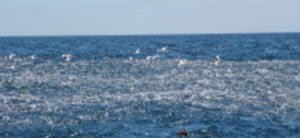 he trout survive despite the ravages of some pretty serious floods and stupid efforts by past Councils to try and contain these floods by channelling them downstream (so that all that silt eventually pours into the Kaipara Harbour). Now at last the Northern Regional Council is conducting a study of the river and all its uses with the intention of preserving water flows and riverside habitats. Such foresight should be applauded and every trout fisher who has ever caught a trout in the north should inform the NRC of this valuable resource we have sitting here in the extensive Wairua River watershed.
The Wairua doesn’t need further channelisation and straightening, rather it would be nice if they fed a bit of water back into some of the old twisty bits and re-energised parts of the old swamp. Also, a word in few farmers’ ears about polluting waterways with hay bale plastic wouldn’t go amiss either. Some of the headwater streams are strewn with the stuff – non-toxic it may be, but downright ugly it definitely is.
That’s my bitch for this month. See ya.
A blast from the past! This article originally appeared in NZ Fisherman magazine – March – 2000
A Blast From The Past!
|
March 2000 - by Craig Worthington |

Fishing Reports Visit Reports
Bream Bay Fishing Report - 29/10/26
'Softly softly' approach to workups. Now is the time most inshore snapper fishers dream of... Read More >
Rotorua Fishing Report - 29/10/26
Fantastic fishing set to only get better! The fishing around the Rotorua region has been... Read More >
Eastern Coromandel Fishing Report - 29/10/26
Kingfish, snapper and crayfish on the menu. The anticipation is building as we find ourselves... Read More >
Tauranga Fishing Report - 29/10/26
Fishing and diving heating up. Let’s start on a positive note this week, as water... Read More >


Tuesday 10 November 2026
Major Bites
 - -
Minor Bites
 -
 -
Wednesday 11 November 2026
Major Bites
- - Minor Bites
- -
Comments