
Caring for Your Catch
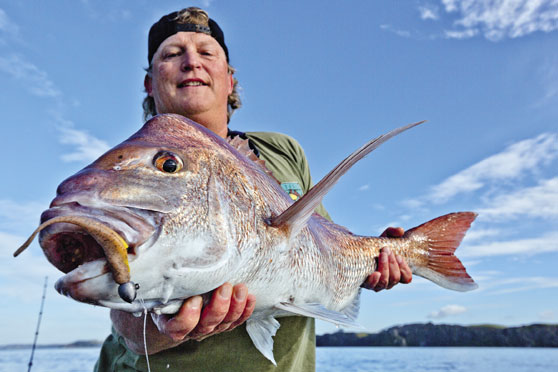
Recent events concerning our snapper fishery have also served to turn the spotlight on snapper mortality caused by both commercial and recreational anglers.
The damage done by the commercial sector tends to be more obvious, with dead fish littering the sea’s surface (and many more sinking down out of sight), but anglers also cause significant snapper mortality – we’re just doing so in a more subtle manner (as I’ll explain further in a moment). Which is almost worse, as this is more due to our attitudes and ignorance than the fishing techniques we choose to use. And, disappointing me even more, many of the ‘high-profile’ anglers and star hosts featuring on television and instructional DVDs are actually setting the bad examples for recreational anglers to copy.
A typical scenario might be as follows:
A big snapper is brought on board, and amidst talk of “limiting your catch, not catching your limit”, you’ll see the lucky angler holding that ‘special fish’ up for the camera with warm, dry hands. Then, after a “Gotta let these big fellas go to breed,” you may see the tip of a rusty knife blade ‘popping’ the intestine protruding from its mouth (pushed there by the expanded swim bladder), perhaps while holding the unfortunate fish against the boat’s hot deck. Next, accompanied by one more triumphant lift for the camera with only slightly less warm, dry hands, there may be a bit of a rundown on how great this fishery is and how lucky we are, before the fish is finally speared back into the water…
Whoops … might come right… Oh well, better cut to the high-fives instead!
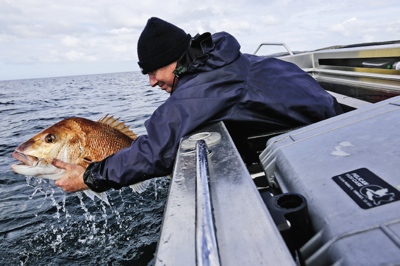
While there’s no doubting the presenter’s often good intentions, several of the above scenarios (just a few of many similarly bad practices) will almost certainly sentence the fish to death. Sure, they may swim away reasonably strongly, but we don’t get to see what happens later, under the sea, when there’s every chance they die a nasty, lingering death.
In the end, an integral part of responsible snapper fishing involves releasing fish in as good a shape as possible. After all, fish that die from the injuries we anglers inflict are a wasted resource (not to mention the suffering we condemn them to).
Functional reasons for releasing fish include them being smaller than the legal size limit or, at the other end of the spectrum, nice big specimens – over six or seven kilos for snapper, say – making them prime breeding fish with the potential to make a significant difference each season.
Whatever the reason for choosing to let fish go, we must look after any destined for release – and not just snapper (although I must admit to failing in this department when dealing with barracouta and spiny dogfish!). The following are my recommendations of how best to achieve this result, and while some people may believe they go too far or are debatable, why take unnecessary chances?
• Successful releases start before starting fishing: select a size of hook that’s hard for an undersized snapper to swallow. I find a 5/0 or bigger J-type hook does the job.
.jpg) • Otherwise, try using re-curved hooks, as they’re designed to catch fish in the mouth; all the major brands – Gamakatsu, Black Magic, Mustad and VMC – have good examples. Once the knack of unhooking fish caught on circles is mastered, these hooks make letting fish go very easy and don’t injure them as much as the other patterns do.
• Otherwise, try using re-curved hooks, as they’re designed to catch fish in the mouth; all the major brands – Gamakatsu, Black Magic, Mustad and VMC – have good examples. Once the knack of unhooking fish caught on circles is mastered, these hooks make letting fish go very easy and don’t injure them as much as the other patterns do.
• Change treble hooks on lures to suitable singles, as they’re easier to take out and do not injure the fish as badly.
• Hold your rod rather than leave it in the rod holder, as you will detect bites more effectively, respond to them more quickly (when using beak/’J’-type hooks) and gut or gill-hook fish less often. Using really long, running-sinker-rig traces (i.e. over two metres) can also result in regular instances of swallowed hooks.
• Unless chasing records, use a weight of line that’s likely to end in a capture rather than a bust-off.
• Make sure a damp rag or towel is handy so snapper – or any other fish – can be handled safely, as well as a pair of pliers or a ‘Hook-Out’ for when stubborn or dangerously positioned hooks must be removed. Boga-grips and similar fish-wrangling tools are also useful.
• Keep in mind that any handling you do out of the water is likely to inflict some sort of injury on your quarry, possibly minor, maybe major. These include:
i) Burns, resulting from the heat of your hands/boat decking/sand/rocks. It may seem strange that fish can often survive having big chunks bitten out of them, yet will succumb to a bit of apparently insignificant heat (usually quite some time after release). However, I’ve seen handprint-shaped infections and ulcerations on the sides of fish with my own eyes!
The remedy: don’t lie fish down on anything hotter than the temperature of the water they’re swimming in. A wet cloth is best for handling fish when out of their natural element; if using your hands, ensure they’re at least well wetted.
ii) Gill filament damage, caused by hands or hooks. Gills allow fish to breathe and are very fragile, so avoid contact with them.
iii) Injury as a result of not being supported properly while out of water. When not in their natural medium, the force of gravity can cause internal parts of fish – especially large ones – to tear under their own weight. If you must handle big snapper out of the water, keep both ends of the body supported.
iv) Holding large fish by the tail for photos prior to release is especially bad. In addition to the aforementioned internal organ stress, this action can dislocate vertebrae.
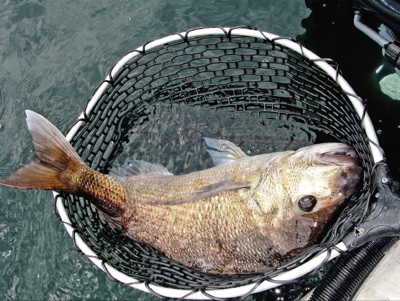
v) Strong fish allowed to thrash around can ‘bash themselves up’ on the deck or on the rocks. Try containing the fish in a soft/rubber-meshed landing net, or if too large for a net, gaff them carefully in the mouth and lift them carefully for de-hooking. Small, vigorous fish can be held under the arm against the body while hooks are removed, with your clothing protecting both you and the fish. It is then a simple matter of opening the arm and making a little thrust with the hip, so that the fish is deflected out past the boat’s side and into the water.
vi) When anglers try to get hooks out from deeply hooked fish, they often cause more damage. Better to cut the trace as close to the mouth as possible.
vii) Embolism, brought about by bringing the fish up too quickly from deep water. This involves the swim bladder inflating so the intestine is forced to protrude from the fish’s mouth. A common mistake is to stab the protruding intestine with the point of the knife to release the air, but this is clumsy, brutal and proven in some cases to result in death later on. The only really effective way to allow the air out is by using a syringe needle — an item, I daresay, not carried by too many boats or land-based anglers! And it also needs to be inserted into the fish’s abdomen in the right place and angle, so it’s not an easy thing to do right…
Or, if the embolism appears slight (i.e. the fish can still flap around), you may be able to simply ‘spear’ the fish down into the water, with the valuable metre or so of depth gained being enough of a head start for them to continue on down to a depth where they can equalise naturally. However, have the gaff or net handy in case of failure. And if you can’t be bothered with the process of
.jpg)
rectifying embolism correctly, it’s irresponsible to carry on fishing for snapper you don’t need in deep water!
viii) Suffocation. Occasionally de-hooking and/or the photo session take longer than is good for a big fish (and some species are more susceptible to oxygen deprivation than others). A hopeful toss back can see the fish floating upside-down on the surface and vulnerable to predation by sharks and birds. The simplest way to avoid this is by ensuring the release is as quick as possible. Otherwise, expect to spend time ‘swimming’ the fish until it recovers enough to swim off by itself.
ix) Severe injuries from the hook – generally caused when fish are foul-hooked or have deeply swallowed the bait. If the fish is brought aboard badly bleeding, or perhaps with some of the belly ripped and intestines exposed, or an eye destroyed, providing these fish are legal and do not put you over your limit, they are best killed and kept.
So how best to kill your fish quickly and humanely? An ‘iki’ spike or Iki-gun works well; for snapper it should be positioned just outside the bony ridge above the eye, and slanted at an angle so it penetrates to a point approximately slightly to the rear and midway between the eyeballs.
 If you get it right, the fish will shudder and stiffen, the gills flaring, then stay still. If not, try again until you get that result.
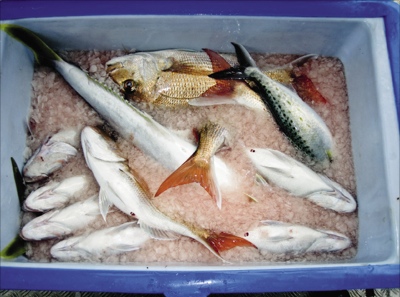
Now place the fish in some salt ice, which can be improved further by adding a modest amount of salt water, forming a slurry.
I don’t know about you, but at this point I start thinking about all the different ways I’d like to prepare my catch – and that is the topic for next month’s article.
Soft-plastic lures nearly always hook fish in the mouth, so it’s easier for anglers to unhook and release the bigger in good shape.
 |
This article is reproduced with express permission of written by Mark Kitteridge - 2013 Originally published in New Zealand Fishing News |
Fishing Reports Visit Reports
Outer Hauraki Gulf Fishing Report 17/09/26
Spring wind the handbrake. Spring is starting to make its presence felt in the outer... Read More >
Top of the South Fishing Report - 17/09/26
Early snapper in Tasman Bay. Well, spring is finally here, and the days are getting... Read More >
Bream Bay Fishing Report - 17/09/26
Good snapper catches reported. After Tangaroa turned off the fish tap for a month or... Read More >
Bay of Islands Fishing Report - 17/09/26
Pacific bluefin tuna for the lucky few. The last fortnight has seen more fishable days... Read More >



Saturday 26 September 2026
Major Bites
 - -
- - Minor Bites
 - -
- - Sunday 27 September 2026
Major Bites
- Minor Bites
 - -
- -
Comments