
Broadbill Swordfish - Tips from the Experts

In a 30-year career in fishing media, I visited many offshore and local destinations where I slowly ticked off my bucket list species, but for a long time there was one that eluded me – a broadbill swordfish.
When it finally did happen, it was a bit of a letdown.
In what was a final hurrah with the NZ Fishing News team before retirement, I went to the Three Kings aboard the Phil Barchet-skippered Demelza. It was a fantastic trip with Commercial Director Josh Williams nailing his first marlin. On the way back down the coast we stopped off for a daytime swordfish drop. Neither Grant Blair (GB) nor I had landed a broadbill before, so to both knock one off each would be something special.
GB was first up and a short time after his squid bait had hit the strike zone the subtle ‘tap, tap, tap’ on the rod tip signalled a fish was onto it. Soon we had a nice broadbill on the deck, followed by the obligatory photo shoot and icing down. One down, one to go.
I was batter up and it was with some trepidation I put the stand-up harness and gimbal on. Carrying an injury, I should not have been on the bench, let alone the pinch hitter!
It was not long until another barely discernible movement at the rod tip indicated another fish. Coming up tight, the sword headed for the surface enabling me to make an easy line gain. I kept waiting for the rod to load up big time, but it didn’t happen. It was a steady pull to the boat when a small swordfish poked its head up, confirming what we had.
With the leader now in hand, the fish (est. 60kg) was worked to the boat where it gave a half-hearted head shake, flicking the circle hook free. Technically I had ‘caught’ a swordfish. One part of me was happy it had not given me any grief physically; the other half was disappointed to not have experienced the true power and dogged determination this species is known for. I was most grateful to now be able to claim I have ‘caught’ a ‘sword’!
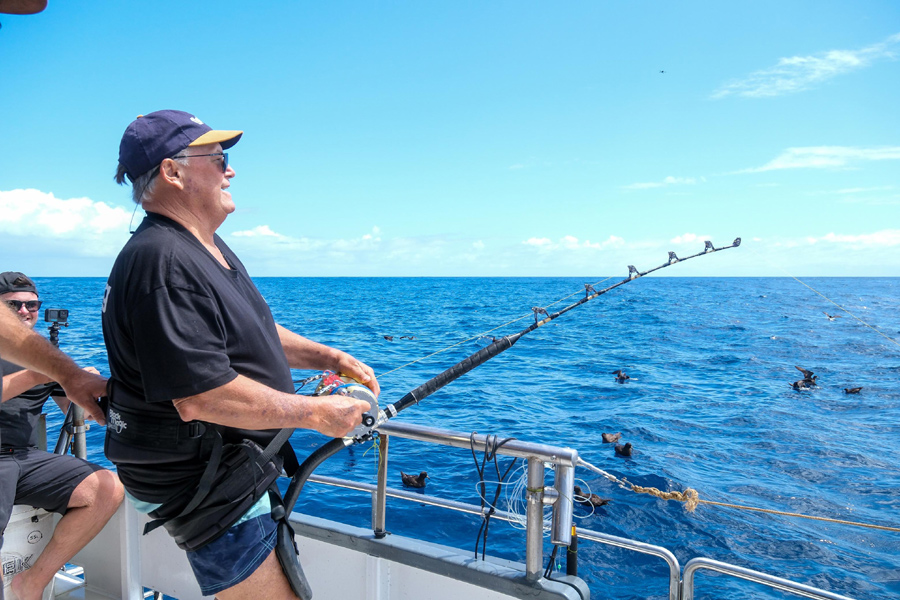 Grant making easy metres on his first swordfish as it heads for the surface.
Former magazine colleagues Sam Mossman and Mark Kitteridge used to say, “I just want to catch a sword so I can stop fishing for them.” Sam has now done 30-40 nights chasing a sword without any luck, while Mark in more recent times finally ticked that box.
In the world of fishing stories, few tales capture the spirit of the angler's struggle and victory quite like Ernest Hemingway's The Old Man and the Sea. Santiago's epic fight with the swordfish isn't just a story; it's a testament to the undying spirit of fishermen everywhere.
‘Swords’ as they are colloquially known, are respected for their incredible power and endurance, making them one of the most challenging and rewarding targets for anglers. Their elusive nature and the sheer difficulty of catching one adds to the thrill, drawing anglers from all over the world to test their skills against these ocean giants.
Once hooked, they can put up a lengthy battle that tests even the most seasoned anglers. These qualities make them a prized catch, representing the ultimate test of skill, endurance, and patience.
Bay of Island’s angler and recreational fishing administrator Gerry Garrett has felt the burn of a protracted swordfish battle, not once but twice. Fishing aboard Major Tom II with the late Jeff Stone at the helm, the IGFA Hall of Famer claimed two world swordfish records. The first fish went 369kg on 37kg tackle and it took the diminutive angler 14 hours and 20 minutes to land. Seven years later this mark was subsequently bettered by Jerry’s second effort of 372.4kg that ‘only’ took him eight hours and 10 minutes. Jerry was twice awarded the NZSFC’s prestigious ‘Old Man and the Sea’ trophy representing the most meritorious capture of the season. Television’s Gone Fishing host Graeme Sinclair also earned the Old Man and the Sea Trophy with a meritorious broadbill capture.
These records for broadbill swordfish (subsequently beaten) are a testament to their formidable nature. The current all-tackle world record is an astounding 536.15kg (1182 pounds), caught off the coast of Chile in 1953.
New Zealand is home to some of the best broadbill swordfish fishing grounds in the world. The deep waters off the North Island, particularly near Northland and the Three Kings Islands, are renowned for their broadbill populations. These locations provide the perfect combination of depth and structure, creating an ideal habitat. Other notable spots include the waters off the Bay of Plenty and the East Cape, where anglers have consistently reported successful catches.
The NZ Sport Fishing Council’s men’s all-tackle sword came from the internationally renowned John Gregory skippered charter vessel Primetime. With just John and crewman/angler Jim Gigger on board, they landed the national all-tackle record, a sword of 404.4kg on 37kg tackle, from the waters off Cape Karikari.
Now retired, John attracted clients worldwide who came to test themselves on the local swordfish population. When he didn’t have charters, he targeted swordfish solo with much success. John says swords are a ‘Jekyll and Hyde’ fish, their fight differing depending on whether they are hooked up in daylight or dark.
In more recent times daylight deep dropping has been the go and has encouraged many first-time broadbill anglers to give it a shot.
While most of the more experienced skippers and anglers keep the locations and techniques close to their chest, recreational fishing personality and advocate Matt Watson has shared many of the tips and techniques for daylight swordfishing over 20 seasons of the The ITM Fishing Show; and more recently in greater detail via his YouTube channel Ultimate Fishing Television.
Matt, for a couple of seasons before The ITM Fishing Show, crewed on Primetime, so it is little wonder he shares John Gregory’s passion for targeting this angling A-lister.
The women’s NZSFC all-tackle record came from similar waters when Mangawhai’s Nicky Wilson (nee Sinden) landed a 361.0kg sword on 60kg tackle, filming for the television show Addicted to Fishing. The fish is also the 60kg women’s line class world record.
Light tackle specialist Guy Jacobsen has claimed 21 world records over the years, of which 19 still stand. These include the men’s broadbill 6, 8, 10, and 15kg line classes with efforts of 94.2, 134.0, 269.0, and 252.8kg, respectively.
When it comes to catching broadbill swordfish, the right techniques and gear are crucial. Fishing after dark with deep-set baits was considered by anglers for many years as the most effective method, as they are known to feed closer to the surface at night. Rigging a squid, small tuna, or mackerel on a sturdy circle hook paired with a heavy-duty leader, is a common setup. Using glow sticks or other light-emitting devices near the bait can also attract these nocturnal hunters.
The gear used for broadbill swordfishing needs to withstand the immense pressure these fish can exert. A rod, rated for at least 80 pounds, paired with a high-capacity reel with a smooth drag system, is essential. Typically braid backing is top shot with 50-100 metres of IGFA-rated mono. This setup ensures that the angler can maintain control during the long and intense battles that broadbill are known for, the braid increasing the reel’s line capacity considerably.
Broadbill swordfish stand as a pinnacle of recreational fishing. Their elusive nature, fighting prowess, and the sheer challenge they present make swords a revered target for anglers. Much like Santiago’s protracted battle, the pursuit of broadbill swordfish for most is a journey of grit, determination, and unyielding passion. For those willing to embrace the challenge, the rewards are immeasurable, creating memories that will last a lifetime and stories that will be passed down through generations.
A fish with a split personality
Few skippers and anglers would know broadbill swordfish better than Kerikeri’s John Gregory.
Prior to his retirement as captain of the internationally renowned charter boat Primetime, John has put his overseas and NZ clients onto hundreds of swordfish and has caught over 100 solo.
With this experience to back him up, John says swordfish fight differently depending on whether they are caught in daylight or after dark.
“That 100kg fish caught deep dropping during the day is not the same adversary the same fish caught at night would be – they are alike as chalk and cheese.”
John says the darkness seems to make the fish bolder – they are a different beast at night, they don’t appear to be scared.
“Gladiator of Sea? – not during the daytime, they are nowhere as aggressive as a fish caught at night!”
John recalls having fish, on their release, charging the boat. On one occasion he had Primetime at 20 knots running away from an angry sword.
“We had released it by cutting as close to the hook as possible, but this time the light was still attached so we could see it lining up the boat. We struggled to get away from it.”
And then there is the celebrated footage of a swordfish ‘destroying’ his cockpit, shunting an XOS ice bin around the space with its bill. This leads John to issue a word of warning, having seen first-hand the damage an angry sword can do.
“I am genuinely concerned with the number of small trailerboats with inexperienced crews aboard targeting swords. These are fish that shouldn’t be tackled lightly, not only due to the nature of the fish, but the distance offshore many are going to catch them. I have experienced first-hand their power, and that was with a big boat separating the fish and the crew, not just a bit of 3-4mm alloy.”
John and Primetime developed an international reputation as the ‘go-to’ swordfishing operation with many repeat customers among his clients.
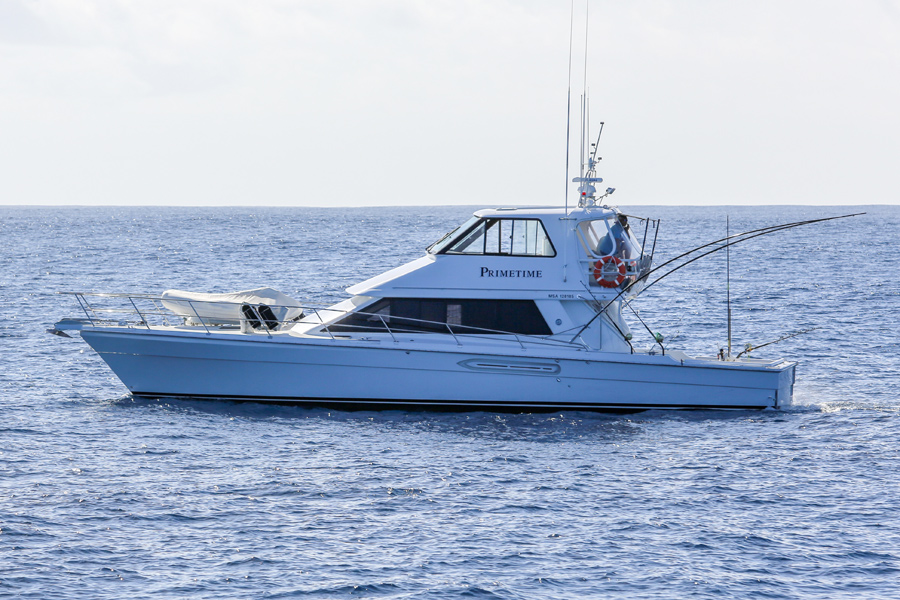 John put his overseas and NZ clients onto hundreds of swordfish and caught 140 or more solo as captain of Primetime.
One, a renowned Belgium angler and Primetime’s biggest client - the late Michel Marchandise – would only take on swords at night and then only on 15kg tackle.
“He initially landed eight or nine on heavier tackle, then decided 15kg was a challenge, going on to capture 29 aboard Primetime on this line weight, the biggest being 270kg. If he thought a fish had not fought well enough, he would DQ (disqualify) them, even if they were a potential record.”
The longest this angler spent on a fish was 15 hours 30 minutes on a sword estimated at well over 300kg. But this was not the longest scrap aboard Primetime – John’s dad Tom did 16 hours 14 minutes on a 298kg fish.
“It would have been a world record at the time, had a mako not grabbed its tail, disqualifying it. Unfortunately, Dad was still playing it at the change of light which gave the fish a new lease on life, typical of the behaviour we have observed numerous times over the years. We might have a fish almost in reach of the wireman in the dark, but as soon as there is a hint of daylight it would be not unusual for a fish to run out 200-300 metres of line in one burst.”
John has also made a name for himself as a solo angler and has accounted for around 100 swords unaccompanied. So why solo?
“I love the challenge, it is personal. You get to wear all the hats – skipper, crew, wireman, and angler. There is no one to help you, it is just you and the fish.”
The other reason John enjoys the solo gig is he can experiment with rigs and fighting techniques.
“It doesn’t matter if I pull the hooks, I just reset the gear and give it another shot without the added pressure of getting it right for the client.
“These ‘practice’ trips benefited my paying guests as we fine-tuned our fishing for when they were on board. When our international guests spend 24 hours flying around the world to fish with us, we wanted to be able to give them the best experience and chance of landing that special sword”.
The majority of swords John and his operation have accounted for have been released. He does have concerns around the number of fish being killed, with some boats keeping multiple fish.
“Most smaller craft don’t always have the ice-carrying capacity to look after several fish properly. Swordfish are like any other fish, the more ice they are covered with, the better the outcome eating-wise.”
That one special fish
One angler who knows just how special that one fish can be is Nicky Wilson, who landed a world record women’s all-tackle and NZSFC line class swordfish of 361.0kg on 60kg standup tackle in March 2017.
Nicky, accompanied by Dave Woodman and Matt Haliday, was filming an episode of her show Addicted to Fishing. She had in the back of her mind targeting the 10kg record which was considered ‘doable’ over a 3–4-day weather window. Nicky even had the record application form partially filled out and pinned to her office wall as a constant reminder of her 10kg line class goal.
“That weather window closed to just one day. As we needed to get some swordfish footage we ran with the heavier gear. Back at Whangaroa charter skipper Phil Barchet gave us some marks after we shared some squid baits with him which he used to land a sword.”
With the bait set it was a matter of staring at the rod tip, waiting for that subtle ‘tap, tap, tap’ indicating the bait had got the attention of the target species.
On hooking up Nicky knew she was into a good fish when at the 90-minute mark she was starting to feel the burn created by 22kg of drag over the rod tip.
“My arms and legs were aching, and it was with some relief the fish was secured. The next problem was getting it into the Extreme 745’s cockpit.”
Swordfish often attract the attention of sharks, and it was with some apprehension Nicky jumped overboard to get a rope around its tail.
“We could only get the fish partway into the boat, so it was a slow trip back to Whangaroa and the club’s weigh station.”
The drama was not over – the sheer bulk of the broadbill breaking the tail rope used to raise it on the gantry, the fish ending up in the water.
“When it was finally sorted, we watched the numbers go through 200, 250, 300, 350 before finally settling on 361.0kg, that weight subsequently ratified by NZSFC and IGFA records officers.”
Nicky’s fish bettered the world record for Women’s 60kg Line Class and All Tackle by 17kg – a mark set in Chile that had stood for 65 years.
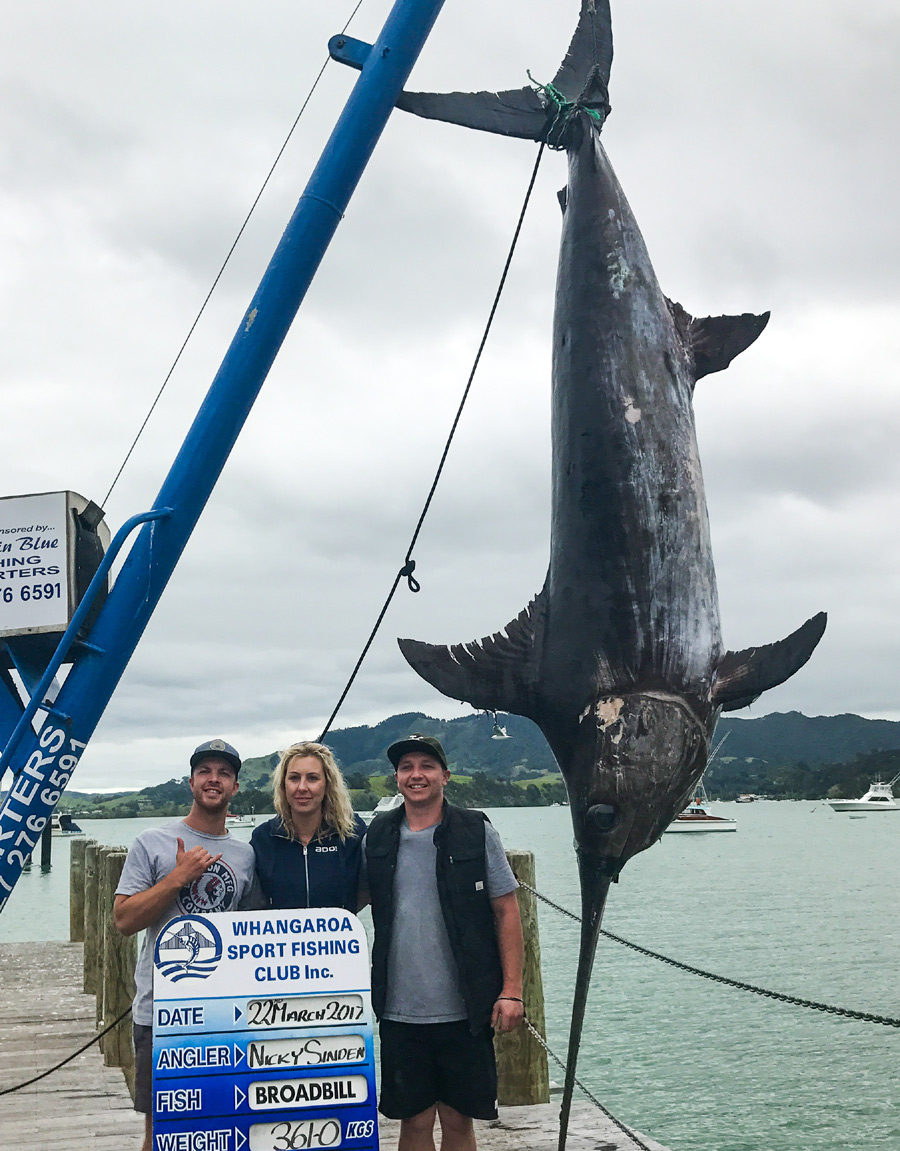 Nicky’s world record women’s all-tackle and NZSFC line class swordfish of 361.0kg on 60kg standup tackle.
Swordfishing is like most angling, the more time you spend doing it, the better you become. Jed Radaly was one of Nicky’s early swordfishing mentors, along with Nathan Adams.
“Jed shared my obsession with swords, and we had no trouble finding and hooking them, it was just getting them to stick, losing three the first day. We went on to lose another 12 before putting one on board, including dropping one ‘monster’ at the boat, and another breaking a rod.
“You do a lot of learning as you go along. Paul Radaly, Jed’s dad and accomplished custom rodmaker, was a catalyst to our first success.
“He taught us to ‘stop rushing,’ not to panic, and to ‘chill out’ on a fish. I caught my first sword with Paul on board, which tipped the scales at 199kg. It came with a sense of quiet achievement, I was so happy after all our trials and tribulations, We had truly earned that fish.”
One of the biggest things Nicky has learned about swordfish is the need to constantly pay attention to the rod tip.
“You must trust your instincts. Broadbill don’t hit with a hell strike, it is more insignificant, like an elephant eating a peanut. A broadbill will give a bait a couple of whacks with its bill, come back to eat, and then most often head for the surface when it feels the hook.”
And what happened to Nicky’s world-beating fish once all the formalities were completed – it went to the taxidermist. It is currently hanging in the Mangawhai Fishing and Boating Club’s clubrooms awaiting taking pride of place in a new home the Wilson family are moving into soon.
Nicky has the same concerns as John Gregory and other leading swordfish anglers around both the resource and safety.
“The swordfishing fraternity is quite secretive, with conservation of the stocks in mind. You don’t need to kill multiple fish on the one trip – just one will provide plenty of steaks for the whole crew.”
Charter demand growing
With the advent of daytime dropping for swords, charter operators have been fielding an increase in demand for broadbill charters. One such operation is Nick ‘Stacky’ Stack’s Whitianga-based charter service.
A former crew member on a tuna longliner, Stacky had some experience with swords. Four years ago, when he set up Stack Attack Sportfishing Charters’ vessel Stack Attack, an 8.4 metre South African built catamaran, targeting broadbill was not on the agenda.
Once he tried it, he was hooked on having another string to his charter fishing bow, to the point where he now has 16 days booked chasing swords this year.
He agrees with the others spoken to – every trip is an opportunity to gain experience and learn something new.
“I am big on moon phases – three days before both the full and new moons are when I have had the most success. The bait rises and thickens, and you are more likely to get a bite than when it is less concentrated,” Nick says.
“Find the bait, find the fish.”
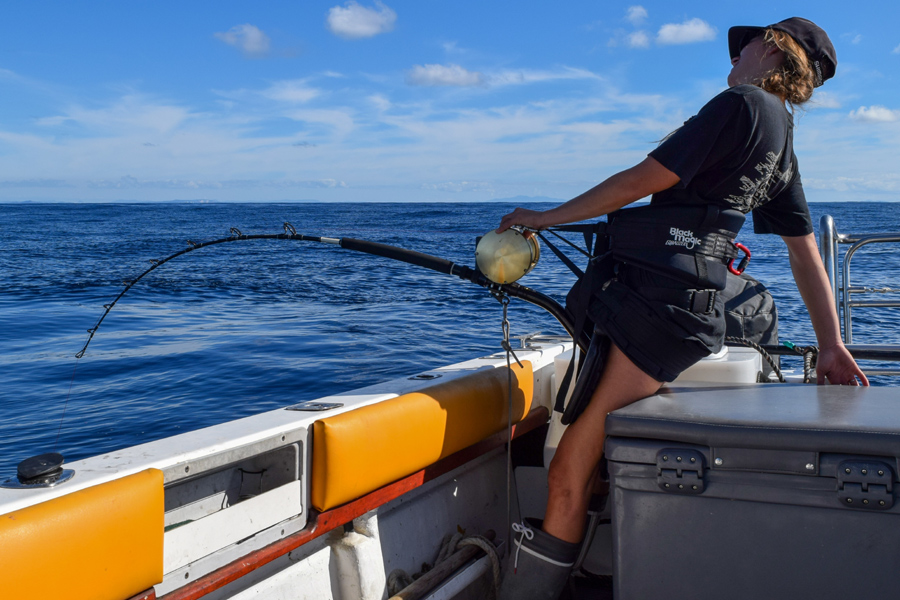 Locked and loaded. Image: Jordy Bardin
Stacky prefers smaller baits – a squid over the skipjack tuna for example – and says use the best gear you can afford.
“Don’t bring a knife to a gunfight, a sword will exploit any weakness in your tackle or rig.”
C-Maps is Stacky’s preferred cartography because of the better detail.
“It shows the trenches and seamouts so much better. I like to work my baits towards the head of any trench. Think of it like a rivermouth guiding fish upstream towards any tucker.”
He likes to keep his terminal tackle simple, preferring a long piece of rebar as a weight on a short wire loop which is placed over the terminal tackle hook. On hitting the bottom the weight drops off, a setup that prevents the bait getting dragged into the mud.
His go-to tackle is a Maxel 50-wide Oceanic reel on a Maxel Twisted Sister rod. The multi-coloured braid is top shot with 50 metres of Varivas 60kg mono. The preferred hook is a tuna circle over the conventional J hook.
“If I am going to lose a fish, I would rather lose it sooner rather than later. The circle hooks make for releasing a fish easier than a J hook which when swallowed can get a fish deep in its stomach – you are playing for keeps.”
After each fish, Nick replaces the trace and has the hooks as sharp as possible.
“If there is a weakness, a swordfish will exploit it.”
Matt Watson – a man with the swordfish mojo
Recreational fishing personality/television host and advocate Matt Watson has long been fascinated by broadbill swordfish. This species has featured prominently in the 20 seasons of The ITM Fishing Show. In keeping with his mantra ‘there are no secrets on the show’, Matt has subsequently produced several how-to segments on targeting broadbill, available on his Ultimate Fishing YouTube channel.
In this interview, Matt shares some of his thoughts on targeting the gladiator of the seas.
How did you get into sword fishing and what were some of your more notable early captures?
I was fascinated with swordfish long before I ever fished for them, but it was in back in 2000 when I started work on the John Gregory skippered Primetime I started fishing for them. Day fishing for swordfish wasn’t a thing back then, so we drifted baits at night, then we started slow trolling at night. We caught a lot of sharks and lost a couple of swords on the leader before we finally landed one in May 2001. From there we learnt a lot and caught loads of big swordfish at night, most in the 200–300kg range, with very few small ones. It was a wild time pioneering new grounds at night out beyond the Three Kings.
I started daytime fishing for swordfish from my trailer boat, much closer to home. I don’t like the crowds at the ‘Garden Patch’ so I found several new areas that I could fish easily in a day, even from my little centre console. New spots would usually yield bigger fish, with several caught over 300kg. Three times I caught swordfish on my first drop at a new spot. My biggest was a first drop, initially I estimated it at 400kg after the 17-hour battle, but after, its measurements were calculated at over 450kg. It was incredible how it still managed to give me one of the wildest pulls on the leader I’ve ever had after all that time playing it. You can see for yourself, on Ultimate Fishing on YouTube, the video is aptly named ‘Swordzilla’.
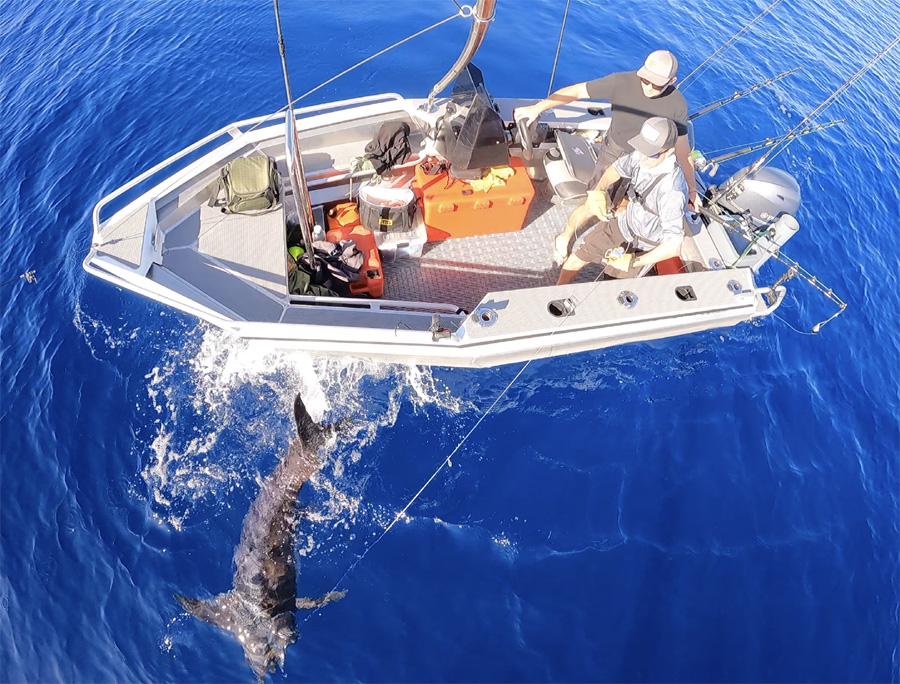 Matt proving you don’t need a big boat to catch a sword.
What are the biggest mistakes newbie swordfishers make and how can they avoid them?
Some anglers persist with J hooks, with the theory that you can choke the swordfish or tear its gills to eliminate the fight. I would have thought if you wanted to catch the toughest fish that swims, you would want to experience what it can do? But aside from the ethical argument, they tear out more often. So you hook the fish and most likely the fish dies. With the exception of trolling, use a non-offset circle hook on your baits and you’ll hold on to more of the fish you hook.
What is your go-to tackle, bait, and time to target swords?
The tackle I use is a Shimano Talica 50, with 100lb backing and 130lb top shot. I’ve caught all my big swordfish on this gear and I use the same sets trolling for gamefish. I’ve got a video on how to set this gear up in our gamefishing tips playlist, and step-by-steps on rigging baits.
I have used 14 different kinds of bait for swordfish – gemfish, frostfish, bluenose, snapper, tarakihi, kahawai, and mahimahi to name a few. The point is they are not fussy, but when the fishing is slow, you can’t go past a big squid, the bigger the better. Or if you can’t get big squid, a whole skipjack tuna works a treat.
I’ve caught swordfish every month of the year except October, but I’ve never tried in October, and I’ve caught them on all moon phases. But May would be the best month, and 4-7 days after the full moon best for the bigger fish.
When prospecting swordfish grounds, what do you look for on a chart?
I look for where the 500m line and the 600m line squeeze up, and ideally run perpendicular to the current.
Among the many swordfish captures you have been involved with, there must be one of two that have stood out?
Wow, there are several memorable swordfish catches. The 250kg swordfish I got on a handline, that got chomped by the biggest mako I’ve ever seen, the footage I guess helps it live on. I’ve caught a couple of big ones with my son, Shaw, on the rod. They are among the fondest memories. We have a whole playlist dedicated to swordfish catches on Ultimate Fishing.
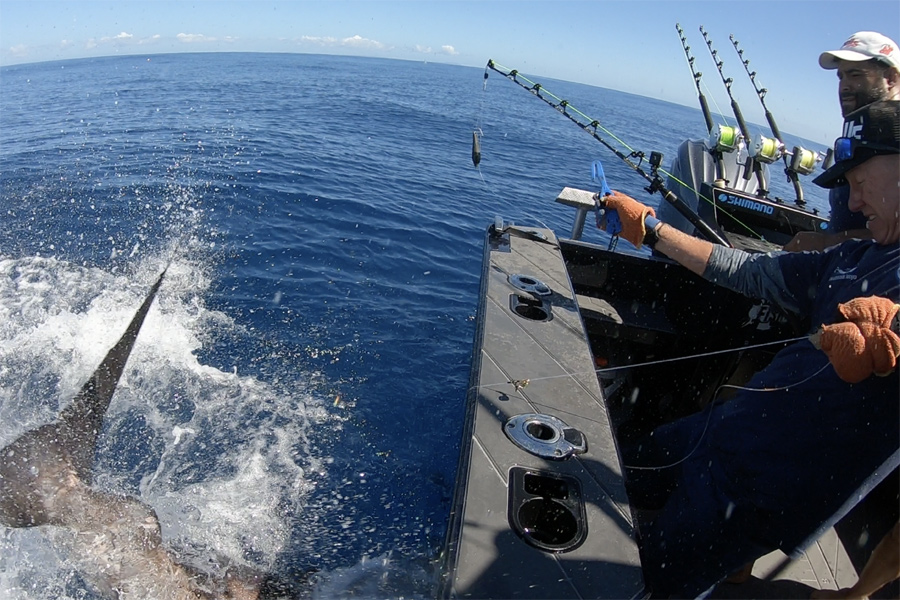 Getting a fresh one on the leader, swordfish can be incredibly violent boatside, so some caution is advised for the inexperienced.
If you had one piece of advice you would like to share, what would it be?
If they are fit and healthy when they get to the boat, let them go. The big fish particularly come back to the same areas to breed, as we have evidenced in tagging data. And when they come back, more fish come with them. If you kill the big ones in a spot it definitely has an effect on how that location fishes in the following seasons.
How should you best look after a fish you keep?
I generally only take swordfish if they have been bitten by a shark, or won’t swim away. But when I do I treat them like all other fish I eat. Get them chilled on ice, as soon as possible, and when set, cut them up carefully so as not to get the gut or the oils from the skin onto the flesh. We’ve done a great video for how to do this on Ultimate Fishing.
A swordfish-inspired beer
What started out as a joke a few years ago while Matt was on a hot streak sword fishing with his mates, has now become beer enjoyed all around New Zealand.
“When people asked why we did so well on swordfish, we jokingly told them it was with the ‘Swordfish Mojo’ in our beer. We had hastily made up some labels which we stuck on cans and I brewed some beer and included a drop of salt water collected during the best bite time – when both the sun and the moon are on the horizon at the same time,” Matt explains.
The first batch of Swordfish Mojo, tested during the 2024 NZSFC Nationals when the Swordfish Mojo team won the swordfish section with 10 catches, has ended up in a popular beer hitting the shelves by year’s end.
The rest is history. The low-carb Swordfish Mojo is batch-brewed by Good George, resulting in a fresher, crisper taste as the time between production and consumption is much less.
Never one to back off from a challenge, Matt had to put a lot on the line to get Swordfish Mojo off the ground, but people have bought into it. The first run of 7,000 boxes was sold out and the brewers have been chasing increased production quantities ever since, brewing 2,000 cases a week.
“We have been blown away by its popularity, which in itself presents challenges. A guy has just ordered a pallet (180 boxes), for his own consumption, and had to wait for three weeks before it could be brewed. The supermarkets and bottle shops are regularly running out, but we’ve upped production and will have enough to go around in the next few weeks”.
To read more about the Swordfish Mojo story and to find a supplier near to you, scan here.
- Grant Dixon
Fishing Reports Visit Reports
Manukau/West Coast Fishing Report - 15/10/26
Big spring snapper in 60 metres. The El Niño weather pattern isn’t going to be... Read More >
Rotorua Fishing Report - 15/10/26
Solid start to the season! The Rotorua lakes have all started the season well, and... Read More >
Tutukaka Fishing Report - 15/10/26
Big snapper in shallow. Things remain relatively quiet on the fishing front out of Tutukaka,... Read More >
Tauranga Fishing Report - 15/10/26
Bait and temperature on the rise. It’s been great to get out and see some... Read More >


Monday 19 October 2026
Major Bites
 - -
- - Minor Bites
 - -
- - Tuesday 20 October 2026
Major Bites
-  -
- Minor Bites
- -
Comments