
Boat vs Landbased
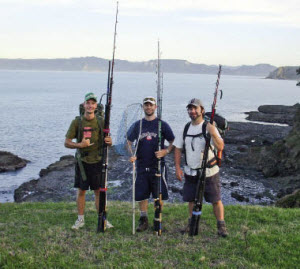 I don’t go boat fishing too often and these skills aren’t that well developed, but generally I go home with a feed.
Most recently my Dad and I towed his trailer boat from Central Otago to Jackson Bay on the South Island’s west coast, and we dropped some baits there.
Although we regularly troll trout lures on the Southern Lakes, this was totally new to us. We drifted around over a mixture of sand and foul in 30-40m of water, catching mostly nuisance spiny dogs, but also some really nice blue cod, tarakihi and gurnard. Given my lack of boat-fishing expertise, experiences like this always get me thinking about the main advantages boat fishermen have over their shore counterparts, which I believe are:
• The ease of finding and fishing deep, dark water;
• The ability to fish directly into berley;
• Increased mobility – it’s easy to up-anchor and move to another spot if the fish aren’t biting.
In my home waters, a successful day’s boat fishing might involve a sunny day out in Cook Strait filling the bin with blue cod, tarakihi and maybe a hapuku or bluenose. Conversely, Wellington shore fishermen might look back fondly at a session that realised a fat kahawai before sundown and a moki or spotty shark after dark. Shore-fishermen generally have lower expectations of their catch, and also adopt different tactics and behaviour to take advantage of the opportunities available specifically from the shore. That is simply common sense, but it would be unwise to dismiss boat fishing as irrelevant, so I’ve given some thought to replicating the three advantages listed above when fishing from the shore.
Finding and fishing deep, dark water
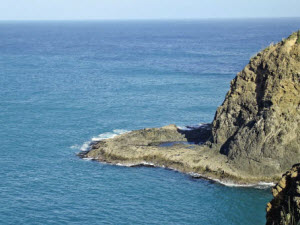 I’ve written before about the disadvantages surfcasters have in fishing the shallow fringe of the coast, and how fishing in shallow waters is best done at dusk, dawn and in darkness (‘the three Ds’). However, deep water can be reached from the shore, and such waters can produce fish all day long.
The very best, genuinely deep water is accessed from rock and cliff positions. The deep water surrounding places such as East Cape and Cape Brett are legendary, but there are deep water spots distributed right around the country. A few that spring to mind are Castlepoint (Wairarapa), Cape Saunders (Otago), and French Pass (Marlborough Sounds). In some places the rock fisherman can drop baits into 20 or 30m of water. When these spots fire, you genuinely have no need for a boat. I’ve been lucky to experience day-long bites in such places – normally for snapper or trevally in the north and blue cod in the south.
Deep beaches also offer the prospect of productive, all-day fishing. Normally these are coarse sand or gravel beaches, and a long cast can put you into more than five metres of water depth. Whilst this is not really deep water, the extra two to three metres of depth offer an advantage over traditional surf beaches when fishing in daylight. Such beaches tend to be more common in east coast locations. A few that spring to mind are Cloudy Bay (Marlborough), Whakaki (Hawkes Bay) and Hawai (Bay of Plenty).
Finally, wharves and promontories within various harbours around the country can also offer access to deeper water and shouldn’t be overlooked.
Fishing straight into berley
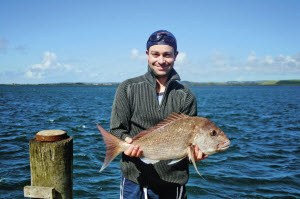 In a boat, berley can be weighted and positioned on the bottom, right next to where you drop your bait. This huge advantage is difficult to replicate at most shore fishing spots. Wharfs and rock platforms offer the easiest opportunities for shore-based berleying, but because frozen berley floats, it can be difficult – sometimes impossible – to get to the bottom. Surface berleying is therefore the norm, and can result in exciting sights as fish buzz through – but is probably less effective. So if you find yourself with deep water right at your feet, try weighting your berley with a rock. If that’s not possible, remember that any berley is better than none!
Most shore fishing is done from rather more difficult positions (in shallower water), and this presents logistical problems for berleying – but with a bit of lateral thinking it is still possible.
A surefire way to put your bait within a foot of your berley is by using berley-cage sinkers. These sinkers have a spring-shaped wire that can be loaded with berley before casting. Try thawing out a frozen berley sausage and making it into a thick paste by adding breadcrumbs or chicken feed. This will hold fast in the sinker throughout the cast and dissolve slowly in the water right next to your bait. Over the course of a few casts, monitor how long it takes the berley to dissolve, then retrieve and recast at appropriate intervals throughout the session.
Another option for getting berley out into deeper water beyond your position is to cut frozen berley into cricket-ball-sized chunks and simply throw it out into the tide. This is effective from scrappy rock platforms and deep beaches, but only works where there is minimal swell or current, as this berley will bob around on the surface. Even so, I have had good success from the beach using this basic method.
Mobility
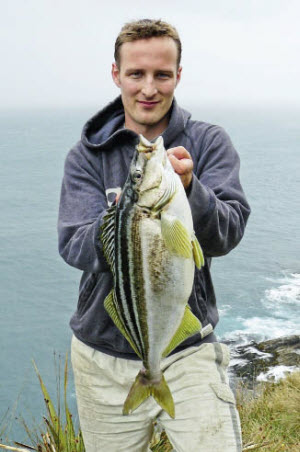 When the fish aren’t biting, it’s pretty hard to beat the convenience of upping the anchor and lines and tootling off to your next GPS spot. Boat fishermen think nothing of it – it’s simply part of what they do – but for shore fishermen it is not usually so easy. Even so, success in shore fishing is also linked to having bailout options close at hand and the mobility to get to them quickly.
Fishing surf beaches is a case in point. Many surfcasters invest in quad bikes and set them up to make packing and unpacking gear quick and easy, with spikes welded to the bull bars, and clips and straps for fastening chilly bins and bait boards. These fishermen mark likely spots along the beach before casting a line, and if spot #1 fails to fire, they quickly move onto spot #2.
I don’t personally have a quad bike, but I do have a lightweight 4WD that will go anywhere on the sand, so use it in a similar way. I regularly night-fish at Ocean Beach in the Wairarapa and move along the beach at 500m intervals if the fish aren’t biting. I organise my gear to make packing-up quick and easy – sealable plastic buckets and chilly bins are invaluable and allow me to quickly stow messy rigs and baits away without worrying about the upholstery!
The rocks are a different proposition, as they are generally accessed by foot or IRB. If able to get your quad bike or vehicle close to your position then the tips above still apply, but most of my serious rock fishing involves walks in of half an hour or more.
Typically, rock fishermen set up a berley station and commit to fishing a single spot for the day on the basis that the berley will draw the fish to them. Sometimes, however, the fishing is stone cold and you must pack up quickly and move on. I maximise my mobility on the rocks by:
• Using velcro straps to bundle my rods, gaff and landing net – this can be done very quickly, and a tight bundle is much easier to carry than a loose collection.
• Consolidating all my commonly used tackle and accessories into a single plastic lunchbox (bait cotton, hooks, lures etc) and this is kept at the top of my pack.
• Placing emergency supplies and important but infrequently used equipment in pockets or at the bottom of my pack.
• Leaving space at the top of my pack for a sealable plastic bucket into which I throw unused bait and berley.
The focus is on packing and unpacking key items quickly to maximise fishing time. Getting as much as possible into your pack is key, too, as it is much easier to carry it on your back than in your hands.
I must admit I get a bit of a kick out of giving my boat-fishing counterparts a run for their money – and, just occasionally, my mates and I manage to out-fish them, normally on our pilgrimages to the productive rocks of East Cape and Northland.
Whilst shore-fishing is a different kettle of fish and specialised tactics are required to succeed, with some lateral thinking we can replicate some of the advantages of boat fishing.
Summing up…
• Search out genuinely deep water spots – these produce fish in greater numbers and even during daylight hours, when other land-based spots are barren.
• Search out spots where you can fish directly into your berley (deep rocks are best) and try and get your berley onto the bottom.
• Try alternative methods of keeping berley near your line – this can include using berley-cage sinkers or throwing chunks of frozen berley into the tide.
• Use a quad bike or 4WD to work along stretches of beach and organise them so that packing and unpacking only takes a few minutes.
• If walking into your fishing spots, pack smart – organise your pack so that the most essential and heavily used items are close at hand, and bundle your rods, gaff etc together with velcro straps for easy carrying.
 |
This article is reproduced with express permission of
written by Andy MacLeod - 2013 Originally published in New Zealand Fishing News ----- Advertisement -----
|
Fishing Reports Visit Reports
Outer Hauraki Gulf Fishing Report 17/09/26
Spring wind the handbrake. Spring is starting to make its presence felt in the outer... Read More >
Top of the South Fishing Report - 17/09/26
Early snapper in Tasman Bay. Well, spring is finally here, and the days are getting... Read More >
Bream Bay Fishing Report - 17/09/26
Good snapper catches reported. After Tangaroa turned off the fish tap for a month or... Read More >
Bay of Islands Fishing Report - 17/09/26
Pacific bluefin tuna for the lucky few. The last fortnight has seen more fishable days... Read More >


Saturday 26 September 2026
Major Bites
 - -
- - Minor Bites
 - -
- - Sunday 27 September 2026
Major Bites
- Minor Bites
 - -
- -
Comments