
Bird watching - finding fish

Watching the birds (Part 1)
Electronic devices are extremely useful tools for fishermen, but as Sam Mossman explains, they should not stop you from having an eye for the birds.
In these days of advanced electronic devices, fishermen (those with boats or kayaks, anyway) have lots of toys to play with.
Even my modest, newly-launched FC430 (4.4m) tinny has a Lowrance Elite 4X HDI chart-plotter and sounder with all sorts of high-tech applications such as Hybrid Dual Imaging, Broadband Sounder plus DownScan imaging with overlay, and TrackBack to review recorded sonar history. TrackBack allows me to put a GPS marker back on fish that I have already passed – a sort of time-travel machine for fishermen. It is all very clever stuff, which I am still learning to use to best effect.
But even with these near-magical devices at my command, I would still only be half a fisherman if I didn’t know and make use of natural indicators to find the fish I want to catch. One of the most important of these markers is seabirds.
For example, as we were launching the boat in the Hauraki Gulf a few weeks ago, I could see birds working about a kilometre off the ramp. We raced straight out there to find they were terns feeding on small baitfish pushed to the surface by predators. I fired out a popper and was nailed straight away by a kingfish. I hadn’t even turned the electronics on yet, and I would not have gone in that direction if I hadn’t seen the birds.

The scents sense
So how do birds locate likely feeding areas in a seemingly limitless ocean? Sometimes food such as schools of baitfish or patches of krill may be located visually when concentrated near the surface, but otherwise it often comes down to sense of smell. Unfortunately, one of the great ornithologists (and artists) of the nineteenth century, John James Audubon, concluded that birds have no sense of smell following some flawed experiments with vultures. Such was his mana though, that it was over a hundred years before other scientists began to make investigation in this field, despite many birds having obvious and well-developed nostrils.
Large nostrils are particularly noticeable in petrels, prions, fulmars, shearwaters and albatrosses, a group of birds collectively called ‘tubenoses’ (Procellariiforms) because of this feature. Their brains also have large olfactory lobes, further proof of the sense of smell’s importance in feeding and, in some species, locating their nest burrows after dark.

Many of these species are open-ocean wanderers, and I often wondered how they located food in vast ocean expanses that are often devoid of life. We all know that phytoplankton (plant plankton) is the base of the food chain that ultimately supports large fish. The next level up is zooplankton (animal plankton), including the shrimp-like krill – tiny animals that eat the phytoplankton. When they do this, aromatic compounds, including dimethyl sulphide, are released and concentrate above areas where plankton is abundant, such as seamounts, current interfaces and upwellings. This scent guides the ‘tubenose’ species to the richest feeding areas in seemingly featureless oceans. (Commercial fishing operations also key in on plankton concentrations well offshore by using satellite imagery.) Tubenose birds can detect these airborne compounds in parts per billion concentrations (and even lower), so their sense of smell is at least 1000 times more sensitive to those particular odours than the human nose.
I know a number of fishermen who claim they can smell game fish, and are often proven right by subsequent hook-ups. In the right conditions I can sometimes get a whiff myself – what we are smelling is the fishy odour put out by an oil slick on the surface where a school of baitfish has been annihilated by the same predators we are trying to catch.
Trials have shown that some birds can smell fish oils from up to 25 kilometres downwind, so when these oils form a slick on the sea surface as a result of predatory fish and mammals attacking shoals of fish and squid underwater, the birds are quickly at the scene to forage for food. Other seabirds can smell a pheromone that baitfish give off when stressed.

The eyes have it
Scent is one way that seabirds can locate food, and eyesight is another. Species like our gannet, which seems to be largely lacking in the nostril department, use their excellent eyesight to spot baitfish (even fish relatively deep below the surface) and probably also take visual cues from feeding predatory fish, mammals (dolphins, whales and seals) and other birds.
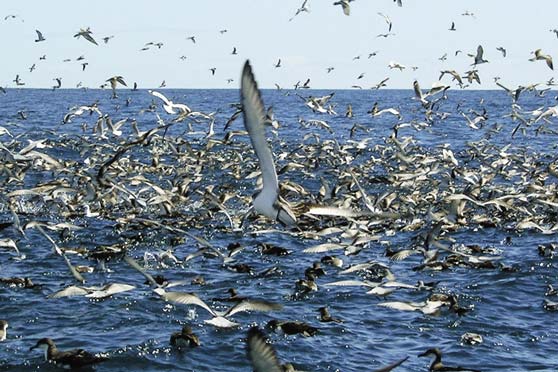 Some seabirds have special adaptations to enhance vision when hunting. For example, terns, gulls and albatrosses are amongst the seabirds which have red or yellow oil droplets in the colour receptors of their eyes to improve distance vision, especially in hazy conditions, in much the same way we humans use amber sunglasses. Gannets can adapt their optical capability from air to water in a split second as they dive, effectively blocking out ultraviolet light reflection that distorts the position of darting prey.
For thousands of years, people in South Asia, the Middle East, Egypt, the Horn of Africa and India, have used kohl (a black cosmetic paste) to darken the area under their eyes and reduce sun glare in bright tropical conditions. More recently, sportsmen – particularly American baseball and football players – have adopted eye black or dark stick-on tape under their eyes (these also often bear commercial messages nowadays). Because black absorbs most light frequencies, placing a black strip just below the eyes will, in effect, reduce the glare reaching the eyes, thereby increasing the definition and contrast of the objects being looked at.
This is helpful for sportsmen dealing with bright stadium lighting and fast-moving objects like sports balls. So it is little surprise to find that some seabirds, including mollymawks and gannets, have developed dark colouration around their eyes and even on the sides of their bills. While I don’t know of any research on the subject, it is a fair bet that this adaptation aids the birds’ eyesight, reducing the glare bouncing off the sea surface and allowing them to spot their prey more easily. (Gannets have other amazing adaptations too, but more about them next month.)
Watching the birds watching the fish
So the birds watch the fish and we watch the birds. And some fishermen take it a step further by using electronic aids to watch the birds, too.

Radar (Radio Detection And Ranging) has been around for about 80 years now. It is particularly useful for measuring distances and as a safety device when travelling after dark or in poor visibility. GPS may tell you where you are, but radar will tell you if there is anything in front of you, such as another craft.
For years now some large boats in parts of the USA have used ‘bird radar’ to pick up work-ups many miles beyond human vision. This is basically a high-resolution radar with a beam angle that takes it above most surface clutter. However, new small-ship systems have made this device more accessible to owners of launches. I fished on Ultimate Lady for a week not long after it was launched, and the then-skipper, Simon Jennings, told me he could spot work-ups of birds at four or five miles (six or eight kilometres) on his radar.
The massive cat’s radar dome is probably higher above water level than most gameboats, but just before Christmas I was aboard the Auckland charterboat Savoy fishing snapper work-ups in the Hauraki Gulf. In this instance chasing gannets is a standard technique, and skipper Kyle Jacobs could ‘see’ the work-ups on his radar at around six kilometres, completing the circle between natural and technological methods of finding the fish we wanted to catch.
|
|
This article is reproduced with permission of |

Fishing Reports Visit Reports
Outer Hauraki Gulf Fishing Report 17/09/26
Spring wind the handbrake. Spring is starting to make its presence felt in the outer... Read More >
Top of the South Fishing Report - 17/09/26
Early snapper in Tasman Bay. Well, spring is finally here, and the days are getting... Read More >
Bream Bay Fishing Report - 17/09/26
Good snapper catches reported. After Tangaroa turned off the fish tap for a month or... Read More >
Bay of Islands Fishing Report - 17/09/26
Pacific bluefin tuna for the lucky few. The last fortnight has seen more fishable days... Read More >



Saturday 26 September 2026
Major Bites
 - -
- - Minor Bites
 - -
- - Sunday 27 September 2026
Major Bites
- Minor Bites
 - -
- -
Comments