
Baiting up with Piper
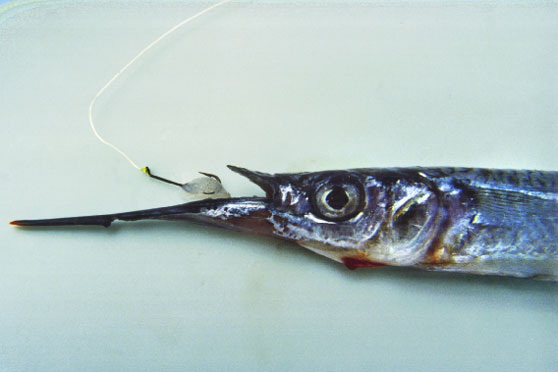
Better still, when dead, they remain remarkably effective when targeting kingfish (more later). The most effective way to catch piper is with a bait net; this is accomplished by targeting shallow bays with areas of sea grass, or by attracting and concentrating the piper by regularly distributing a ‘mush’ of watery, finely-smashed-up bread mixture, and then deploying a cast-net over the feeding fish, or surrounding and dragging a bait-net through them.
Otherwise, they are easily caught on rod and reel, using the same bread-water mixture already mentioned, but be careful not to overfeed them, or you’ll find they’re less inclined to eat the bait. The best baits for piper tend to be silvery skipjack belly strips, cut so they’re relatively long and thin, or regularly refreshed slivers of squid/tentacle. Either way, they need to be slim for easy swallowing and hooked just once at one end. There are two main ways to present these baits – a light spin outfit loaded with 2-3kg line is perfect for both methods. The simplest way is to tie a long-shanked hook – as they’re harder to swallow – at one end (#10 trout nymph hooks work well) and crimp on a split-shot.
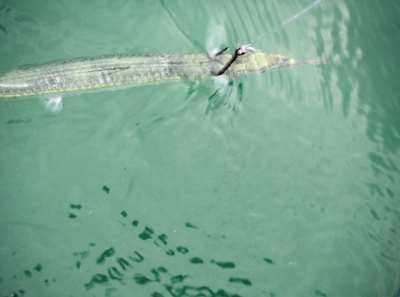
Now cast out to where the piper are feeding on the floating bread crusts, and wind in very slowly – but winding quickly whenever the light-coloured bait ‘winks out’, signalling a bite, to hook them. Otherwise, tie on a long slim float and have a baited hook hanging off it, either on the mainline before the float or hanging down from it. When the float slips down below the surface or steadily heads off somewhere, quickly lift the rod to set the hook.
If chasing kingfish, you want the bait to be alive if possible, but piper are relatively fragile live baits, so hard to keep that way for any length of time; it’s best to catch them at or near the location being fished. Otherwise, you’ll have to settle for them dead, but as will be explained shortly, that’s not necessarily a bad thing, especially as they can be used very effectively in this state for both snapper and kings.
Live-baiting piper tips
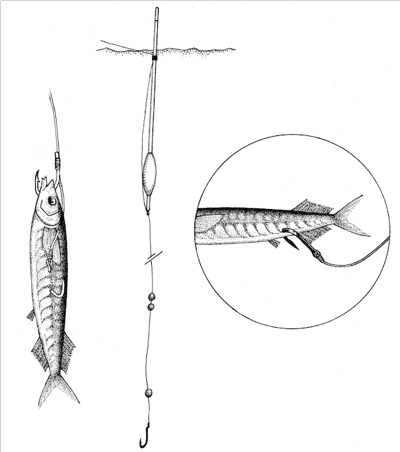 There are some problems to using piper for live baits. For a start, they have a high-placed backbone, so it’s easy to cripple them with a hook that’s too big or deeply set. And even if you do manage to hook them lightly enough, they’re easily ripped off on the strike. Unfortunately, hooking them through the nose just crosses their eyes and makes them ‘lethargic,’ so it can be better to hook them in the lower part of their bodies, towards their tails. A smallish hook that’s not too heavy in gauge is good, as it won’t cause much damage and results in a livelier bait.
- A thinner than usual trace is recommended, as piper are small, making everything else seem more obvious.
- Piper may be set under small, brightly coloured balloons blown up to just a tennis-ball size, or even less, minimising the wind influence (especially if blowing onshore), and making them easy to pull under the water on the strike.
- Deploying piper under a float is better still, as these can incorporate fish-attracting features such as bright colours, flash and rattles, and are also tougher and reusable. ‘Glitter Bugs’ are a great example of this and, better still, are designed to have the line threaded up through their middle. Some anglers will toothpick this type of float so it remains in a fixed position, but leaving it free-running, so that when the live baits swims away, the line pulls through the float until it reaches a stopper-knot or joining-knot is much better. This allows the bait to be set at much greater depths than the former system does, and as the float slides back down the nylon again on the retrieve, the leader length is kept to a minimum boat-side. This makes controlling hooked kingfish at close quarters much easier.
Dead-baits for kings (and snapper)
 No live piper left? No worries, a dead piper can really ring the dinner gong for kingfish, too, either cast out on a double-hook rig and erratically retrieved back through your berley trail or skipped across the surface.
You will need a heavy popper or stray-lining outfit that can be cast, armed with 24-37kg braid.
N.B.: Frozen piper are less robust but can still do the job, and saury can make a great substitute if you have access to them, too.
Rigging and fishing tips
- The ‘keeper’ hook should be inserted down into the piper’s hard skull, level with the eyes, to withstand repeated casting. Be careful not to break the gill latch while doing this, which renders the bait useless for retrieving.
- Make sure when attaching the main hook to the piper further down its body that there is a small amount of slack in the trace between it and the keeper, as you don’t want the bait to become curved by the trace, causing it to spin.
- If necessary, limber the fresh/thawed snap-frozen piper up a bit by gently flexing it from side to side. This will allow it to skip/swim better.
- So why a double-hook rig? Piper are a long fish, so need to be covered effectively when retrieved, as kingfish often nip dead baits experimentally. A hook set further down the bait makes a hook-up more likely; try continuing to wind with circle hooks, keeping your rod down, and when the pressure from the biting fish prevents any more winding, simply lift the rod for the hook-up. Such a method relies on both hooks being fixed in place!
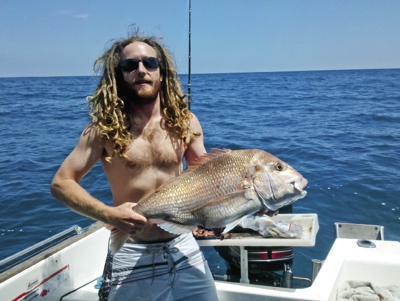
- This same two-hooked bait can be cast down a berley trail or off the rocks for snapper, and just like kingfish, the size of fish attracted to such a bait can almost be frightening!
 |
This article is reproduced with express permission of written by Mark Kitteridge - 2013 Originally published in New Zealand Fishing News ----- Advertisement -----
|
Fishing Reports Visit Reports
Outer Hauraki Gulf Fishing Report 17/09/26
Spring wind the handbrake. Spring is starting to make its presence felt in the outer... Read More >
Top of the South Fishing Report - 17/09/26
Early snapper in Tasman Bay. Well, spring is finally here, and the days are getting... Read More >
Bream Bay Fishing Report - 17/09/26
Good snapper catches reported. After Tangaroa turned off the fish tap for a month or... Read More >
Bay of Islands Fishing Report - 17/09/26
Pacific bluefin tuna for the lucky few. The last fortnight has seen more fishable days... Read More >



Friday 25 September 2026
Major Bites
 - -
- - Minor Bites
 - -
- - Saturday 26 September 2026
Major Bites
- - Minor Bites
- -
Comments