
Back to bait basics
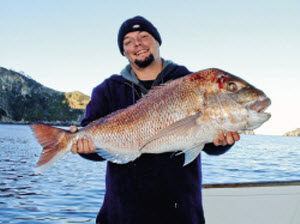 One of my favourite forms of fishing is bait fishing, but all this talk of soft-plastics, hard-bodies, slow-jigging, speed jigging, top-water and wash fishing has got inside my head and sent it into a spin.
Back in the day (geez, I am showing my age – even my teenage daughters cringe when I say this), we went fishing with what was then, and basically still is, ‘modern’ fishing techniques.
We had jigs (we used to make them out of cutlery, for crying out loud) and we had soft-rubber baits – although not scented as they are now, and most came from the US or from across the ditch.
We certainly had slow jigs – after all, we couldn’t wind very fast with our Shimano TLD 10s or Penn Longbeach 66s. We also had poppers to work the ‘top water’, and these gems mostly came from imported sources, too. Basically they were painted sections of broomstick with a wire through them, but man did they work (and still do). The flash ones had a scooped head – WOW!
Everything came with treble hooks, and when the very first knife jigs came out, I’m sure half of us put them to work upside down, just as I did when slow-jigs grabbed my attention after fishing with a group from Shimano Television. (Boy, did I learn some stuff that day!)
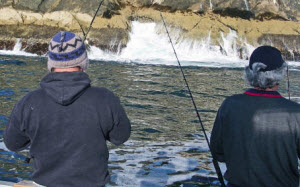 However, while I do enjoy all this modern apparatus and technique (I really do), the little monkey on my back is tapping away and his tune is all about bait!
Consequently, having so many fantastic bait-fishing options available is my idea of fishing heaven. For example, I love pitching baits to any hungry marlin chasing a teaser or lure into the transom, as well as slow-towing live baits around the rocks for big kingfish – or setting a live bait under a balloon for them while snapper fishing. And then there’s setting traps for john dory with live baits, too – great fun. Hell, on more than one occasion I have set a long-line with 25 livies on it and caught half a dozen humble JDs. (A mate has played with this idea in dropper form, too, just quietly.)
Then there’s snapper fishing of course; I love to drift-fish a live bait over a deep reef in the hope of enticing a hard hit from a snapper over 12kg, followed by strong run and swallow.
But, most of all, I love stray-lining for snapper with bait. I’m not fussy about the type of bait so much, because I’ve been known to mix it up a little, often turning my nose up at a freshly-thawed pilchard without a scale missing for half a sweep or a partly mauled mackerel head instead. For me it’s more about laying the trap, putting all the elements of the puzzle together so there is only one piece missing – the capture (and often the release these days).
All the little things are easily taken care of, like having the traces pre-tied and stowed away neatly for quick use, right through to setting the alarm clock to make sure you’re up on time. As for the stuff in between, like rods, reels, lines and techniques, these are things you gather and develop over the years (from as young as four years old in my case).
Some of that early stuff I learned was with Dad – like how to net fresh sprats, getting the beggars out of the net, and the gold-star moments like finding five piper among 200 sprats. I also learned how to package them in a bag with layers of newspaper so they didn’t tear apart on defrosting, and learned where to hook them properly so they didn’t become an awkward triangle dangling from the trace. You gain all these little things as you go and grow, but the most important thing you gain is ‘instinct’ (sadly, you can’t buy the stuff, otherwise I’d be leading Pokerstars right now).
Ever wondered why the same names keep popping up in fishing comps? It’s because they have it. Ever wondered why Ninety Mile Beach winner Rob Parker sometimes drops a bait only metres into the surf, while others are wading out neck-deep? He has it. It’s also why Rick Pollock, Mark Hoare, Lance Goodhue, John Gregory and Geoff Lamond often top the leader boards – they have it, too. These guys know what to do next, even if it’s completely outside the norm when thinking up a cunning plan.
Yep, this instinct is put in a pot with your methods, style and apparatus (include your vessel in this), and mixed up. Next, it’s baked at 180° for 40 minutes, and hey presto – fish on your hook!
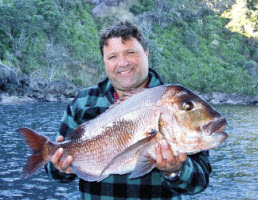 That’s why I love bait fishing, especially stray-lining: all these ingredients come into play, as you are literally setting a trap and then lying in wait. You have to use your instinct and knowledge to park the boat in the right place. You have to use your instinct and knowledge to choose a bait appropriate to your prey (match the hatch, as they say); you have to know how to disperse your berley, and the length of time needed before engaging your reel after getting a thumb-blistering run.
Not much is better in winter than pulling a big, dark snapper from the inky shallows, after putting the trap together, and the keys here are simple. First, find somewhere where the wind and tide are flowing in the same direction. Next, get the berley flowing and the current taking the baits with it. There’s no point fishing along your anchor chain, right?
When I was commercial fishing, one of my skippers used to say (as we steamed along the coast for an unload) that there was a big snapper on every 200m of coast. Twenty years ago this may have been true, but 20 years ago the inshore reefs around the Gulf weren’t as heavily fished and silted up as they are now. But what he was saying was still basically true; we often used to pull big fish from inshore areas like the Noises and Ahaahas, Tiri, Kawau and Whangaparaoa – and I will never forget nearly 25 years ago catching three snapper over 9kg from the island at Waiwera in my 3m dinghy. My mind was blown!
These days, however, with the use of BlooSee.com and Google Earth, it’s easy to see the guts and structure in close to the land and islands, so taking this into account, I have now stretched my skipper’s 200m to 1000m. I’m sure this is fair, considering inflation, gst and other detrimental factors affecting such a calculation.
Depth is a little irrelevant, but I like 5-30m. In such depths there is: light in the water column (so baits are visible); usually some baitfish around; normally some kelp or weed (which provides all fish with cover); and normally shellfish are present. These elements may vary, but they’re keys to a good fishing possie, along with some current and – another thing I really like – some shadow.
The shadow can often hold a bigger fish or make them less wary, as it’s a little darker in that part of the bay or section of reef. I noticed more snapper in these areas when spearfishing (especially when also holding over sand, amongst the reef). The biggest snapper I ever saw (without a spear in my hand, as I was gathering kina for berley) was at Great Barrier Island, and I swear it spooked me more than I spooked it! It was in the shadow of the cliff in the shallows (obviously, as I don’t hold my breath that well), and as dark as the shadow-covered rocks it was holding against. In a couple of rapid heartbeats it was gone.
In all instances, try to use fresh baits. Whatever bait you can catch at your chosen spot is more than likely on the menu of the big resident snapper. Sweep, maomao, sprats, kahawai, squid and mackerel are the preferred baits for big snapper. Of course your shop-procured baits will also entice a bite, but ‘fresh is best’, and often the results speak for themselves. It might just be me, but I can’t say that I’ve had much luck in this situation with mullet.
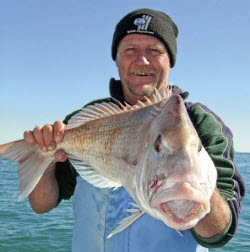 Use a longer rod so you can keep a fish’s head up (or try to, at least); 2-2.5m is good for this, and also gives better casting distance. Match the line weight to the rod, but don’t go into this gunfight with a knife; 4-6kg line is great fun to fight fish on, but with big baits and rugged, kelpy terrain, there is not much to be gained by busting off good fish and leaving them with a few metres of line and hooks in its face. Outfits of 10-15kg are a much better option in my opinion, as this at least gives you a fighting chance to land and release a big, kelp-dwelling snapper.
I must admit, I’ve not always been as conservative as I am today. Perhaps it’s something that comes with maturity. I remember releasing my first big snapper. I didn’t really want to; I wanted to drag it around the bar and club showing everyone what a magnet I had become. But I can tell that once you get over yourself and let those big ones go, it’s actually quite rewarding. And now it’s become a habit.
I could go on and on about stray-lining till the berley defrosts, but now it’s up to you to keep this skill alive in your fishing arsenal.
Remember, every spot you lay the trap down at, every bait you let slide into the current, every knock and run on that bait, and every thumb-burn you get, is building your instinct – and it’s this instinct that will make you more productive, skilled and patient.
Many years ago, Kerren Packer turned to me at Great Barrier and said, after catching a squid and live-baiting it right back into the inky bay and nabbing a 10kg snapper, “Don’t ya just love it when a plan comes together?!”
Yes, I do, mate.
 |
This article is reproduced with express permission of
written by Damian Clayton - 2012 Originally published in New Zealand Fishing News |
Fishing Reports Visit Reports
Outer Hauraki Gulf Fishing Report 17/09/26
Spring wind the handbrake. Spring is starting to make its presence felt in the outer... Read More >
Top of the South Fishing Report - 17/09/26
Early snapper in Tasman Bay. Well, spring is finally here, and the days are getting... Read More >
Bream Bay Fishing Report - 17/09/26
Good snapper catches reported. After Tangaroa turned off the fish tap for a month or... Read More >
Bay of Islands Fishing Report - 17/09/26
Pacific bluefin tuna for the lucky few. The last fortnight has seen more fishable days... Read More >


Friday 25 September 2026
Major Bites
 - -
- - Minor Bites
 - -
- - Saturday 26 September 2026
Major Bites
- - Minor Bites
- -
Comments