
10 jigging tips - catching kingfish
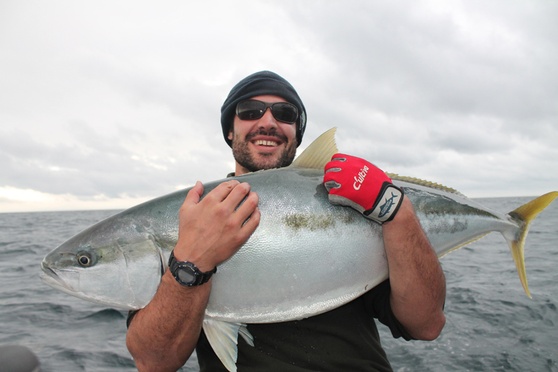
Specialist Bay of Plenty kingfish charter skipper Ben Pokaia shares 10 areas to concentrate on when targeting these great sportfish with jigs.
While many anglers have firm ideas on the best ways to get kingfish biting jigs, few are lucky enough to actually fish for them as regularly as I do. So here are my top 10 tips – and please note that the few brands mentioned have been tried and tested for years.
First, you need to get the right gear to do the job…
1. REELS
There so many options out there to choose from. My advice is to buy quality if serious about jigging for kingfish. The fish you are targeting are hard fighting, and the jigging action is repetitious, so a sub-standard reel will soon fail.
To give you an idea what’s possible, we use the Shimano Trinidad 40N as a jigging reel/live bait reel. They are four years old, have been given an absolute thrashing, and are still going strong. Another brand that stands out is Accurate jigging reels – these are built as tough as nails and will last for a long time.
As for the drag pressure set, generally this should be around one-third the mainline’s breaking strain, but I tend to bend the rules a little here. Instead, as I use 37-45kg (80-100lb) lines, I set the drag by taking two wraps of the main line around my hand and increasing the drag pressure until quite a bit of force is needed to get the line off the reel. This can equate to half the line’s breaking strain or more – but keep in mind my knots and tackle are all topnotch, so I know I can rely on them.
2. RODS
With rods the sky is the limit. My advice is to figure out where you’re going to fish most of the time, then choose your reel and rod combo to match this. On the boat we run 400g rods as our main set because they double as live-bait sets. We also have a few 150g sets for jigging lighter lures. Again, match your rod with the size lures you think you’ll be jigging most of the time.
3. LINE AND LEADER
We use Jerry Brown 45kg (100lb) hollow braid in 10m colour increments. In my experience this is the Eveready battery of braid – it just keeps going and going. “Why so heavy?” you may ask. The answer is: “Because it gets thrashed day-in, day-out on a charter boat – and anyway, the Jerry Brown 100lb is smaller in diameter than most other types of 80lb braid.
The great thing with this braid is that when your reel’s line load gets low, a joining splice and top-shot will get you back in action.
When it comes to leader material, you can get lost in the options. I use Black Magic ‘Tough Trace’ in 130lb, which is very strong and up to the task of dealing to massive kingfish with jigs or live baits.
4. KNOTS
When it comes to knots, I have a few tried and tested favourites that I confidently stick to, knowing they will withstand the punishment that kingfish inflict.
First off, my braid-to-leader connection is provided by the FG knot. If unsure of this knot, check out
www.youtube.com/watch?v=Rj9I4j0Jj9c. I can have this knot done in under a minute, which is why I like it.
I use the good old Uni knot to attach the jig to the leader – fast and simple, and I have not yet had one fail.
5. TERMINAL TACKLE
My standard go-to terminal-tackle setup for over eight years might be on the heavier side, but has never failed me. Besides, we are talking about targeting one of the hardest fighting fish, kilo for kilo, in the ocean!
The aforementioned Uni knot is tied to the jig’s Owner #9 solid ring; for added protection, I use a plastic thimble for the leader to go around, as this tends to be the weakest point. The thimble is worth its weight in gold.
The split-ring is also an Owner, size 11H. It’s so heavy-duty that a solid pair of split-ring pliers is required to open it. I use the size 11H split-ring because it does not lose its tension after being opened to change jigs time after time. I have seen lesser spit-rings remain open, and as the angler rips the jig around, it works its way free. This simple tackle component is a good investment.
6. ASSIST HOOKS
My opinion with assist-hook rigs is that you need to make your own. The rigs that come attached to jigs in the packet are often not up to the job and can fail at some time – probably while hooked up to that mega-king – leaving just a short length of assist cord dangling from your lure.
There are all sorts of jigging hooks on the market, but my favourites include: the Jig Star Ninja 13/0; the BKK jigging hook, size 11/0; and the Swage in 13/0. These big hooks are less likely to get fouled on the lure and are easier to remove from the fish.
I position this hook on the assist cord so it ends up about a third the way down the jig’s length, leaving the hook reasonably near the top of the jig, where kingfish tend to strike.
As for assist cord, I really like the Varivas SS Assist Cord in size 80 (330lb). This is top of the line and not a cheap option, but will stand up to the sharp teeth of our beloved ‘couta, as well as other sharp-toothed predators in the tropics. My experience indicates this cord will last for so long that the only time you’ll need a new one is after getting busted off by a freight-train fish or upon hooking the bottom – it’s that good!
7. MAKE A FISHING PLAN
The first thing I do before leaving is have a plan in my head of where we are going to fish throughout the day. Things I consider include: the time of the year and where I know fish will likely be holding; the direction, speed and change of tides through the session; and how to pace ourselves so the whole crew can jig for most of the day.
A typical day plan involves starting off at a spot that’s not too deep – 50 to 70m say – where the team members can dust off the cobwebs, get their rhythm, and try to get a few fish under their belts. Then, once the arms are warmed up, we head out a bit deeper – typically 80m to 150m – and get stuck in.
I will try to have around three or four fishing spots in mind, because chances are we will have to do some searching to find a ‘bite’. However, in all cases the most important thing to remember is to be persistent – don’t give up – and if catching small fish, just keep going, ’cos if you put in the hard yards you will be rewarded.
8. LOCATING KINGS
When out targeting kingfish on a rock or reefy structure, the fish will move throughout the tide, so when it slows and/or changes direction, the baitfish/kingfish will usually change location, too. Sometimes though, they just seem to simply swim off, and your hot bite suddenly turns cold. In all cases a good fish-finder will prove invaluable.
9. UNDERSTAND YOUR FISH-FINDER
I am very fortunate to have the latest CHIRP sounder from Garmin installed on the boat. The great advantage of a CHIRP sounder is that the target separation is insane; all the guesswork determining what marks are baitfish and what are kingfish is potentially taken out of the equation with a sounder like this one.
Anyone who has been on the boat will know much detail my electronics show, and how I am fixed to the screen searching for the fish. (I don’t mind giving anyone advice about what I am doing/looking for as well, so feel free to ask.)
10. JIGGING ACTION
When it comes to the actual mechanical-jigging technique, here are the basic actions involved: lift the rod and take a half wind on the reel, then, and as you drop the rod, take a half wind of the reel. Keep repeating till you hook-up.
Over the years I have seen some very interesting jigging actions from my widely varying customers, ranging from a very fluid, rhythmic action to extremely uncoordinated movements that see the angler’s body moving more than the rod itself. But you might be surprised by the actions that get kingfish to bite. One angler stands out in my mind. A male in his mid-50s, he asked if he could “have a crack at this jigging thing”. First drop he was waving the rod around and having a wind every now and again. Then, just as he said to his mate, “Bugger this!” the line came tight and suddenly he was hanging on for grim death. He ended up with the biggest kingfish I have seen on a jig, going into the mid-40kg range. So what I am saying is, if seeing fish on the sounder and they are not biting, change your action – you never know what might work.
A few extra tips when handling fish for release and photos...
When we land the trophy fish, or, in fact, any fish we choose to release, maximum care should be taken to ensure the fish is let go in the best possible condition. As the fish comes to the side of the boat, I lip-gaff it and, if possible, grab the tail to lift over the gunnel, where I have a wet towel waiting on a chilly bin. From there I remove the hook, give the angler a quick breather, then pass over the fish using wet hands for the money shot – after all, they’ve generally earned it!
|
|

Fishing Reports Visit Reports
Manukau/West Coast Fishing Report - 15/10/26
Big spring snapper in 60 metres. The El Niño weather pattern isn’t going to be... Read More >
Rotorua Fishing Report - 15/10/26
Solid start to the season! The Rotorua lakes have all started the season well, and... Read More >
Tutukaka Fishing Report - 15/10/26
Big snapper in shallow. Things remain relatively quiet on the fishing front out of Tutukaka,... Read More >
Tauranga Fishing Report - 15/10/26
Bait and temperature on the rise. It’s been great to get out and see some... Read More >


Tuesday 20 October 2026
Major Bites
 -
-  -
- Minor Bites
 - -
- - Wednesday 21 October 2026
Major Bites
 - -
- - Minor Bites
- -
Comments