
Spearfishing for beginners
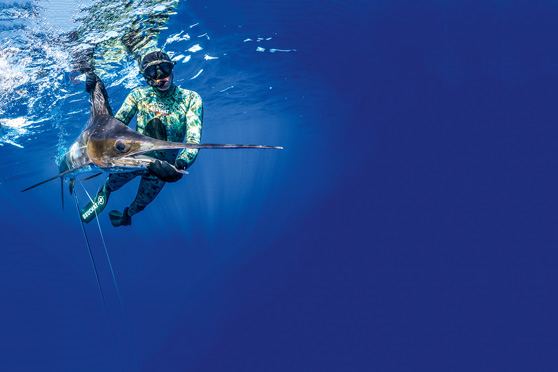
While many divers use the sport to provide food for the table, sadly there is an element among them who still trophy hunt, which continues to provoke heated debate. But spearfishing is unquestionably the only truly sustainable fishing method where the spearo is one-on-one with the prey in an environment where he’s at a disadvantage. Underwater, the spearo can be selective when it comes to the fish he takes.
This ability to size up the fish before it is shot is why spearfishing has no by-catch. By-catch is non-targeted fish caught using other fishing methods. An example of by-catch is catching a fish that is too small when fishing with a rod and reel. These fish can be injured enough to die shortly after they are released. The spearo only takes what he will consume.
If you want to go spearfishing you will certainly benefit by learning to use free-diving techniques, especially breath-holding, to increase your depth confidence and dive duration.
Learning such techniques allows you to better access species or specimens that would otherwise be out of reach. Just duck-diving and chasing anything you happen to see won’t get you to the top of the predator list!
You need to understand your prey, where it is likely to be, at what depth, and how to stalk it. And you will need a variety of hunting techniques in your armoury – one method won’t suit every kind of fish.
Practicing free-diving techniques will increase your bottom time and reduce the feeling of ‘discomfort’ that signal when you should swim for the surface. It will certainly increase the opportunity for you to find and select the prey you want, rather than having to take an opportunistic approach of shooting whatever happens to present itself.
There is no doubt free-diving can be an alternative experience to scuba diving. I can recommend no better way of exorcising the stresses of the day and relaxing the mind and body.
Whilst there is a cross-over between free-diving and spearfishing equipment, there are some fundamental differences. Understanding the equipment that is needed is essential if you want to have any chance of catching something. Otherwise you will just waste time and energy endlessly chasing ‘the one that got away’.
Additional equipment
New Zealand’s spearfishing conditions are unique, from water quality through to fish species. We need to be vigilant when selecting the most appropriate equipment to maximise our potential catch.
Equipment can vary between environments, the hunting conditions and the species we are targeting. Apart from some of Northland's offshore islands, New Zealand waters are usually relatively cool, and of low or medium visibility. These conditions, for example, lend themselves to shorter European-style spearguns for an everyday all-rounder.
Spearguns: Length is often mistaken to be directly proportionate to power. While the two are related, it is ultimately the length and weight of the power bands that affect shaft speed. If the barrel and mechanism are sturdy and of a good quality, the rubber or number of rubbers can always be modified for more power. A good rule of thumb is a shorter gun in lower visibility for faster tracking and maneuverability, and a longer gun for greater range in clearer water.
Buoys: A high-visibility buoy is an essential accessory to any gun in any situation. A float line is attached to the butt of the gun and runs around 15-30 metres to the buoy on the surface. For safety’s sake, the fluorescent orange colour and a ‘Diver Below’ flag serve as a marker for vessels to keep clear when you are surfacing. The buoy also acts as a fish-stringer on which to store your catch, eliminating the need to transport the catch to and from the boat or the shore. The float also keeps dead fish at a distance, should a larger, toothier creature become interested in it.
Wetsuits: Let’s face it – New Zealand doesn’t have the most tepid waters in the world and spearos are especially susceptible to the debilitating effects of cold. Deep, easy breaths slow your heart rate and ultimately lower your core body temperature. A lack of vigorous movement and long periods spent in the sea mean that old, poorly fitting wetsuits won’t keep you warm enough.
Two-piece, open-cell wetsuits have the best seal system. Open-cell neoprene maintains direct contact with your skin, without a layer of water between the two as in a traditional system. An attached hood and no zips allow fewer entry points for water to find its way into your cosy cocoon.
Fit is key, so the tailoring and number of panels are the first things you should be looking for in a good suit. Making sure that there are no seams running through the backs of the knees, for example, which will lessen the likelihood of rash. Pre-formed tailoring though the arms, legs and chin will mould anatomically. Better fit results in ease of movement and ultimately in the preservation of oxygen.
Wearing a neoprene sock makes for a more comfortable fin fit and gives a more fluid movement between your foot and the rubber pocket. An open-cell sock completes the total body seal with your suit for those epic August sessions!
A synthetic leather glove is adequate for a good grip on your catch before it is iki-ed, but a good 4mm neoprene glove can prove warmer. Once again, Supratex is a very hard wearing and flexible material for both the bottom of socks and the palms of gloves.
Fins: Free-diving blades are up to twice the length of a standard fins, increasing the ‘working area’. The blade works on reactive thrust, a flicking movement at the tip, as opposed to the active thrust of a short blade. Using a long, slow kicking style from the top of the thigh maximises power transfer and minimises oxygen consumption. Any free-diver will vouch for the importance of a good fin to increase bottom time and to get you back to the surface in a hurry.
A closed-foot pocket is not only the most comfortable option, but the most effective system of power transfer. A soft upper and stiff sole, (combined with a good amount of width for the ‘Kiwi foot’) are points to consider.
A blade should be nice and light and the foot pockets have the option to remove the blade for replacement or upgrade. Material such as fibreglass or carbon fibre are extremely strong and light, increasing the whipping effect for more speed.
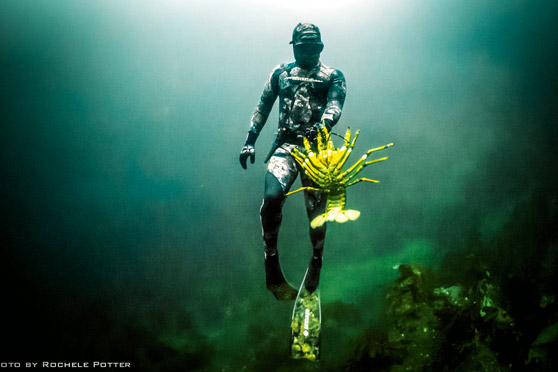
Masks: When selecting a mask, comfort and fit are paramount. A good fit makes for a good seal, which in turn eliminates any leaking. A high-quality silicone skirting with a double edge will mould to the anatomy of your face over time and add to the comfort factor. Good silicone also reduces any sensitivity or allergy issues for your skin. Black silicone is sought after to reduce light intrusion and concentrate focus towards the task on hand. A low internal volume makes equalising easier and provides better peripheral vision as the frame is closer to your eyes.
Snorkel: A snorkel shouldn’t have a purge valve. As a scuba diver would know, bubbles make noise, and noise does not attract most fish. The colour, as with other equipment, should be subtle, in black or a camouflage shade. Remember to remove your snorkel from your mouth when diving to flood it immediately and clear all bubbles and lift your head right above the surface of the water when clearing it after a dive.
Summary
Adopting the skills of free-diving makes perfect sense if you want to improve your proficiency, success rate and safety in this vastly popular sport.
Everyone has their own tricks to achieve their longest breath hold or to bring in their biggest fish but applying the fundamentals of free-diving techniques and adapting your equipment to best suit the territory and sea conditions you can do even better.
|
----- Advertisement -----
|
This article is reproduced with permission of |

Recent Forum Posts Visit Forum

FC 595 For Sale
in Buy Sell Trade or Exchange29 hours ago
Kevin.S
I have reluctantly decided to sell my boat. It really is not getting enough use to justify keeping it. It is a 2016 FC 595 with...

2026 Grunter Hunter
in The Briny Bar45 hours ago
smudge
Bugger, the only way we can swap tickets is like for like and while a couple have come up they have been club member tickets. Hope...

Manukau Harbour & West Coast fishing
in Fishing Reports69 hours ago
smudge
That's a great catch Schecter! Kayak fishers do it so much harder than anyone else. It would be an absolute pleasure to hand over the $5k...

Knife sharpeners
in The Briny Bar116 hours ago
krow
I'm about to order a couple from Amazon. Check your PM Smudge...
1989 Evinrude 90hp V4
in The Boat Shed117 hours ago
bricker
Inherited the above outboard on a boat - is in very good order with little use. The serial number is A1351974. Is there a way of...

Auckland Yakkers
in Yak Yak Yak195 hours ago
BananaBoat
Out from Mission bay this evening. Went to the red marker by Mission & Kohi. Never fished this area beforeHad a quick looksie for some structure....
Yellowfin
in The Briny Bar212 hours ago
krow
I heard there were Yellowfin East of the chicks yesterday but I'd suggest this is unusual this late in the season as the water is cooling....

Mac'nificent Autumn Fishing....Mokau!
in Fishing Reports238 hours ago
Snappa Geoff
Thankyou for the replies guys... Tagging some bigger fish is a good idea Krow! but it doesn't interest me enough to get involved....
Yozuri crystal minnow deep diver lure 6"?
in Popper and Topwater Fishing278 hours ago
SeniorInvissibl
Anyone ever used this lure before to provide feedback? I've never used yozuri before.The package states it dives to 20 feet, I'm using it to troll...
Comments