
Spearfishing - Choosing the Right Speargun
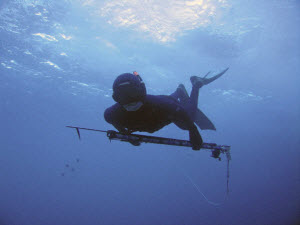 If you look at old magazines from eras gone by, the speargun has changed very little.
The basic principles are still the same: nice snug handle, tube or wooden barrel, a basic head that contains the rubber, and a reasonably light spear shaft.
In today’s world of bigger, longer, faster, lighter spearguns, with more rubbers, camo paint, fatter shafts, drop-off heads, double spears etc, you have to ask: does it really make a difference?
I have been a spearfisherman for some 38 years. During this time I have competed in many countries around the world against the best, and seen spearfisherman win the world champs with a basic aluminium tube gun with no camo on the outside, no drop-off heads, a standard set of 19mm rubbers and no rail on top of the barrel, just a basic tube with no guides.
What these guys concentrate on is getting the basics right: they are fit, they know the environment they’re fishing in, and their gear is checked and re-checked before the event to make sure the spear is straight, the tip sharp, the mono has no nicks in it, the rubbers do not need replacing, and the wishbone will last.
A question I regularly get asked is: why not pneumatic guns? Well, they are a little more complicated when things go wrong, are never allowed in competitions, are more expensive to purchase, heavier to use, and potential records are not recognised if the fish is shot with one.
I have heard spearfisherman so many times blame their equipment for failing, when nine times out of 10 it is actually the spearo at fault.
Here are a few simple points to consider.
What size gun do I need?
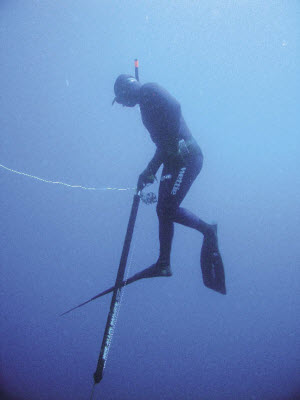 Too many spearfisherman get sold a gun that is too long. In New Zealand the maximum length you need for day-to-day spearing is a barrel around 110cm to 120cm. Do not buy anything bigger until you have a gun this size.
A gun with a 130cm barrel will accommodate you well in mid-summer in nice clear water or when targeting kingfish, but try hunting around the reef in our normal conditions and you will find the gun too long. Never buy a 140cm barrel gun or bigger. In my experience very few people are accurate with a gun this size and some days you will hardly be able to see the end of your spear.
These longer guns are designed to shoot fish in the tropics. The technique mostly used is to lie dead-still on the sand, gun extended in front of you, while waiting for fish to approach. Generally in the warm, clear water the fish stay a long way out and require a long gun for long shots that are mostly in front of you. Here in New Zealand we have to be able to move a gun from side to side with ease – something that’s hard to do with a long gun.
How many big fish do I really shoot each year?
I spear with a 6.5mm shaft all year round, as I like the speed and accuracy of a lighter shaft. Thicker shafts are slower and maybe not as accurate.
I shoot several kingfish each year and very rarely do I bend the shaft, because I can generally shoot fish in the desired spot. Accuracy is more important than shaft strength.
How much power does my gun really need to be effective?
Rubbers almost turn into a macho thing. Many guys want the largest diameter and several of them; they feel it will make a shaft shoot further. Nothing could be further from the truth: if you overpower a shaft it comes out with a wiggle, the back wanting to overtake the front. At times I have seen mechanisms shear off due to the pressure of too many rubbers – this can be extremely dangerous and hard to repair if you do not have the spare parts with you.
I have recently gone back to using a very short pair of 16mm rubbers on my 120cm gun, and find it extremely powerful and accurate. I have taken several long shots at big snapper directly below me in deep water – the hardest shot. With bigger rubbers I would probably have been dubious about making the shot, but each time I have successfully landed the fish with my lighter rubbers.
Does a railgun really make a difference?
Many think this makes a gun shoot straighter. Again, it’s been proved not to be the case: a spear slides on the water sitting on top of the rail the same as when fired from a plain tube gun. I have used plain tube guns for years and find them extremely accurate with nothing to guide the spear but the hole in the muzzle. A rail also adds mass to a barrel, creating more water resistance when swinging a gun through the water.
The upside to a rail gun is it’s much easier to slide your spear in and locate the mechanism.
Does my style of diving warrant a light or heavy gun?
Barrels should be a major consideration. I prefer carbon-fibre as I spend a lot of my diving time hunting snapper. A lightweight gun is better for my technique. I hold the gun by the top of the handle, well back behind me, with the tip of the spear just in front of my head as I sneak over a rock. Aluminium is too heavy for this and also noisy should I accidentally bang it on a rock. The downside to carbon barrels is that they can be broken and are susceptible to wave and surge action, making it hard to hold them steady and track a fish. Also if you want to drop your gun on the bottom while hunting a crayfish, carbon-fibre guns tend to float away and should be anchored. This can be done by placing a small rock on top of them or pushing your spear tip into a hole to hold it in place.
What handle suits my shooting style?
A comfortable handle is a must. Make sure it feels like an extension of your hand: you must be able to get a firm grip, and the trigger-guard area has to be large enough to get a gloved finger through. Check the handle is not too short. It should extend a little below the heel of your hand to provide leverage for tracking a gun up or down.
Make sure the entry to the mechanism is wide enough for the spear and the piece of mono that you string it up with – some are too tight and make it difficult to locate the spear.
Make sure the handle will take the load that a fighting fish sometimes puts on it. Your body weight as it’s dragged through the water behind the gun while connected to a fish will put huge strain on this area.
Open muzzle or closed?
Open is certainly nice to shoot with, but fiddly when trying to get the line to wrap over the top of the shaft and around the front. Closed-muzzle guns can be quicker, but are a little harder to sight along. There is also debate as to the type of throw a rubber gives with an open, loose-fitting rubber compared to the tighter fitting closed-muzzle configuration.
We each have our favourites. I base mine on years of using nearly every style available, and working out what is right for me and the conditions I hunt in.
 |
This article is reproduced with permission of |
Recent Forum Posts Visit Forum

FC 595 For Sale
in Buy Sell Trade or Exchange29 hours ago
Kevin.S
I have reluctantly decided to sell my boat. It really is not getting enough use to justify keeping it. It is a 2016 FC 595 with...

2026 Grunter Hunter
in The Briny Bar45 hours ago
smudge
Bugger, the only way we can swap tickets is like for like and while a couple have come up they have been club member tickets. Hope...

Manukau Harbour & West Coast fishing
in Fishing Reports69 hours ago
smudge
That's a great catch Schecter! Kayak fishers do it so much harder than anyone else. It would be an absolute pleasure to hand over the $5k...

Knife sharpeners
in The Briny Bar116 hours ago
krow
I'm about to order a couple from Amazon. Check your PM Smudge...
1989 Evinrude 90hp V4
in The Boat Shed117 hours ago
bricker
Inherited the above outboard on a boat - is in very good order with little use. The serial number is A1351974. Is there a way of...

Auckland Yakkers
in Yak Yak Yak195 hours ago
BananaBoat
Out from Mission bay this evening. Went to the red marker by Mission & Kohi. Never fished this area beforeHad a quick looksie for some structure....
Yellowfin
in The Briny Bar212 hours ago
krow
I heard there were Yellowfin East of the chicks yesterday but I'd suggest this is unusual this late in the season as the water is cooling....

Mac'nificent Autumn Fishing....Mokau!
in Fishing Reports238 hours ago
Snappa Geoff
Thankyou for the replies guys... Tagging some bigger fish is a good idea Krow! but it doesn't interest me enough to get involved....
Yozuri crystal minnow deep diver lure 6"?
in Popper and Topwater Fishing278 hours ago
SeniorInvissibl
Anyone ever used this lure before to provide feedback? I've never used yozuri before.The package states it dives to 20 feet, I'm using it to troll...
Comments