
Sabiki Techniques - Makin' Mackerel (2004)
Catching your own bait is less popular these days, probably because so much high-quality frozen and salted bait is readily available.
Nevertheless, better anglers still make the effort when the opportunity arises because fresh is best. Nothing beats a wriggling live bait, or a twitching, butterflied mackerel trailing a fighter-plane plume of fresh blood as it sinks slowly towards the bottom.
Such baits can turn a dull day into one of celebration, so starting a day with a tank-full augurs well for a successful trip.
Bait galore
New Zealand waters contain plenty of potential bait species, including pilchards, sprats (herrings), anchovies, mackerel, squid, mullet, flying fish and piper, as well as larger species such as kahawai, skipjack tuna, trevally and barracouta. All catch fish, either used whole or cut into smaller pieces, but mackerel tend to be the easiest baitfish to catch and are attractive to an assortment of predatory fish.
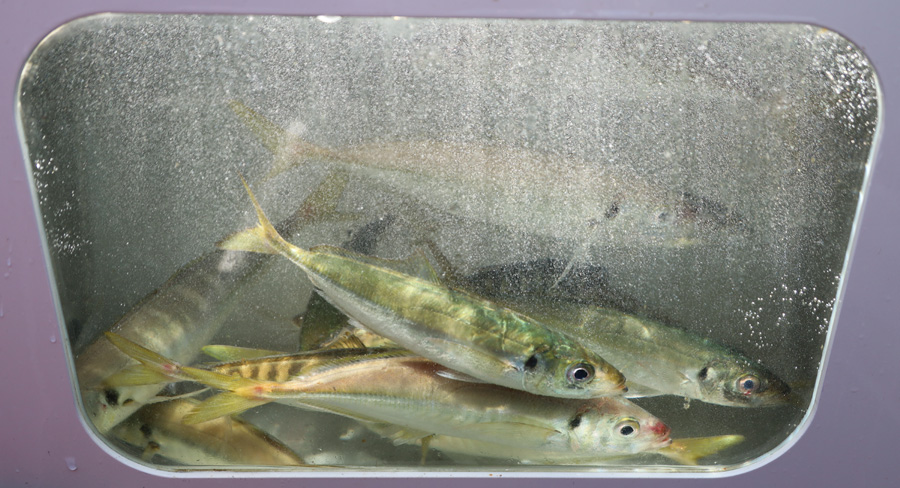
We have several species of mackerel in New Zealand, but the most commonly encountered is the yellowtailed variety, followed by koheru and blue mackerel, otherwise known as slimy mackerel. These baitfish species have helped me hook more kingfish, hapuku, marlin, yellowfin tuna and big snapper than all other bait types combined — so it’s no wonder I’ve worked hard to become good at catching them.
The right stuff
What makes a good mackerel fisherman? Mostly it involves using the right tackle and technique at the time, but the flexibility to try something different when the tried-and-true fails is also important.
Rod and reel outfits should be small and light enough to hold and work effectively — for hours if necessary. Typically a small spinning or baitcasting reel loaded with 3-4kg nylon and matched to a whippy, two-metre rod is used. It’s easier to impart movement to flies and jigs with whippy rods, and a ‘forgiving’ action helps absorb sudden bumps and bangs that often cause the soft-mouthed mackerel to rip free.
Fill up on flies
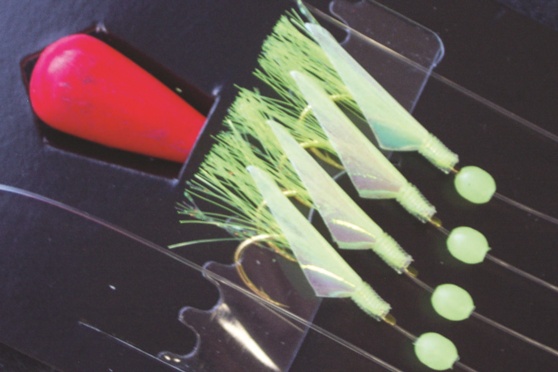
Make sure you have a decent selection of bait flies (sabikis) of different types and sizes. Although the ‘original’ white ‘fish-skin’ wing and fluoro-red snooded flies so commonly available do catch fish, particularly when the mackerel are numerous and hungry, it takes a better calibre of sabiki to do well consistently. This usually means paying more money, but flies that ‘cream’ the baitfish equate to less time spent bait fishing, leaving more of the day to hook whoppers, so they’re a worthwhile investment.
The most effective sabiki flies tend to imitate the mackerel’s favourite foods — krill or whitebait, for example — and are often accompanied by accessories and/or properties that help stimulate the mackerel into biting.
The Black Magic and Hyabusa are very good options and have produced excellent sabikis that mimic krill and are deadly.
Another sabiki rig that worked particularly well over the years was the Kilwell Jig Rig 121, but unfortunately these flies are long gone. Consisting of a chrome head and a see-through body covering a red-thread ‘gut,’ I’ve never seen anything that imitated a small school of whitebait/juvenile anchovy quite so effectively.
But natural isn’t always best. For example, when night fishing, especially deeper down below the spotlit surface layer, Black Magic’s ‘Midnight Mackerel’ take some beating. Their luminous and fluorescent qualities combine to produce something especially attractive to mackerel. Again, by joining two sets together, one of the flies is more likely to be presented at the right depth. Where fish hold in the water column can be very specific, and this changes from moment to moment.
Of course I haven’t used all the flies available, as there are hundreds hanging around on shop walls waiting to be discovered and still more being created even as you read this.
But don’t be daunted by the big selection on offer. To start with, get some reasonably heavy-duty pink-shrimp imitations in size 10, as well as some Midnight Mackerel packs for night fishing in the same size. Then, just in case, get some smaller shrimp-type flies for smaller mackerel and pilchards, along with two or three packs that suit your fancy in different sizes. Even if the latter prove relatively ineffective, they can still be used in conjunction with bait — but more on this later.
Daytime boat tactics
A fish-finder is the easiest way for boaties to find schools of mackerel during the day and will also show you the depth they’re holding.
When a decent-sized school is found, reverse the boat up a little to get back on top of the school, possibly taking the current direction into account.
Your flies’ sinker should weigh at least an ounce — two is better — and streamlined shapes are best. So much weight may seem like overkill, but in fact allows the flies to fall more quickly in response to the rod’s action for a jerkier, more realistic movement, and the heavier weight helps maintain pressure on the fly-string throughout the retrieve, making tangles less likely when multiple hook-ups occur.
As the flies descend, it pays to slow them occasionally, just in case. When you guess they’re near where the fish are holding, stop every metre or so for an experimental jiggle before continuing the drop. At all times be vigilant for any sudden jerks or line-slackenings that might indicate biting/hooked fish.
When you’re in ‘the zone’, just thirty or forty seconds is enough to get a bite or hook a fish if they’re present. So if nothing happens, drop down a little deeper, or wind up slightly and repeat the process. And if you reach the bottom, it pays to spend a little time there, unless the fish-finder suggests the fish are higher up.
The jiggling movements you impart to the flies will have a major impact on the number of fish you catch (or don’t!). Most importantly, DON’T use exaggerated arm movements to sweep the rod upwards, as many fishers do; instead, concentrate on producing a constant, erratic succession of short, sharp rod jerks while simultaneously sweeping the rod around slowly, first one way and then the other. Mentally picture what a small, frightened fish looks like when it swims, and try to imitate that action.
It’s also important to keep yourself updated on the depth of the mackerel school(s). I suggest one person be left in charge of calling out the fish-finder depths every thirty seconds or so, so that other angler(s) can adjust their fly depth accordingly.
If the mackerel visible on the sounder prove hard or impossible to hook, try replacing your flies with something smaller or different — or go in search of another school. The fish on the finder may be too small or simply not biting for fishy reasons of their own.
Sooner or later you will get bites. This often takes the form of a slackened line, the fish reacting to the weight of the sinker by pulling up against it. Start winding in immediately — but slowly, steadily, and with a reasonably light drag. Retrieving helps keep the flies taut so tangles are less likely, but still allows the fighting baitfish to whip the remaining flies around, often attracting more strikes in the process. As for the light drag, this further aids the flexible rod by helping to soften sudden bumps and bangs so that fewer fish rip off — it is also why you should keep rod-pumping to a minimum.
Once your flies and mackerel reach the surface, wind down to within a few inches of the swivel and smoothly lift the string over the side with the rod, before clasping the sinker with your free hand to control the bait string. This makes it easier for the ‘de-baiter’ —if you’re lucky enough to have one — to remove the mackerel. It also helps prevent flies snagging nearby buddies.
The other popular method used to catch mackerel during the day is anchoring in some current over, or near, foul ground and berleying. If it’s not too deep, berley from the surface, otherwise a weighted berley system a few feet up from the bottom is better.
It is important not to berley so hard that baitfish eat their fill and move off. Also, flies must be presented at the same depth the fish are feeding. (See ‘night time tactics’ and ‘auto baiters’ for baiting specifics and techniques.)
Night-time antics
The success of overnight and long-range trips can be dependent on your ability to ‘make bait’, which is often done while anchored in a sheltered bay or cove for the night. Although ‘me old favourite’ shrimp-type sabikis can produce right through to murky twilight, after that they tend to be less reliable. Bright deck lights can keep them catching all night long — sometimes — especially if they’re not dropped down too deep.
However, I generally change over to Midnight Mackerels after dark — or whitebait-type imitations if I see lots of them swimming around in the boat’s light.
When fishing unbaited flies at night, it becomes even more important to cover as much of the water column as possible. This means constantly dropping and raising big strings of flies (six to eight flies if possible) to cover slightly different depths until you start to connect. And remember: the depth can change from minute to minute.
Yep, night fishing for mackerel can be tough, so a few tricks up your sleeve can cut your session short by several hours. It’s nice to get to bed before midnight when you’ve possibly got a big day ahead.
In addition to using light as a bait attractant (sometimes less is more, but more on that later), berley and bait can also be used to help ensure a reasonable bait supply.
Tie the berley bag where it can be seen in the bright light of the cockpit or spotlight, and make sure a steady stream of goodies flows out of it. Sometimes it takes several hours for the berley and light to attract the bait, so start both as soon as possible and don’t give up too quickly.
My favourite bait for mackerel is squid because it’s reasonably tough, can be cut into nice slim, bite-sized slivers with a knife, and has a light colour that allows me to tell when a mackerel has eaten it by suddenly ‘winking out’.
Arm each hook with a slender squid strip or tentacle, taking care to leave plenty of the sliver dangling free and the point and barb of the hook well exposed. While this is a bit of a hassle — particularly as re-baiting is needed every few minutes or so, even when mackerel aren’t removing the baits, because the flavour washes out — the good news is that you no longer need to do any more jiggling. Indeed, moving the baited flies in anything other than the slowest of sweeps is unproductive. Instead, simply suspend your flies where the mackerel seem to be holding and wait for bites. As soon as you get one, strike gently and hopefully you’ll be hooked up.
Usually the best place for your baited flies will be where mackerel are visible in the berley trail. Lifted and dropping the berley bag produces more tidbits, encouraging mackerel to feed with greater gusto, but don’t feed them so heavily that they fill up and no longer want your baits.
Sometimes mackerel will not be visible but are hanging around deeper down. This often happens when the moon is full, which diminishes the effectiveness of powerful ‘bait lights,’ or when predators are on the prowl.
In these circumstances it can actually be better to turn the bait-lights off or fish in areas protected from the brighter light — especially if you have taken the trouble to ‘charge’ the luminous beads on your flies with a bright light before dropping down. In all cases, anglers with longer sets of sabiki flies will do better, as presentation at the exact feeding level is more critical in the dark.
Sometimes mackerel simply will not take your flies, yet they can be seen chasing and slashing at various organisms swimming around on the surface.
Try removing the sinker and ‘flylining’ for them, slowly trolling the ‘naked’ krill or whitebait imitations across the surface. This can be lethal — as can a string of squid baits drifted back in the berley. Of course, this method can also lead to some pretty horrendous tangles, with trailing flies whipping around wildly as the mackerel are brought struggling on board. Therefore, it’s sometimes better to stay simple, and drift a single, unweighted or very lightly weighted bait naturally amongst the berley particles.
Auto-baiters
At times anglers will have other priorities ahead of catching bait — such as nailing a big snapper or hooking night time kingfish — but would still like a few fresh baits if possible.
During the day, especially when there’s a bit of a joggle, a set of flies, either baited or ‘naked,’ can be set in the berley trail and left to look after themselves. As soon as the rod tip begins bouncing, the angler ‘downs tools’ for a moment and retrieves the baitfish, often immediately converting it into a fresh and tasty bait.
Caring for livebait
A lot of what ultimately happens will depend on the condition of your livebaits, so look after them as well as possible. Start by keeping contact to an absolute minimum, especially with baits to be used on long-range trips. Any handling produces skin damage, which often develops into an infection after a day or two, resulting in death.
Because of this, use a wet cloth, or better, the back of a stainless steel butter knife. Slide the knife along the trace and the hook’s shank until it is right up in the bend of the hook next to the mackerel’s mouth. At this point the bend of the hook should be pointing upwards and the mackerel hanging down (see illustration). Give a couple of gentle shakes and the bait’s own weight will cause it to fall off the hook and into the livebait tank or bucket.
Don’t fill the tank too full with baits, as this can be detrimental to their general health. While around thirty mackerel are desirable for a reasonable live-baiting session on a typical day, your livebait tank size may only accommodate 10-20 baits. Overloading it will kill all of them, so it’s better to keep no more than the optimum number of livies in your tank, despatching the rest to a salt slurry to use as nice, fresh dead baits for snapper or ’puka later on.
Try not to mix big live baits with small, unless they are of the same species. An adult kahawai can really stress smaller mackerel, knocking them around to the point they lose condition and die prematurely. Don’t mess up a lot of good small baits for the sake of one big one. If you don’t have a proper tank, it is possible to use a large bucket or container. Again, don’t overload it — around two mackerel to every three litres of water is about right — and completely change the water a few minutes after landing your baits for the day. Mackerel have a protective coating of body slime that is easily wiped off and hangs suspended in the water. This will choke their gills if the water remains unchanged.
After that, check them every quarter of an hour — or if there is an increase in splashing noises, as that’s a sure sign of oxygen deprivation.
As I said at the start, the ability to catch fresh bait can make a big difference to a fishing trip’s success. It may seem a drag at the time, especially if you need a good night’s sleep or are dying to get a bait in the water, but the extra effort will often be rewarded.

2004 - Mark Kitteridge
New Zealand Fishing News Magazine.
Copyright: NZ Fishing Media Ltd.
Re-publishing elsewhere is prohibited