
Baitfish
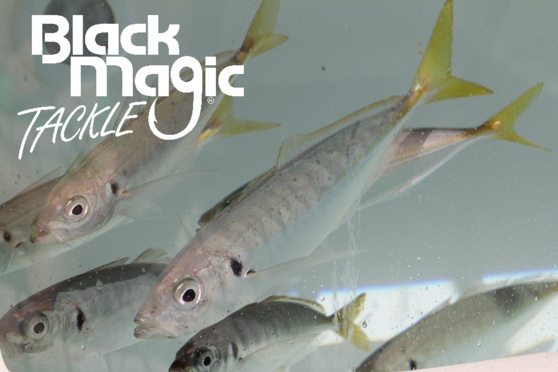
Māori name: Hautere
Scientific name: Trachurus spp
All-tackle NZ record: 1.940kg
Eating quality: Good, but usually used for bait!
Description
Jack mackerel are primarily used as live or dead baits by Kiwi anglers, although some anglers specifically target them for their eating qualities. In Japan, jack mackerel (aji) is often eaten raw as sashimi or cooked deep-fried (karaage) style.
There are three different species of jack mackerel, difficult to tell apart, swimming in NZ waters. They are little fish (generally caught between 15-30cm) that are fast-moving and prey on plankton and smaller pelagic fish like anchovies.
Their distinctive feature is their unusual bony plates (scutes) which cover the lateral line and form a broad spiky keel at the tail. The colour scheme includes a silver-green back that fades to a creamy-white underside and a yellow tail.
Jack mackerel belong to the family Carangidae, which also includes trevally, kōheru, and yellowtail kingfish. They can be distinguished from kōheru by their distinctive bony, kinked lateral line.
.png)
Where to catch
Found right around NZ, jack mackerel school in midwater and range from bays to oceanic islands. They are often encountered in large schools at inshore depths, both over flat bottoms and around reefs. Good areas to start hunting out ‘jack macs’ are sheltered areas like harbours, bays, sandy drop-offs, and shallow reefs – often in depths between 5-25 metres.
Birds on the water (gannets, terns, and/or shearwaters) are a good mackerel indicator, and schools often show on your fishfinder as baitballs in midwater. They also congregate around man-made structures such as bridges and wharves, making them an accessible target for any angler.
When to catch
Jack mackerel can be reliably found throughout the year, although the schools tend to shift around a bit – therefore, where you found them a month ago might not be where they are now. In shallower coastal areas, large swells influence mackerel and often push fish out into deeper water.
Although jack mackerel feed throughout the day, they become more active in the dark, making them a great prospect to catch when anchored up overnight. They are also attracted to lights, meaning wharves and city breakwalls are popular areas for keen aji anglers.
.png)
How to catch
The most common method of catching jack macs is on a sabiki, a string of 3-6 small flies tied on tiny fine-gauge hooks. Keen live-bait fishers generally cruise around and find the bait with the fishfinder. Mackerel sign will either show up as big balls or small scattered shapes around mid-water.
You’ll likely hook several fish on a single drop if you get onto a hungry school. Try to keep the sabiki flies moving. Normally, the best technique is simply to drop all the way to the bottom and then retrieve quite quickly, interspersed with a few jiggly pauses. This way, you cover the whole water column and keep the flies looking alive.
At other times, they can be a tad fussy, so parking up with some berley in conjunction with tiny slivers of bait on the sabikis will help your chances. If you’re catching mackerel under lights at night, micro-softbaits (ajis) or very small jigs can be deadly.
The gear for the job - Black Magic Tackle
The easiest way to gather that live bait? Using quality Black Magic Wasabi and Sabiki rigs, designed specifically to tempt baitfish species and featuring high-quality Japanese hooks, durable monofilament, and realistic flashers that perfectly imitate tiny baitfish or shrimp.
Recommended hooks sizes:
- #10 for sprats, pilchards, small piper
- #7 for piper, kōheru, medium jack mackerel
- #4 for slimy mackerel, mullet, large jack mackerel, and small kahawai
With the right rig and a bit of finesse, you’ll have a live-bait tank full of sprats, kōheru, and slimy mackerel in no time – setting you up for those unforgettable moments when the reel screams and the bait has done its job.
Fishing Reports Visit Reports
Canterbury Fishing Report - 03/09/26
Whitebait season underway. Spring is here, and along with it, the good old Canterbury nor-Wester!... Read More >
Bream Bay Fishing Report - 03/09/26
Fishing hard, weather conditions trying. Cold winds and lots of rain have made for testing... Read More >
Outer Hauraki Gulf Fishing Report 03/09/26
Workups building as spring approaches. Spring is starting to show its hand in the outer... Read More >
Bay of Islands Fishing Report - 03/09/26
Pacific bluefin tuna return. The day after I submitted the last report, we were out... Read More >


Sunday 13 September 2026
Major Bites
 - -
- - Minor Bites
 - -
- - Monday 14 September 2026
Major Bites
- - Minor Bites
-  -
- Latest Articles
How to Catch Sea-run Trout
September 2026One area Greg Morton returns to time again to hunt sea-run and estuary brown trout is the coastal stretch from Christchurch to Southland... Read More >

Garmin Force Kraken + LiveScope Review
September 2026Garmin’s Force Kraken trolling motor and LiveScope sonar system enable positioning, tracking, and targeting fish with a high level of precision... Read More >
How to Catch Snapper on Jigs
August 2026Metal lures have come a long way since the 80s. They now come in all sorts of shapes, colors and weights to suit all situations. Grant... Read More >
Extreme Boats 696 Xpedition Amphibious & 746 Game King Review
August 2026The NZ Fishing News team hit the Hauraki Gulf to check out Extreme Boats' brand-spanking new 696 Xpedition Ampibious & 746 Game King... Read More >

2026 Father's Day Gift Guide
August 2026Our Father's Day Gift Guide has all the inspiration you need to spoil the outdoor-loving dad in your life... Read More >