
Tips to land-based success
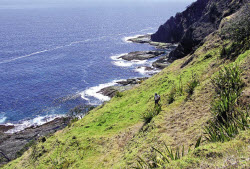 If I had to choose three months of the year to fish the beach or the rocks, they’d be February, March and April.
Looking back over my fishing diary, I note that my personal-best snapper, kingfish, moki and trevally have all been caught at this time of year, so for me this is ‘prime time’.
I bet many other land-based fishos would have similar stories of success to relate from these months. It’s a time of year when the serious ones among us cash in their annual leave and spread far and wide to the likely snapper and kingfish spots of the North Island, and stories of great catches and the ‘ones that got away’ abound. So each year I try to get away at this time for a week in the land-based Mecca of the Far North, but even in my local waters of the lower North Island the fishing can be first rate.
A smart approach and good habits are essential at all times of the year for fishing success, but during prime time they can really pay dividends, often delivering a trophy fish or the bag of a lifetime. So what things should we be doing to ensure we’re really switched on for prime time? It strikes me there is a massive volume of information out there about how to increase your odds of catching a fish from the beach, but filtering through this to separate the really important things from the not so important can be a challenge. When I think back to the days when I was starting out, it was through trial and error, persistence, and a few patient mates that I eventually learned the good oil. The unfortunate part is that others fall through the cracks after a dozen or so unsuccessful trips, convinced that fish don’t swim within a mile of the beach.
To avoid this and to help you maximise the rewards on offer during ‘prime time’ I offer up my top five priorities when chasing fish from the beach. These are not the little things, but the big ticket items that I feel sway the odds significantly in my favour and give me a chance of hooking a trophy or catching a decent bag of fish. They probably won’t appeal if you’re more interested in going fishing just to get out of the house or to enjoy a beer or two on the beach with your mate, but they will help you catch fish.
Fish where the fish are
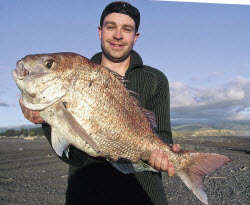 This is the most obvious and most important of the five, and also the most often ignored. There are places that you will catch fish regularly and places you won’t. As a rule of thumb, the further you can get away from fishing pressure and pollution, the more fish there will be. This is the reason my regular ‘local’ fishing spots are at least an hour’s drive from home; why I will drive fifteen hours to the Far North; and why I’m prepared to walk three hours to the best fishing spots when I get there. By putting in this sort of leg work, your catch rates will go through the roof – simple as that.
If it’s hot and sunny, go swimming
There’s nothing like a hot, sunny day to get you enthusiastic about going fishing, and that’s when I see the most people out on the beaches with their surfcasting rod. However, there is not a worse time to cast out a line. You’d be far better to go swimming. Generally speaking, fish do not enter the shallows under a blazing summer sun, and will wait until the light fades before moving into casting range. I like to time my arrival for mid to late afternoon. This allows me to orientate myself on the beach and get ready for the usual bite time that occurs during dusk and into the darkness. On very shallow beaches, like those on the Kapiti Coast an hour from Wellington, the fish often don’t move into casting range until pitch darkness occurs.
Bank your brownie points
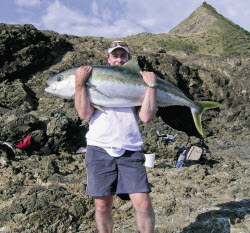 When people find out I’m a keen fisherman, they often ask, “Do you go fishing every weekend?” They are always surprised when I respond that it’s more like once every two or three weeks. I like to bank my brownie points and make a real go of my fishing trips. Like most people, I have work and family commitments that limit my fishing time, so I like to make my efforts count. This means fewer fishing trips, but more serious ones. When I go out I normally pack my 4WD for an overnight journey into a remote spot, and put in twelve-hours-plus on the beach. This allows me to fish through the tides in a proven fishing spot, providing a better than even chance of catching fish. On such trips to the Wairarapa I regularly catch my daily limit bag of finfish (20), normally made up of a combination of kahawai, spotty sharks, gurnard, moki and red cod. Days on the beach in the Far North will turn up similar-sized bags of kahawai, snapper and trevally. This is nothing unusual; my fishing club colleagues regularly produce catches like this. It is simply a matter of using your fishing time wisely. If you’re able, it is also great to be able to pick your conditions so that not only are you putting in the time in the right place, but in the right place in the right conditions. This may mean postponing your trip until the following weekend.
Bait works best in the water
This is also obvious, but often ignored. I regularly see people fishing at the beach who consume most of their fishing time tying rigs and re-baiting, all the while without a bait in the water and with no chance of catching a fish. Working on the law of averages, I like to maximise the time I soak baits. Here are some simple things I do:
• I tie all my rigs at home before I go fishing; with modern fishing rigs and clips there is no need to waste time tying knots on the beach.
• I rotate a series of detachable traces that enable me to prepare new baits while I’m still fishing. When it’s time to re-bait, I simply wind in, clip off, clip on, and recast.
• I use two rods and ensure that at least one rod is ‘fishing’ at all times; with two rods you can effectively do ten hours of fishing in a single afternoon!
• I normally check my bait every fifteen minutes, although when there are lots of ‘pickers’ or sea lice around, you may to check even more often than this to ensure you have bait left on the hook.
Fishing like this is brisk business that won’t allow you to slump back in your deckchair, but it does lift your catch rates!
Another thing about bait
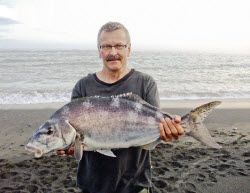 I’m pretty uptight about surfcasting bait. I’ve noticed boat fishermen don’t always treat their bait with the same respect, leaving it out on a bait-board under the hot sun. Maybe it doesn’t matter so much when you can drop a bait directly onto a school of fish in deep water? In surfcasting, with so many added challenges, I don’t take any chances with bait. Often you are dealing with fish that feed warily in shallow water, so you need to make the bait as inviting as possible.
I have no doubt fresh is best. I source the freshest looking trevally and mackerel from the fish shops, put some of my catches straight on ice for bait (e.g. kahawai), and catch my own paddle crabs and carefully pack and freeze them. Last February I lovingly froze and transported some fresh craytails from the Chatham Islands and was rewarded with a NZ record tarakihi (2.3kg) and a 7kg snapper from my home waters. Fish like this are rare in Wellington, and I believe it was the bait that made the difference. In a nutshell, source the best bait and look after it.
As you read this, you have, in my opinion, the three best land-based fishing months of the year ahead of you. It’s an exciting thought, so make the most of it. Applying some thought and pre-planning to your fishing can make all the difference and should bring you the sort of success that will help you endure the winter.
 |
This article is reproduced with express permission of
written by Andy Macleod - 2012 Originally published in New Zealand Fishing News ----- Advertisement -----
|
Fishing Reports Visit Reports
Hauraki Gulf Fishing Report 11/06/26
Workups the best option mid-Gulf for quality snaps and kingfish Fishing across the Hauraki Gulf... Read More >
Bream Bay Fishing Report - 11/06/26
Normal transmission returns! It seems only the hardy have been wetting a line these last... Read More >
Raglan Fishing Report - 11/06/26
Solid snapper hook-ups out deep With the continuation of more settled weather there’s been some... Read More >
Canterbury Fishing Report - 11/06/26
Brave the cold, reap the rewards With a big southerly blow through here yesterday, it’s... Read More >


Major Bites
Minor Bites
Major Bites
Minor Bites
Comments