
Tips for Surfcasting
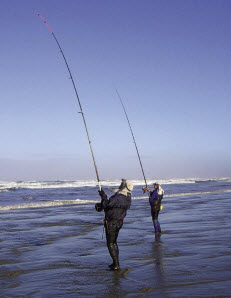 My February 2012 article ‘Keys to land-based success’ outlined five fundamentals to catching fish from the beach or rocks (the article is also available in the ‘how to’ section of the website www.fishing.net.nz if you missed it). To briefly recap, the five fundamentals are:
Put in the effort to get to productive locations
Fish low-light hours when fish come into range
Bank your fishing time and use it wisely
Maximise your bait-soaking times
Source top quality bait and take care of it.
These are determining factors for fishing success which often sway the odds far enough in your favour so you can still catch fish – even after making a couple of mistakes. I reckon they account for about 75% of the overall fishing success equation. The remaining 25% is made up of a long list of lesser components. Identifying and addressing these final pieces of the jigsaw can take your fishing to new levels, but require a good, honest look in the mirror. Here are some things to think about.
The same old methods means the same old results
Like everyone else, we fishermen are creatures of habit – having identified a successful spot or method, we tend to stick with it. There’s nothing wrong with that, but if you want to take your fishing to new levels you’ll need to continually challenge your thinking, even when something is working for you. Visiting new spots with different terrain and employing different rigs, baits and hook sizes are ways of doing this. At the very least you’ll learn a few new things.
Intensity
 Land-based fishing can be hard work, and sometimes hours pass between bites. This is part and parcel of fishing the shallow fringe of the sea, but this disadvantage can be offset by bringing some intensity to your fishing.
The keys when surfcasting are to rotate your baits regularly and minimise the time that your rods aren’t ‘fishing’. As I outlined in my February article, detachable pre-baited traces make this much easier, while on the rocks the key is to keep a consistent berley trail going.
I was firmly reminded of this during a recent session in Parengarenga Harbour. Fishing the final day of a week-long trip, we dispensed the mountain of remaining bait and berley into the water, and after a long afternoon the fish started to show up in the last half hour of fishing. This included several big trevally, packs of kingfish, and ultimately a bronze whaler shark of well over 200kg.
Casting distance
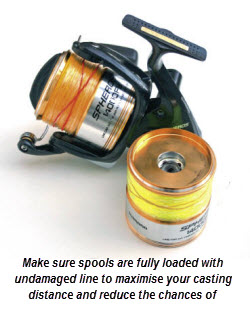
I absolutely agree with the old adage ‘fish your feet first’, but there are scenarios from both the rocks and the beach where casting distance can be crucial to success. ‘Beating the bar’ to fish deeper water on traditional surf beaches is the obvious example. Whilst it may not appeal to you, dry-land casting with a weighted tennis ball is worth the time invested. Here you can focus exclusively on your casting technique and distance without the distraction of fish. Also, even if you’re not a big caster, little things like using light line and ensuring your spools are fully loaded (to minimise friction during the cast) can add 10-20% to your casting distance.
Awareness
 How many times have you heard the commentators talk about Dan Carter’s ‘awareness’ as a rugby player? Awareness is also an important component in fishing success – awareness of the conditions, the opportunities presented by the season and the specific location you are fishing, and most importantly, awareness of what’s going on at the business end of your line.
The ‘aware’ surfcaster will have his eyes religiously trained on the tips of his rods, glancing away to attend to other tasks as he waits, but never for more than a few seconds at a time. I still laugh about a surfcaster fishing 100m along from me in the Wairarapa a few years back. With his rod nicely set, he faced directly away from it, sucking serenely on a cigarette. His rod bent over and a fat kahawai danced a merry jig on the end of his line, clearing the water now and again. No amount of shouting could capture his attention, and by the time he finally did turn around the fish was gone, so he wound up his slack line completely unaware of what had just happened.
Leave nothing to chance
 ‘Leaving nothing to chance’ could entail just about anything, but here are some specific things to think about:
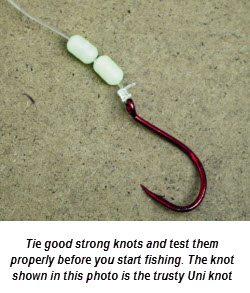
Test your knots to make sure they won’t fail when you’re hooked up – if there is one knot every surfcaster should know, it’s the trusty old Uni knot, which tightens under pressure and is easy to tie. I use it wherever I can.
Use mainline that is undamaged and won’t break under pressure – this is particularly important when targeting heavy, strong fish. I replace my mainline after about 30-40 hours of serious fishing time (three to four ‘trips’ on average), because beyond this can be risky. I buy ‘bulk’ spools of monofilament to keep the cost of line replacement down.
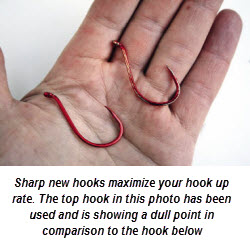
Only ever use new hooks; old, dull hooks will reduce your hook-up rate. Sharp hooks are particularly important when surfcasting because of the generally long distances between you and your hook. In this scenario line stretch hinders your ability to set the hook with a sweep of the rod, so the sharpest hooks are essential.
Consider the different scenarios you could be faced with when you arrive at your fishing spot and ensure you have the right tackle to exploit them.
Nobody knows better than you how to improve your fishing results, but it takes an honest appraisal and a commitment to change to make it happen.
Looking at fishing in this way will surprise many; non-fisherfolk are often gobsmacked when I explain the habits of the serious land-based fishing fraternity. We don’t fit their mould of the happy-go-lucky, beer-swilling fishermen they see on TV (well not all of us, anyway!).
I will never forget the NZACA Nationals at Coromandel when my fishing partner and I woke at 1am to ‘secure’ a likely-looking rock platform in time for start fishing at 6am. This involved scaling a steep escarpment in the pitch darkness, so imagine our horror and surprise when we were well and truly beaten there by two anglers competing in the Veterans category! To me this symbolises the utter commitment of serious Kiwi surfcasters – they certainly take care of the little things!
Quick checklist
•Don’t be afraid to go away from the ‘tried and true’ this means new locations, techniques and rigs.
•Rotate baits and recast regularly when beach fishing.
•Keep a constant berley trail on the rocks.
•Work at your casting distance by practising on dry land with a weighted tennis ball.
•Maximise casting distance by using the lightest line you can get away with and by keeping your spools full.
•Stay tuned to your fishing environment and what’s happening on the end of your line.
•Test your knots before fishing.
•Avoid using damaged mainline.
•Use brand-new hooks every outing.
•Bring the right gear for all the scenarios you could be faced with.
 |
This article is reproduced with express permission of
written by Andy Macleod - 2012 Originally published in New Zealand Fishing News |
Fishing Reports Visit Reports
Canterbury Fishing Report - 23/07/26
Lake fishing strong July is close to an end, our duck season is closing this... Read More >
Northland Fishing Report - 23/07/26
Inshore snapper fishing heating up It’s officially past the halfway point of winter, and the... Read More >
Bream Bay Fishing Report - 23/07/26
Winter kahawai abound Kahawai and kingfish have ‘invaded’ Bream Bay over the last few weeks,... Read More >
Inner Hauraki Gulf Fishing Report - 23/07/26
Choose a spot and stick with it Why the chill factor of the wind affects... Read More >


Major Bites
Minor Bites
Major Bites
Minor Bites
Comments