
Tips for fishing in shallow water
Casting at ripples
It was a beautiful morning at Rangaunu Harbour. Subtle dawn colours were reflecting in mirror-like waters and everywhere there were the ripples and swirls of moving fish.
I had picked a path through a patch of mangroves in order to connect with one of the shallower channels that drain the harbour. Its watershed came from a massive area of sea grass flat. I figured that baitfish, mullet, kahawai and kingfish must pass down this channel on the dropping tide, so I might get a chance to cast a fly to some of them. That was the plan, anyway.
 Immediately it became apparent that water visibility would be an issue. I had some pre-trip hopes that the low-angled morning sun would light up the channel and let me see every fish swimming past, but this was not to be. Instead, the harbour was a shimmering expanse of reflecting silver and would probably stay that way until about 10 o’clock. Passing fish would only be visible as ripples and bow-waves.
So I concentrated on these surface swirls and tried to separate fish from fish. This was not easy because lots of ripples looked the same.
Mullet were common and pushed a lot of water as they moved along. I was fooled a couple of times by small active groups of mullet swimming closely together.
A closer look revealed that these small mullet schools had a non-defined start to their ripple formation (i.e. no central point). This was clear evidence that more than one fish was involved. With practice I managed to identify (and avoid) most of the mullet schools.
Kahawai and large single mullet were more difficult to tell apart. Four good bow waves tracking my way turned into kahawai at the very last minute and sped on by.
However, I noted the subtle differences in the swimming pattern and ripple configuration, and was ready for the next ones.
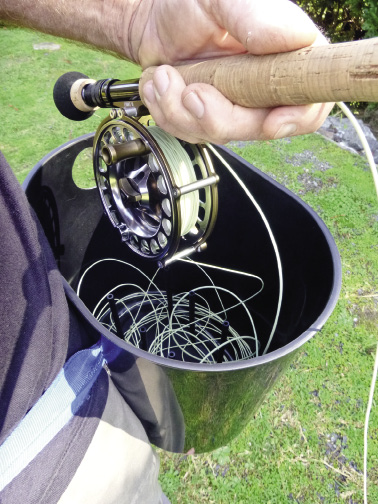
To get the cast away smoothly though, I had to cast off the reel. The outgoing harbour current had been dragging the shooting line at my feet downstream, turning my casting line into one big long loop and making effective forward casts almost impossible. Casting off the reel was about all I could do (I badly needed the hip-shooter casting bucket I’d left at home). Fortunately, I still managed a reasonably quick cast, which soon had me connected to a high-jumping, gill-rattling kahawai. This was good.
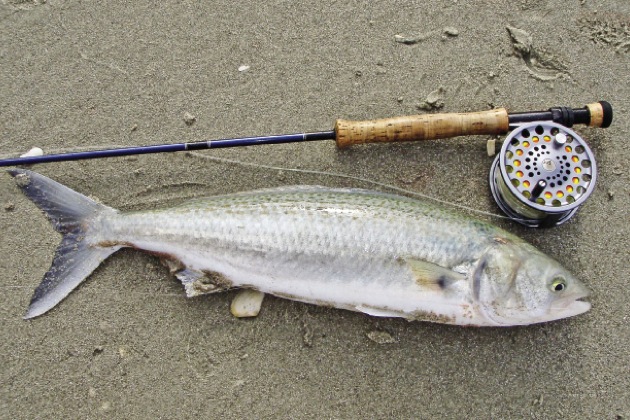
Retreating to dry sand on the channel edge, I landed the kahawai. It was a nice fish, but no match for the 10-weight. There were more suspicious bow-waves and ripples moving down the centre of the channel, but I elected to stay on dry land where the casting would be easier.
Moving across to a deeper channel, I started examining the water for signs of rays. Ray riding is a well proven kingfish phenomenon from further south, and it would be great to find the same thing happening in the Far North. To do so, though, meant separating eagle ray ripples from short-tail ray and long-tail ray ripples, as kingfish are rarely found associating with eagle rays.
This too became an exercise in analysing the ways in which the different species disturbed the water and figuring out what were the identifying features of each particular ripple or swirl.
The eagle rays were identified by their wing tips being visible above the surface and a broader bow wave reflecting off their head. The ‘black’ rays by comparison broke the surface rarely and had a more oval-shaped bow-wave coming off their humped back directly behind their eyes.
Unfortunately, I did not see any kingfish. What I did achieve that morning though, was an understanding that fish species could be identified by their ripples in the low light of dawn, and that casting to ripples could be an effective and productive fly-fishing method to use on New Zealand’s sand flats.
Now fast-forward six months to the middle of winter. I’m wading a tropical sand flat and once again looking at ripples. The morning light is too weak to allow any sighting of fish in the water and the tide is too deep (about knee depth) to really allow for any decent bonefish tailing action. Fishing to ripples is the only way of identifying the species I want.
Again, a quick big fish identifier was to establish whether the bow wave I was looking at had multiple start points or one single start point. From a distance this was hard to figure out; I nearly strained my eyes looking. A few quick exploratory casts helped to separate some of the questionable bow-waves and ripples into their unwanted component parts (i.e. mullet and goatfish). As I became more familiar with the distinctive features of the unwanted fish groups, I started to eliminate large numbers of the ripples that could potentially waste my time.
.jpg)
Then I saw a ripple that seemed to have a singular start point, but was quite large at the same time. Possibly it was a decent sized fish. A gentle tidal current was flowing toward it, the fish slowly moving upstream. I would need to cast at least five metres in front of it to avoid spooking it, and then leave the fly quietly on the sand until the fish happened upon it.
This I did. Luckily the fish got to the fly before the current started to drag the fly line sideways. There was a slight swirl where the fly had been cast and I instinctively pulled back hard on the fly line. Instead of ripples, there was now an explosion of salty water. I held the rod high to get the fly line up and out of the water, away from lumps of coral and into the air, hoping to ease the water’s drag pressure on the line. The fish accelerated away.
Thankfully, everything held together and the bonefish moved into an area that I knew was fairly clean and coral free. There it made screaming circular runs with the fly line and backing ‘rooster-tailing’ after it. What a magnificent fish!
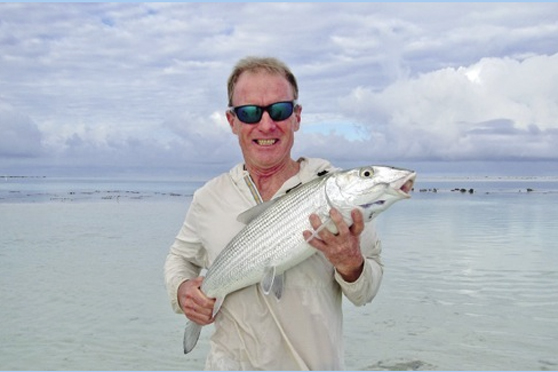
After a whole lot of anxious moments the bonefish came to hand, and I managed to grab it by the tail and flip it into a leaking plastic dinghy we had with us that was half full of water. It was a perfect live-fish transport tank.
Using the dinghy, with the fish happily stowed inside, I made my way to the only piece of shallow ground around – about five hundred metres in the distance. I needed a spot where I could beach the boat and put my gear down. I wanted to get a picture of this fish-proof of what could be achieved by simply casting at ripples!
|
|
This article is reproduced with permission of |

Fishing Reports Visit Reports
Tauranga Fishing Report - 28/05/26
Tarakihi on the bite Trips are few and far between at this time of year,... Read More >
Canterbury Fishing Report - 28/05/26
Fresh and salt turning it on! It is not very often I get to say... Read More >
Bay of Islands Fishing Report - 28/05/26
Lures paying dividends We finally had a break in the SE winds that have been... Read More >
Manukau/West Coast Fishing Report - 28/05/26
Snapper and gurnard in the harbour The weather has finally taken a turn for the... Read More >


Major Bites
Minor Bites
Major Bites
Minor Bites
Comments