
Tackling Trevally
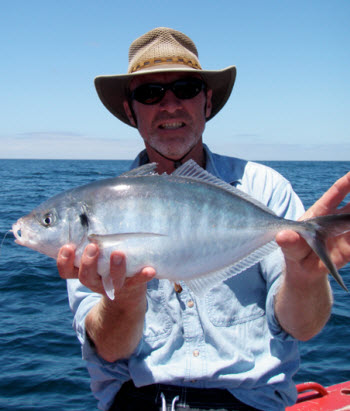
Terrifying trevally encounters from the past rarely slip from the mind. They remain etched, like hieroglyphs chiselled in stone, for no other fish in Aotearoa picks up your bait with such enthusiasm and powers into the reef with such recklessness as trevally. Even kingies give you a few minutes grace before implementing the unmentionable, but not trevally – they feel the hook and then burn. Weed and rock are a natural sanctuary.
We used to do battle with them under the Marsden Point wharf in winter – an excellent time of year for chasing trevally in the north. Here we would target them with stout handlines and huge treble hooks, smothering the points with freshly dug pipis.
It was hardly sporting tackle. But the environment was very challenging because the trevally had to be winched from a close-set arrangement of huge concrete piles. This wasn’t easy. Give them an inch and they’d have you wrapped. The fact that the fish were often foul-hooked on the outside of the mouth only added to the battle.
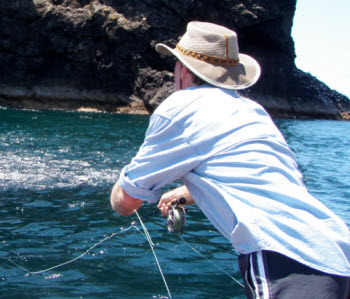
And damned exciting it was too. Especially for 12 and 14-year-olds hanging on to greasy wharf railings with spindly legs, hauling hard against wild fish powering around below.
We learnt quickly that any hook smaller than huge would be ripped out in the struggle. With big hooks not fitting very well in small trevally mouths, foul-hooking trebles had to be used. These would take hold on the forward edge of the gill plate just under the jaw. Here they were less damaging to the fish than little hooks embedded in lips. All in all it was torrid, heart-stopping sort of fishing that left deep impressions.
I remembered these Whangarei Harbour ‘trevors’ and the tactics we used to catch them some time later. I had managed to plant myself at the end of Cape Karikari. We’d made the long walk (still possible in those days) and chosen a quiet point away from the frightening swell sucking up and down on the seaward ledges. Here we began berleying with softer portions of our meagre supply of bait, lugged over those endless hills.
Within moments massive trevally appeared in the berley trail: huge hump-headed things that swam by unconcerned in the crystal-clear water and gulped down berley as though it were a traditional food source. These things were monsters! They had me in fits, running around rigging tackle frantically, shaking like a leaf.
I presented a ‘Marsden Point special’ first – big treble, heavy gear, hook smothered in bait. The trevally completely ignored it. They continued to unconcernedly feed in the berley trail directly under our noses. Thus began a series of rejected offerings that progressively became smaller and lighter.
Eventually, I found myself digging for tackle that I knew would have little chance of survival should I actually hook-up. A tiny bronze treble from an old trout-fishing lure was found. This was tied to a long length of cl ear, four-kilo monofilament trace. Mussel flesh from a few mussels found attached to the rocks was the bait.
The first trevally rejected it, as did the second, then the bait drifted a bit deeper and a huge blue-flanked trevor that had to be every bit of eight kilos sucked it in. I was connected!
My little black Butterworth jig stick whipped over into a very tight bend and momentarily described the power of a bluewater trevally gone berserk. The fight lasted the length of time it took for the trevally to race to the end of the point (around 50 metres away) and bust me on an underwater ledge. These fish were smart and obviously any attempt to stop them on delicate tackle would be futile.
Even more years later I struck a similar trevally happening out at Cape Brett. We’d been fishing there with the infamous Gary Kemsley. Gary had, prior to bunking down for the night, hung a kingfish frame off the rocks in such a way that wave movement would generate a natural berleying action.
Being the all-knowing person that I am, I scoffed at this archaic berleying practice, but come dawn I had to eat my words. Surfing up the kingfish frame, biting big chunks out of it and then falling back with the receding waves were trevally of similar proportions to those I’d seen at Cape Karikari! Needless to say, three sleepy-eyed fishos were galvanised into action.
Now these fish weren’t in a fussy mood. We presented pilchard baits on some fairly serious tackle and received instant approval. The territory, though, was horrifying. Gary was wasted by unstoppable fish a couple of times; I pulled the hooks on a hump-headed monster and brother Ian was buried in the weed.
Hurriedly we ditched the ‘light’ six- to eight-kilo gear and instead rigged up the fifteen-kilo land-based game stick. Ian took the ‘chair’ and flopped a bait into the water. He hooked-up, locked-up and succeeded in pulling a seven-kilo trevally from the briny, a magnificent fish.
You don’t get too many chances with trevally of such proportions. These fish are long-lived and clever; they’re super-cautious in bright light conditions (the Cape Brett situation was at the start of day). Also, they are only found in a few localities. The largest fish appear to be found around the blue water headlands of the east coast and the surf-bashed rock promontories of the far north and west. Why these fish should grow to a larger size than trevally from other localities is a little hard to understand, but their early growth rate may have something to do with it.
Trevally grow fairly rapidly in the first three years of life. Trevally from warmish, food-rich habitats are therefore going to pile on the pounds faster in those crucial early years and achieve a much greater growth potential overall. A bit of isolation and low fishing pressure helps immensely. Fast growth fish that are given the chance to reach a ripe old age end up achieving gargantuan proportions. Many of them continue live long and untroubled lives around distant headlands. Paradoxically though, others haunt heavily fished places like the Manukau’s Whatipu. Perhaps there are fish that are just plain smart.
Few Kiwi ‘silver’ trevally (Psuedocaranx dentex) do however achieve a size similar to that seen in the silver trevally of Lord Howe, Norfolk, and Kermedec Islands. These fish are frightening. 10-kilo fish are not uncommon and are so specifically tied to these three isolated island groups that some suggest they are another species. Possibly they are.
More likely the silver trevally of these northern islands are simply member of an isolated sub-species with a greater growth potential. Just as the Californian yellowtail and the Kiwi kingie have no distinguishing differences except size, so silver trevally exist in populations separable on size difference alone. I can put my finger on four discernable silver trevally populations stretching across Australia and New Zealand. The West Australian silver trevally exists from Perth in the west through to Adelaide in the south and rarely grows above three kilos. One-kilo fish are common, while two-kilo fish are trophies!
A silver trevally with a growth potential similar to our own exists from Melbourne through to Brisbane, while the Lord Howe-Norfolk-Kermedec monsters and our mainland fish comprise the last two groups. It just goes to show that getting in the record books depends very much on the place you choose to fish.
There have been a few trevally taken in New Zealand around the 12kg mark. And some others seen and photographed underwater may have been even larger. But your average Kiwi trevally is creeping into monster class when it gets above five kilos. I have never succeeded in landing any of the larger fish that I have encountered. The chances of landing any further big fish I come across are probably hampered now by my preference for saltwater fly. I’ll still hook them, mind you – trevally are very keen to munch on a fly and ditto for small silver jigs and plastic lures.
The trick when using artificials on trevally is to get the lure down to where they are holding. I sometimes fish a clean sand hole in which one can see the fish swim through. The kahawai always come through near the surface while the trevally are hard-to-spot silver ghosts whipping around down deep over the sand. In order to connect with them I need to show them a fly that is connected to an almost invisible leader and ensure that my fly is right down there, hard upon the bottom.
My greatest success is always achieved just on dusk. At night trevally throw all caution to the wind and begin feeding ravenously in the shallows. A luminescent fly would probably take them at this time but I prefer to fish only the last hour of fading light and return home when it is pitch-black. Night fishing might be okay for some but the prospect of pursuing a hard-running, fly-hooked trevally across jagged rocks in the middle of the night just doesn’t appeal. There have to be easier ways of breaking a leg.
The thing with trevally on fly gear is that there are no second chances. All hell breaks loose the minute the fish feel the bite of the hook. I’ve had more torrid encounters with cranked-up, fly-hooked trevally than I care to name, but only have a 30 percent fish landed rate to show for it. Indeed, it is very disheartening when the trevally decide to exit stage right, into the most awful conglomeration of rocks and weed that you’ve ever seen. When this happens you just have to enjoy the excitement of the short-lived run – there isn’t a helluva lot else you can do!
For these reasons I sometimes long to return to a clean river mouth I fished as a boy. Here the trevally would come up the river channels right at your feet and snaffle small silver lures in a clean, snag-free environment. This was real two-kilo country; the sort of place that fly fishing nutters like myself should perhaps be consigned to.
Trevally just aren’t trevally though in environments so tame. If they were they wimps we would think less highly of them. Such bold fighting fish deserve to be tackled in rugged environments where only the persistent survive. Every trevally dragged from dirty country is a trophy fish; every harrowing encounter around the rocks, weeds, and wharf piles is a very good reason to go hunting them again and again. Trevally are truly, terrifyingly terrific!
The surface schools of shrimp-feeding trevally foaming the waters of our outer islands and headlands along eastern and northern coasts are easily a treasure of our time. Foreigners visiting our shores comment on them always. They are very much part of the tourist route in the Bay of Islands. And yet we undermine their value by still allowing the remaining schools to be hammered by gill nets (and the occasional purse seine).
Fisheries biologists would argue that these schools are not particularly delicate. Many schools are made up of young fish that may be quickly replaced by new recruits within a summer season. So some fishing pressure is justified. But bulk-fishing techniques that remove whole schools from sheer-sided pinnacles leave these rocks denuded of fish and destroy a living spectacle that so many tourists and recreational fishers enjoy. Also, the older surface feeding fish, with their great lumpy heads and impressive size, are quickly lost from populations put under even light commercial pressure.
It would be far better for these schools to be the sole preserve of considerate light tackle anglers and saltwater fly-fishers: two groups of fishers that have a worldwide reputation for sensible (read ‘sustainable’) fishing behaviour. In this way the tourist spectacle would remain, the sportfishing/fly-fishing tourism industry would be nurtured, and the trevally schools would be maintained for an eternity.
Indeed, saltwater fly is a technique purpose-built for surface trevally. These fish rarely take larger lures and infrequently take a bait. A tiny fly is about the only way to go. Even then the technique requires a fair degree of skill and a certain amount of persistence and patience. One has to present a tiny shrimp imitation close to the surface of the water right on the nose of the feeding fish – without putting the whole school down. It can often be a dramatic and demanding task.
Every trevally caught this way is a fish well earned.
It is impossible to fill the boat with fly-caught trevally taken from surface-feeding schools. But it is possible to derive enormous amounts of enjoyment and satisfaction from the exercise. Charters fishers would be able to build up strong fly-fishing clienteles based on the existence of healthy trevally schools. The resource therefore, is presently undervalued. I think it is time we recognised that.
A Blast From The Past!
|
July 1998 - by Craig Worthington |

Fishing Reports Visit Reports
Hauraki Gulf Fishing Report 11/06/26
Workups the best option mid-Gulf for quality snaps and kingfish Fishing across the Hauraki Gulf... Read More >
Bream Bay Fishing Report - 11/06/26
Normal transmission returns! It seems only the hardy have been wetting a line these last... Read More >
Raglan Fishing Report - 11/06/26
Solid snapper hook-ups out deep With the continuation of more settled weather there’s been some... Read More >
Canterbury Fishing Report - 11/06/26
Brave the cold, reap the rewards With a big southerly blow through here yesterday, it’s... Read More >



Major Bites
Minor Bites
Major Bites
Minor Bites
Comments