
Surfcasting - catching smooth hound, rig or lemon fish
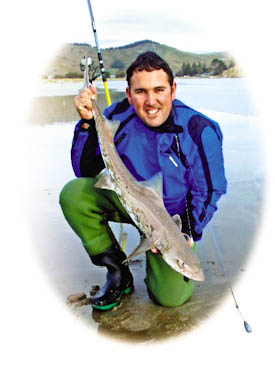 Spotted smooth-hound, rig, grot sharks, lemon fish – call them what you will in the areas you fish – are one of the hardest fighting surf fish available countrywide.
Whether you’re a surfcaster on the mighty Ninety Mile, in the Bay of Plenty, Hawkes Bay, Wellington/Wairarapa, Taranaki, or the east and west coasts of the South Island, all have beaches that fish well for smooth-hounds at certain times of the year – but many surfcasters do not know they’re there.
From sandy surf beaches to shingly, stony beaches, providing there’s a reasonable concentration of paddle crabs, there’s a good chance smooth-hounds will be present at some stage during the year, if not year round.
Most of us have heard the term ‘shark ‘n’ taties’ (slang for ‘fish and chips’). Well, much of the fish served up in the past – and even today – in many fish and chip shops, is spotted smooth-hound shark, also sold and known as lemon fish. These beautiful, white, boneless fillets, which flake apart when cooked, have earned the smooth-hound a reputation as a quality table fish.
Smooth-hounds can seem non-existent on a lot of beaches, until you use the right baits and fish a more effective time of the day/night, thereby increasing your chances of success.
In this article I will discuss the spotted smooth-hounds’ coastal movements; where to find them; the best times and conditions to fish for them; appropriate tackle and bait; as well as what to do with them once caught.
Smooth-hound movements
Late spring and summer are the most productive times for smooth-hounds, as they are in close feeding on the copious quantities of paddle crabs available during the warmer months.
Smooth-hounds, after giving birth during the winter months, need to put plenty of condition on, making them an easier target for the surfcaster. It is interesting to note that most of the smooth-hounds of any size (4kg-plus/one-metre-plus fish or bigger) taken are female fish; the males tend to be smaller. My personal best fish of 18kg measured over 1.5m, and our local Pania Surfcasting Club record fish weighed 23kg – but they have been recorded in excess of 35kg. Now that is one serious smoothie!
In summertime you tend to capture a wide range of fish sizes, from pint-sized 2kg models through to 10kg-plus specimens. Quite often you’ll be fishing away for them, catching several smaller fish, then they will go quiet until the next school swims through to your baits – and these will all be much larger specimens. Very strange.
During mid to late autumn the numbers tend to drop away, but those fish that remain will be the big, heavily-pregnant female fish in pup. For example, an 8kg smooth-hound is likely to be carrying a dozen or so young – so if you do take these large female fish, dispatch it quickly after capture and release the young (which are alive in the fish’s belly) straight into the sea. This at least gives them some chance and helps contribute to the species’ numbers. Otherwise, let the fish go to live and fight another day.
Where to find them
As previously mentioned, smooth-hounds can be located on most beaches at some stage of the year. Steep, shelving, shingly beaches or shallow and sandy, it is the food source that brings them into particular parts of them. You need not cast into a deep channel; unlike fishing for a lot of other surf-caught species, smooth-hounds can often be caught in some of the most turbulent of spots, where the waves crash and the white water sweeps inwards to the shoreline. Casts of 20 metres can sometimes be as productive as casts of 80 to 100m, as quite often the smooth-hounds are cruising the edge of the shoreline feeding on crabs dislodged and tossed about in the beach break. Fishing beaches of known high crab concentrations will certainly increase your chances.
During the winter, when there are fewer smooth-hounds close to shore, the heavily pregnant females tend to be found in calmer, shallower bays, again where crab concentrations are high. A good, constant food supply means they expend less energy in hunting – but this is not the sole reason for why they can be located in calmer waters: by giving birth in a safer, calmer, and food-rich environment, the survival of their young is made more likely.
The best times and conditions
This is why I find them so appealing and intriguing to catch: for a lot of surf-caught species the conditions usually have to be reasonably clean and calm to catch a decent amount of them (i.e. gurnard, snapper or moki). However, spotted smooth-hounds can be caught in absolutely rubbish-looking sea conditions: seas of up to four metres, discoloured water, windy, rainy – it doesn’t matter – in fact, sometimes the rougher the better. (Providing you can keep your bait in the sea during these unsettled conditions that is!)
A lot of the bigger smooth-hounds will be taken in these conditions during summer. Big ocean swells dislodge crabs from the safe haven of the seafloor, along with any rock crabs and crayfish from nearby rocks, sweeping them along the beaches. In the dirty, discoloured water, smooth-hounds can easily sneak up on their prey without being detected. During the day when the catch numbers may be down due to the bright conditions, dirty water offers the smooth-hounds cover.
Consequently, the best time to target smooth-hounds is just after a good storm has blown through and churned up the seafloor, dislodging food and discolouring the water. The next-best time is night time. Night time is the right time to target ‘ol’ green eyes’ (when the shark’s reflective eyes are illuminated by your torch or headlamp, they shine green). Just as the dirty water masks the presence of the smooth-hounds sneaking up on their prey (crabs), the darkness allows the smooth-hounds to hunt easily and well at this time, too.
The catch rate certainly increases at night. You can cast out, set your drag, put the rod in the rod holder, turn to walk away, and whammo! a smooth-hound will nail your bait just like that!
Sometimes the bites can be more subtle, just sucking on your bait, shifting the sinker and then dropping it. As tempting as it may be to strike, or reel in and check your baits, just leave the bait to sit for a while longer – until the fish hooks itself.
Bait and tackle
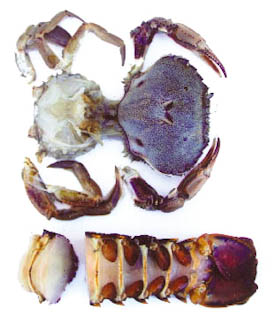 The best baits to target smooth-hounds are crabs (paddle or rock crabs), followed very closely by crayfish (yes I did say crayfish – about all it’s good for, I reckon!), prawns (Vietnamese RAW prawns), and I reckon a freshwater crayfish would certainly produce the goods, too. If it’s a crustacean, smooth-hounds will have a bite.
Smooth-hounds in their natural environment use crusher plates in their mouths (they don’t have teeth!) to crush any crabs/crayfish they locate before swallowing. They seldom take conventional fish-flesh baits.
Although I have caught a few on kahawai, pilchard, skipjack and squid, they will generally bypass these baits – which is why most anglers fail to realise that these fish are present – sometime in large quantities – on their favourite surfcasting beaches. (Just go try, you may be pleasantly surprised and certainly rewarded.)
Crabs are reasonably easy to catch. I find the best way to catch them is by purchasing a crab pot from your local tackle shop. Bait it with an old fish frame or fish scraps, and throw it out just beyond the first beach break, or paddle it out on a kayak.
The alternative is to get a tangled-up ball of nylon, attach a swivel to it, attach the swivel to a rod and reel, then bait your ball of tangled nylon with fish scraps and cast this just behind the first breaker.
 Leave for about five minutes (sometimes less), then slowly retrieve your tangle through the surf line. With any luck one or more crabs will be holding on/tangled in your nylon mess and you will have fresh bait to target smooth-hounds.
The other baits – crayfish/prawns – need to be bought, unless you know someone who will give you a crayfish to use as bait!
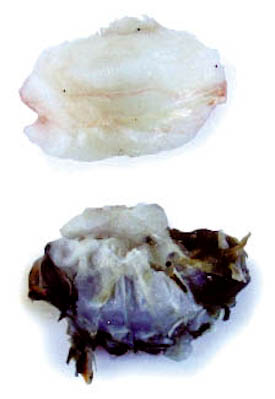
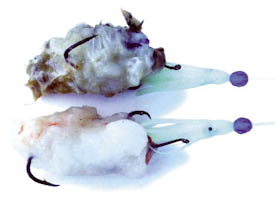
The photos show an easy step-by-step way to rig up your crab/crayfish bait. I like to be generous with the size of my baits, as sometimes the baits may sit on the sea floor for a while – half an hour or more – before getting hit.
So try and ensure enough bait will remain, as the smooth-hound is more likely to eat if a decent amount is there. Use half a decent-sized paddle crab or a whole small one (once the back shell and all the legs are removed), to streamline the bait and let the smelly juices waft out in the current. Otherwise, use a cut cray-tail segment or a whole (preferably) shelled raw prawn.
This leads me to the hooks. I prefer a nice, sharp Gamakatsu 5/0 Octopus Circle main hook and a small 2/0 keeper fished on a running style or IMP pulley rig. I’m sure in past articles you would have read how often I catch fish on the small keeper hook.
Well, as with other fishing baits and targeted species, this is true with smooth-hounds as well. The 2/0 Gammy circle hits hard, locks in strong, and seldom gets shaken free. As long as both hooks are protruding well out from the bait, you will maximise your hook-up rate.
The only bling I like to add on my rigs for smooth-hounds are small lumo squid skirts, lumo tube or Snappa Flash lumo beads. These are ‘glowed up’ at night using my headlamp, and seem to attract the smooth-hounds to my baits.
My traces are made with 40 to 60lb Black Magic fluorocarbon leader, which I find is the best value-for-money trace line. This product offers good strength and abrasion resistance, and the slight stiffness means it’s less likely to tangle in turbulent surf conditions.
Although the smooth-hounds don’t have teeth, their crusher plates can chafe through most trace monofilaments during lengthy battles, resulting in lost fish. Fluorocarbon lasts the distance.
 BOS Breakout sinkers are a must when fishing in turbulent sea conditions, otherwise you will constantly be retrieving your tangled gear from halfway down the beach. A comfortable breaking strain of 8 to 10kg mono, with a 15kg shock leader, is strong enough to hold a decent smooth-hound in boisterous surf. I’ve been using the Black Magic Premium Supple line in 8kg breaking strain for some time now, and it has caught me many large fish.
Other useful items include: A good quality spotlight or headlamp (check out the LED Lenser h7 headlamps in your local tackle store), and reflective tape on your rods for shining your bright headlamp at so you can spot any big benders – must-haves while fishing at night. Alternatively the good ol’ Cyalume stick or battery-operated Tip Lights work well.
A good gaff – better still, a gutsy gaffman – is essential to wrestle your big smooth-hounds out the heavy surf. Just take care and have plenty of patience when your smooth-hound is in the trough waiting to be gaffed, as the bulk of the fight/tussle time is played out here before the beach. Plenty of good fish are lost by over-eager fishermen or impatient gaff men!
A good clobbering stick to dispatch your smooth-hound – or an iki spike – is handy, and beware when holding the smooth-hounds or unhooking them. When green, smooth-hounds thrash about violently and can cause some damage, especially to us men, should its thrashing tail come into contact with certain parts of a male’s anatomy – I’ve witnessed it before! Also, when unhooking smooth-hounds, subdue them first, otherwise you run the risk of becoming hooked yourself by the thrashing fish.
Cleaning up and caring for your catch
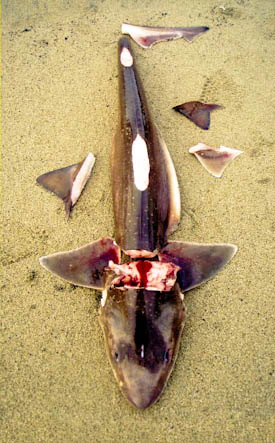 Once you’ve bopped your smooth-hound on the head, the best way to ensure great-tasting, safer, cleaner and fresher fish fillets is to behead the fish and cut all the fins off (‘trunking’ the fish). Then, remove the guts before rinsing in the seawater and chilling in a slurry of salt-ice (ideally) or saltwater and ice. At the very least, keep it cold on ice bottles in a chilly bin.
Removing the guts, head and fins (see photo) quickly reduces the ammonia content of the fish and also makes the fish easier and cleaner to fillet back at home. The fish is boneless: it has a cartilaginous spine, which is easy to navigate down when filleting. I just trim the belly flaps off once filleted; a 5kg Smooth-hound will provide enough flesh to feed the average family, and without the hassle of plucking out bones for fussy eaters.
So next time you get given a crayfish to eat, or catch a pesky crab that you would rather stomp into the shingle or use as a voodoo pin-cushion with your knife, save it for when the sea gets stirred up or later when the sun goes down. You may be pleasantly surprised that you can turn that silver-platter crayfish or crab into a hard-fighting, string-pulling, great tasting, fun-to-catch spotted smooth-hound!
 |
This article is reproduced with permission of |
Fishing Reports Visit Reports
Canterbury Fishing Report - 03/09/26
Whitebait season underway. Spring is here, and along with it, the good old Canterbury nor-Wester!... Read More >
Bream Bay Fishing Report - 03/09/26
Fishing hard, weather conditions trying. Cold winds and lots of rain have made for testing... Read More >
Outer Hauraki Gulf Fishing Report 03/09/26
Workups building as spring approaches. Spring is starting to show its hand in the outer... Read More >
Bay of Islands Fishing Report - 03/09/26
Pacific bluefin tuna return. The day after I submitted the last report, we were out... Read More >



Wednesday 16 September 2026
Major Bites
 - -
- - Minor Bites
 -
-  -
- Thursday 17 September 2026
Major Bites
- - Minor Bites
-
Comments