
Soft-plastic - Casting angles
 As time passes and my passion for targeting snapper with soft-plastics continues to burn brightly, I’ve found many aspects of technique that are much more important than they initially seemed.
For instance, while the specific weight of lead-head and/or the size/shape/colour of the soft-plastic lure are obvious candidates for experimentation, there are many other variables that affect fishing success. These include the lead-head’s shape, an aspect that determines how it sinks and then moves through the water when retrieved; hook size/shape, which largely dictates whether a fish is hooked and stays on; various scents/flavours incorporated into or applied to soft-plastic lures; the action imparted by the angler during the retrieve (which needs to vary according to the circumstances); the properties of different braids and trace materials; and maintaining good contact with the lure.
Recently, I’ve also begun to pay more attention to my casting angles. While most keen soft-baiting exponents agree that casting ahead and/or out the side of a drifting boat is consistently productive, we must also concede that there are occasions when very unlikely casting angles prove surprisingly effective. That’s why it pays not to get stuck in a ‘casting rut’: if things are quiet, without many bites, you may find success is just a matter of casting and retrieving at a different angle.
 I must admit that I don’t fully understand why some scenarios turn out the way they do. While it’s true you need only present a suitable lure near a snapper and move it in an attractive way (to the snapper) for it to be eaten, several factors can combine to influence how the soft-bait behaves, greatly affecting its attractiveness in a greater or lesser way. Anglers must therefore think about what’s going on and experiment to make the most of what’s on offer, or try and overcome any potential hurdles. Just changing your soft-plastic lure and/or altering the lead-head’s weight may do the trick, but a different casting angle may prove better still.
So what exactly are the main elements that determine how your lure behaves? The first is the rod and reel manipulations you provide; the second involves your soft-plastic lure’s shape and weight; third is the thickness of your braid and trace; and the fourth includes the influences of wind, swell and tidal flow.
The good news is that we can control the first three aspects, but the fourth is the tough one – conditions never remain the same for long, so there are endless, constantly changing permutations. Also, to make matters worse, we must take into account the very erratic behaviour of the snapper we’re targeting: sometimes they prefer their food jiggling and fast moving, at other times they like it hovering and easy to smash.
While your skill, tackle and size/type/weight of lure plays a big part in what the lure does underwater, the rest comes down to the casting angle: the angle at which the soft-bait and line encounter Nature’s forces affects the lure’s action, sink rate and the type of retrieve you should adopt.
Now let’s look at specific casting angles. For me, casting up ahead of the boat’s drift direction, or out to the sides, produces the most consistent results. However, if casting straight ahead, you need to understand what’s happening: the boat will be drifting towards the lure while you’re winding it in, so the time it spends on or near the bottom tends to be relatively fleeting.
On the positive side, you’re casting into undisturbed water, and the angle and action imparted to the lure suit the fish – snapper tend to feed and hold head-first into the current, so soft-baits hop and wriggle past, seemingly trying to escape, rather than unnaturally rushing straight at them, which can prove unnerving. Many of the bites also occur reasonably close to the boat on a shorter, tighter line, allowing quicker, more effective hook-sets.
However, while centre-console and small, open-boat layouts are great for this casting strategy, it can be far more challenging – if not impossible – to fish this way from some hard-tops. Using a drogue can complicate things too, as depending on the conditions (i.e. the wind and tide direction and strength) and where the drogue’s attached, the boat may drift at an angle that makes fishing tricky.
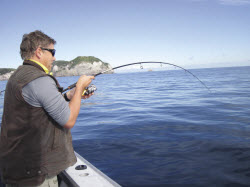 Consequently, when fishing in reasonably deep water (20-30 metres, say) from a hard-top vessel with limited forward casting options available, I’ll still make the longest-possible cast well up ahead of the boat at a narrow angle that allows my lure to reach the bottom and avoids colliding with the drifting boat later on. I maximise the distance/time available to work my lure afterwards by steadily feeding out braid while it’s sinking, but keep slack line to a minimum by only feeding out line when the braid is almost tight to the reel, before finally engaging the reel so the line tightens and stays that way for the last few metres to the seafloor. If you’ve judged correctly, the boat should eventually slide on past the jiggled lure, so if the lure head’s quite heavy, the drift’s not too fast, and the terrain’s reasonably benign, you can try dragging the lure along the seafloor afterwards. This is quite a simple procedure, but many anglers find it hard to keep the steadily lifting lure well positioned afterwards. I jiggle mine gently but erratically once in a while, and let out more line occasionally so the lure regularly tumbles back down to the bottom. Otherwise, I just wind in and cast again.
This strategy can work well in shallower territory, too, although I often cast ahead, but much more out to the side to compensate for the lure and boat closing in on each other and reducing the potential retrieval distance. This means the retrieval distance is affected much less by the drift speed, allowing me to cover more ground per cast, a strategy that generally produces the goods.
But not always. Sometimes, for whatever reason, the snapper show more interest in casts made behind the boat (i.e. behind the boat’s centreline fore and aft). This can be true even for areas the boat has already drifted over, especially if occupied by a patch of fish you’ve seen on the fish-finder!
Casting down-current can produce some pleasant surprises, too, but you’ll probably need to let out more line to get down, making bites on the drop harder to detect; in such instances a heavier lead-head helps to compensate for the opposing tidal flow.
At other times it’s possible to simply jiggle the soft-plastic lure after it reaches the bottom, so it slowly sweeps around as the boat drifts past, jittering enticingly.
Sometimes there will be no apparent reason for the success of a specific casting angle, which can be frustrating when this means your mate’s getting all the action. Generally though, there will actually be a perfectly good explanation involving the positive effects of the combined influences of the tide and wind on the lure’s action. At other times, adopting a particular cast angle might bring success by overcoming less-than-perfect fishing circumstances.
As we’re dealing with nature’s invisible forces in the first instance – both above and below the water – you often won’t know which angles are more effective until you’ve experimented a bit. Wind and tide can have strange effects. For example, sometimes you’ll find your lure refuses to touch down, no matter how far ahead you cast and how much line you release. That’s generally not a good thing, but occasionally I’ve used this to my advantage in shallow water, simply leaving the soft-plastic lure out there, twitching and hovering over the weedy reef, knowing that snapper – particularly the bigger ones – will happily come up a couple of metres to smash their prey.
At the other end of the spectrum, you may find the lure whizzing back towards you too quickly to maintain good contact, a situation that can usually be improved by using a drogue and/or a heavier lead-head. Whatever the scenario though, it’s usually possible to improve the situation by thinking about what’s happening and casting at a different angle to avoid or reduce the problem.
These are not the only issues to influence your casting angles, however. Others include wind direction, the angle of the sun (glare on the water makes it difficult to monitor your line for fishy interest) and structure/fish marks showing on the fish-finder.
The wind direction can be a pain. Very often it will limit casting distance when you’re forced to cast into it, or it creates a big bow in the line that makes bite detection and angler reactions much less effective.
One option is to engage the reel as the lure hits the water, drive the rod tip down to tighten the line and sink the lure (and line) quickly, and then keep the rod low to reduce the length of line exposed to the wind. But it’s not ideal, as you’ll also need to work the lure back with low rod manipulations, so instead I try to find an angle that allows me to cast with the wind and still fish effectively. This may mean using a heavier jig-head (the extra weight helps the line cut through the wind and current more effectively, keeping the line tighter) and a faster retrieve to compensate, but at least I’m much better able to see and feel what’s happening on the end of the line.
The sun’s glare can make things hard, too, so don’t try and put up with it. Instead, cast somewhere that allows you to see your line more easily. You might not get quite as many bites (although you might get more, too!), but you will be able to see what’s happening to the line and react more quickly and decisively, maximising your hook-up chances.
As for targeting visible structure (such as exposed or shallow reefs and weedy areas) from any direction, that’s simply taking advantage of potential opportunities, and should play a part in your usual shallow-water soft-baiting strategy.
Still not catching? Damn, that means we have to return to those familiar old aspects that involve effective lure colour, size and head weight, and then apply the appropriate action. However, I’ve written about those topics before…
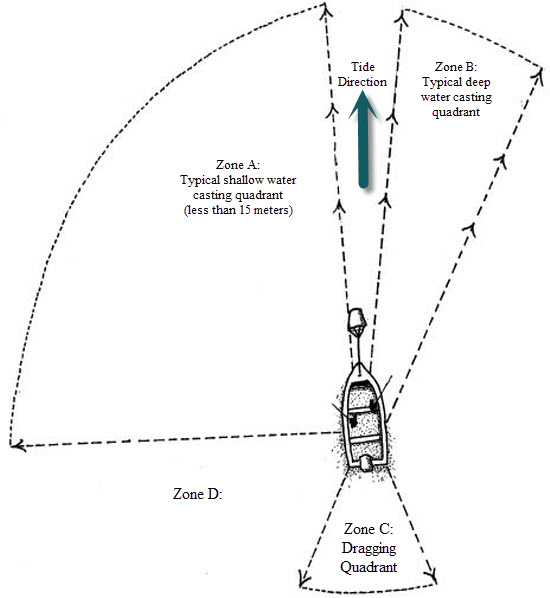
Zone A: When casting into shallow water, it’s generally better to cast out the side, up ahead, rather than straight ahead, as the drifting boat and retrieved lure move closer together throughout the process, reducing the retrieval time. However, in both instances you will still be casting into undisturbed water and getting down to where the snapper are – big pluses!
Zone B: Casts made into deeper water are usually made up ahead of the direction you’re drifting, enabling good lure sinking conditions; try to cast at an angle that allows you to keep fishing past your boat and out the back – but not too far away.
Zone C: The deeper water (i.e. over 15m) also suits ‘dragging’; just lob or lower your soft-plastic out the stern, endeavouring to keep the descent in freefall as much as possible. Just the odd, jerky twitch afterwards will be sufficient, but you’ll need to let out more line regularly if the lure-weight used is borderline. When the angle of your line becomes more horizontal than vertical, rewind, and drop again, perhaps increasing the lure weight if necessary.
Zone D: Nature’s forces can combine to produce all sorts of strange drifts and lure presentations, so if bites are slow, or you’re battling sun glare or the wind, try casting at less likely areas around the boat - you may well be happily surprised!
 |
This article is reproduced with express permission of
written by Mark Kitteridge - 2012 Originally published in New Zealand Fishing News |
Fishing Reports Visit Reports
Canterbury Fishing Report - 01/10/26
Freshwater season underway. Wow, it’s October already, and our freshwater season is underway, and the... Read More >
Top of the South Fishing Report - 01/10/26
Snapper about but not yet firing. It’s certainly nice to see daylight savings upon us... Read More >
Hauraki Gulf Fishing Report 01/10/26
Big reds in the shallows. The weather has made getting out on the water challenging... Read More >
Bay of Islands Fishing Report - 01/10/26
Snapper moving in. A few Pacific bluefin are still gracing the weigh stations with last... Read More >


Wednesday 14 October 2026
Major Bites
 - -
- - Minor Bites
 -
-  -
- Thursday 15 October 2026
Major Bites
- - Minor Bites
-
Comments