
Selecting leader and trace - Part 3
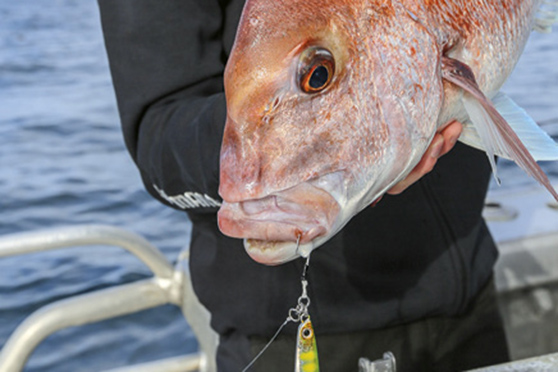
In the third part of Mark Kitteridge’s series about the wide-ranging roles performed by leaders/traces, he looks at the more specific requirements when using the more popular types of snapper lures.
It’s interesting how different the roles of leaders are when using lures, rather than baits, for snapper. The biggest change, with one exception, is how much lighter the trace material is when used with lures, as lures are relatively small in proportion to typical baits (especially those used to target bigger snapper) and there’s no need to withstand the powerful jaws and crushing teeth because they are rarely swallowed.
The biggest attractions involved with fishing snapper lures is that not only are they highly effective, they also tend to be used on tackle that is lightweight and a lot of fun to use. In this case ‘lightweight’ means outfits with reels that contain around 250-300 metres of 6-10kg line. These braid diameters cut through the water efficiently so the lure stays down at the bottom for longer. This is where snapper mostly hold, and a light trace enables the relatively small lures to move in an enticing manner. These factors need to be taken into consideration when choosing suitable leader material.
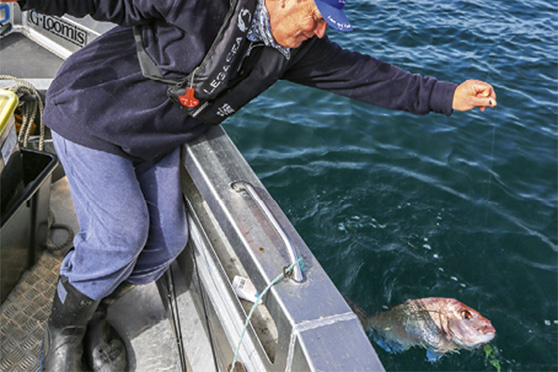
Keeping a fish supported in the water puts less strain on the line, especially when using a lighter leader.
Standard metal jigs
This includes knife, madai, slow-pitch and inchiku type jigs. It’s unusual to fish jigs over rough ground, as the snags can make proceedings expensive, although those lures armed with hooks at the top rather than the rear are less likely to be lost if the fish-finder suggests the risk is worthwhile.
With the relatively clear ground fished over meaning there’s no need for overly long, thick, protective traces. Instead, a couple of metres of 20-30lb trace, ideally fluorocarbon, is usually fine, unless using jigs over 150g.
Although modern swivels can be very small and strong, the length of the trace means you’ll have too much line hanging out the end of the rod tip, limiting your options (lobbing up ahead of the boat in particular), so I prefer to join my trace to the braid with an FG knot – but an adapted Albright will do, or even a Back-to-Back Uni if that’s all you know.
If the jig is fitted with an assist rig, the leader should be attached to the solid metal ring, not the lure’s wire loop or the split ring. I like to use a Rapala Loop knot for this, as it allows the assist more freedom to move effectively (but avoid using the trace to lift legal-sized fish over the side, as this damages the loop’s base).
Many anglers simply use a Uni or Clinch knot, even though this can see the assist rig secured at ineffective angles out from the lure. A small, compact clip (i.e. the smallest Sea Genie or the second-smallest Mustad Fastach) will be okay too, as these lure types are rarely swallowed, so the chances of the snapper’s crushing jaws coming in contact with the clip are minimal. Don’t use big, bulky clips though, as they can be too obvious and can adversely affect the lure’s performance.
Kabura/Sliders
While it’s possible to get away with the standard 20-30lb fluorocarbon trace with the smaller kaburas/Sliders to 60g, the nature of the lure’s two-section design sees the sliding head being whipped back and forth on the trace when hooked to large, head-shaking snapper, which can cause leader damage.
It, therefore, pays to add some insurance to your rig by using a stronger trace. It is not unusual for charter skippers to use 60-80lb trace when fishing 140g Sliders. The primary objective is to get the Slider’s/kabura’s trailing tentacles down to the bottom, then keep them there as long as possible, so the risk of overweighting is not a problem in this instance.
The 35-60 metre depths commonly fished mean the trace is hard to see down there anyway. For those recreational anglers using the more widely chosen 80-100g models, 40-50lb trace is recommended.
The leader is threaded through the kabura/Slider head and secured to the rubbery tentacles with a Uni knot.
Micro jigs
The increasing popularity of tiny jigs that catch a wide range of fish sizes and species has lead to similarly lightweight tackle attached to them and a whole heap of fun for anglers who use them!
However, to get the best from these small fish-catching packages, it’s important to use trace material that doesn’t appear too obvious in relation to the lure or so thick the lure’s action is hindered.
I suggest a metre or two of leader material around 12lb b/s for lures around 14g, 16lb for 21g, and 16-20lb for 28g (one ounce); this can be hard to do if you’ve bought a small, heavy tungsten lure that cost $20, but the potential rewards outweigh the risks!
Same as any jig fitted with an assist rig, the trace should be attached to the rig’s solid ring, not the lure’s wire loop or split-ring.
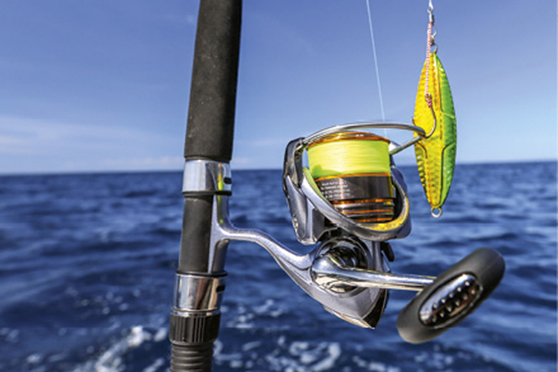
When fishing micro-jigs, it's important to use trace material that doesn't appear too obvious in relation to the lure or so thick the lure's action is hindered.
Soft-baits
I am constantly amazed by the size of fish that can be caught on a soft-bait outfit, even though most anglers use just 20lb fluorocarbon, with reasonable numbers also using 16 through to 25lb, depending on the circumstances. Indeed, when fishing inshore waters over clear ground, some even go down to 12lb!
Unlike the other lures covered so far, soft-baits are often deployed in very rugged territory, yet anglers are well advised to resist the temptation to up their leader poundage to help provide extra insurance from bust-offs. This is because the thicker leader is more obvious – especially in shallower water – cutting down on bites, as well as dampening the lure’s natural action and becoming more problematic when cast, thanks to the thicker joins involved.
My own strategy involves lengthening the 20lb trace to three metres in this situation, as the fluorocarbon line is more resistant to damage than the much thinner braid. The extra length also allows for lure changing and cutting off any line damage that occurs near the jig head over the session (damaged fluorocarbon trace is not just weaker, it also becomes very obvious underwater, cutting down on the bites attracted).
Even so, upon obviously hooking a large fish in shallow weedy territory, anglers are well advised to promptly get someone on the boat’s helm so they can stay closer to the fish, avoiding potential cut-offs on structure and weed, or to slowly lead the fish out into deeper water, especially those you suspect are kingfish.
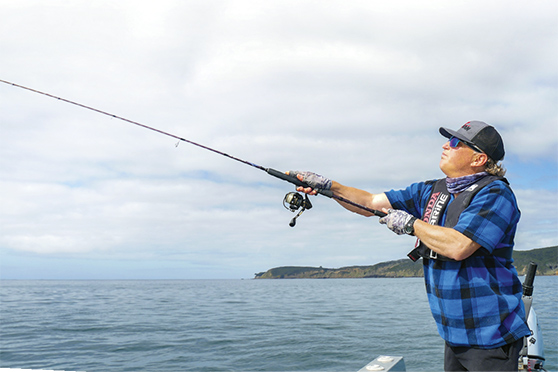
The FG knot is by far the best knot for attaching the leader to the trace when soft-baiting, being strong and streamlined, enabling it to flow beautifully through the guides when cast, but it is hard to learn and can take a while to tie.
Having said that, you should still make the effort as every other option (except the FG) has significant downsides, with the worst aspects including having too much weight and bulk, so the knot becomes a mini bola, whipping around and jamming on the guide frame.
Jig-heads are best attached with a Loop knot for greater freedom of movement, but again, avoid lifting fish over by the trace as the stress cuts through the base of the loop. I also like the Loop knot because it’s slightly less strong than the FG knot, so just the lead-head gets lost when snagged, so it’s not necessary to start from scratch with the leader
|
|
This article is reproduced with permission of |

Fishing Reports Visit Reports
Canterbury Fishing Report - 03/09/26
Whitebait season underway. Spring is here, and along with it, the good old Canterbury nor-Wester!... Read More >
Bream Bay Fishing Report - 03/09/26
Fishing hard, weather conditions trying. Cold winds and lots of rain have made for testing... Read More >
Outer Hauraki Gulf Fishing Report 03/09/26
Workups building as spring approaches. Spring is starting to show its hand in the outer... Read More >
Bay of Islands Fishing Report - 03/09/26
Pacific bluefin tuna return. The day after I submitted the last report, we were out... Read More >


Wednesday 16 September 2026
Major Bites
 - -
- - Minor Bites
 -
-  -
- Thursday 17 September 2026
Major Bites
- - Minor Bites
-
Comments