
Scallops - How to find and shell them
- 3 Comments
 I have been diving in the Marlborough Sounds for scallops for about 25 years, and have found there are just as many of them around now as any time in the past.
Having a boat makes things easier and gives enormous scope for finding good areas, but is not essential. For example, scallop beds can be accessed from the roadside in places like Governors Bay off Queen Charlotte Drive at the head of Queen Charlotte Sound. A short, sharp downhill walk to the beach from the road and you are into it. The scallops are more prevalent in the 14- to 20-metre mark here though, as they tend to be in a lot of the local bays.
I wouldn’t recommend diving any deeper than 20 metres for a bag of shellfish, as the associated risks of gathering them much deeper than this are not worth it. The greater the depth one dives, the more the bottom time is reduced, the colder and darker the water becomes, and the psychologically less inviting it is. The shellfish are abundant enough at shallower depths anyway.
Once down in your selected area, the best strategy for finding them is to look for recently disturbed gravel or sand areas where the scallops have been digging. The hardest part sometimes is being able to see them, as they are masters of camouflage. However, they seem to be gregarious, so if you find one there are bound to be others very close by. Consequently, once scallops have been discovered, hold a consistent depth around an arm’s reach off the bottom and slowly zigzag your way along.
The fisheries regulations for divers stipulate that the shellfish must be measured on the bottom before being placed in the catch bag. Once in the bag they are deemed taken. So although measuring on the bottom slows up the gathering process, it does prevent you struggling to the surface with a haul of undersize scallops. (The only exception is for snorkellers; as they have less time at the bottom, it is reasonable to expect the scallops will be measured up at the surface.)
There are various measuring devices available on the market, and the one shown in the photo nearby is one I made from a scrap piece of aluminium. It is always clipped onto my catch bag and will measure crays, paua and scallops. The scallops are measured between the two turned-up sides of the gauge. If they don’t fit within it then they are keepers – simple as that.
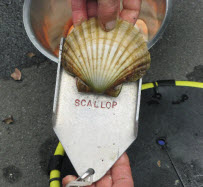 The minimum legal size in the Sounds is 90mm across the widest part of the shell, and the daily bag limit here is 50 per diver but regulations vary in different regions. A diver can now also gather a maximum of two extra bag limits for boatmen actively engaged in the gathering process (i.e. assisting the diver in and out the water, keeping an eye on their bubbles, able to pick them up with the boat, and not drunk!).
Diving for scallops can be dangerous – and I’m not talking about being attacked by a horde of hungry sharks either. Many divers have drowned trying to haul a huge bag of shellfish to the surface, and consumed all their air in the process. After all, who wants to let go of their full catch bag, even if you are drowning?
It can be very tempting to dive a little deeper for that extra big one just sitting down there a few metres away, or hunt around for that last-one-for-the road scallop as the air pressure gauge is almost tapping you on the shoulder to surface.
I once heard of two novice divers that ventured down to 40 metres, filling their catch bags as they went. The scary thing was that they didn’t even notice the depth they had descended to until the sheer coldness of the water prompted them to check. They were very lucky to make it back up with their heavy catch bags. At this depth the bottom time is minimal, with a recommended safety stop at three metres for several minutes.
The best way around this problem is not to do it. Attach a light rope, 20 metres or so long, to your catch bag, and the other end to a small, brightly coloured float. Before rolling off the boat, which will preferably be anchored in about 15 metres, just throw the catch bag over the side. You now have a drop line to dive down as well.
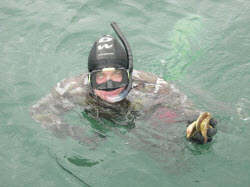 When you have gathered a feed and are ready to surface, just leave the bag on the bottom and leisurely fin your way up the line to the float. Back on the boat, it is pretty easy to cruise over and pull up your catch – all measured and counted, hopefully.
Before you get started on shelling all your hard-earned scallops, just be aware that they must be shelled above the high water mark, not out in the boat on the water. The last thing you want to encounter back at the boat ramp is a certain officious-looking gentleman in uniform, wielding an infringement pad with pen poised, hell bent on wanting to measure the shells of your now shucked scollies. He won’t like it one bit when you tell him those shells are lying on the bottom of Queen Charlotte Sound, 200 metres below.
However, if you want to eat a few as an on-board meal, that’s not a problem. Just keep in mind that they must still be of legal size and are part of your daily bag limit.
A simple way to shell scallops
Opening the shells can be a drama if not approached in the right manner. The following is the way I like to do it.
Step 1:
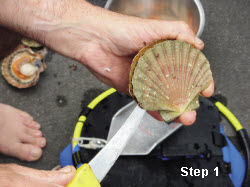
First, get yourself organised and find a seat, as it could take a while. I use a thin, stiff-bladed knife and a soup spoon for this task. And an ice-cold beer is always within easy reach to provide moral assistance.
After a short time out of the water, some of the scallops will be slightly open. Start on these ones first, slipping the thin, sharp blade hard against the inside of the flat upper shell and slicing down toward the hinge.
Most of the shellfish will need to be prised apart, but be careful, as it is easy to break the shell and make a mess of it.
Again, lay the scallop in your left hand with flat side up. Insert the blade in the side about 25mm above the hinge, just enough to be able to prise it open slightly, about 15mm and no more. Now cut down through the muscle as before.
Step 2:
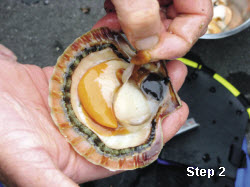
Once the muscle has been sliced and the lid folded back, you can lift away the brown coloured lip.
Step 3:
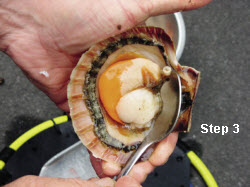
Next, using the spoon, push down between the muscle and guts as shown. The spoon can now be scooped under the scallop meat, separating it from the guts and shell in one operation.
Step 4:
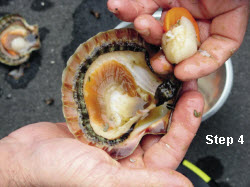
Once the meat is scooped out, the other lip can easily be pulled away with your fingers.
Now for the best part – there’s no shortage of recipes out there for scallops. Otherwise, just throw them in the frying pan or on the barbie as is. Just be careful not to overcook them. Slightly brown and they are good to go.
Like most other seafood, scallops are far and away tastier when cooked fresh. Frozen scallops are just not a patch on the real thing. I have learned over time that the best scallop storage facility in the world is the ocean itself.
 |
This article is reproduced with express permission of written by Kevin Bashford - 2011 Originally published in New Zealand Fishing News |
Fishing Reports Visit Reports
Bream Bay Fishing Report - 20/08/26
Bait and berley does the business. The message from those on the water is a... Read More >
Coromandel Fishing Report - 20/08/26
Snapper and kingies on the menu. There are plenty of snapper around the coast and... Read More >
Raglan Fishing Report - 20/08/26
Solid snapper in the deep. Excellent snapper continue to be caught out deeper in 70... Read More >
Bay of Islands Fishing Report - 20/08/26
Impressive catches coming in It seems that over the last fortnight I’ve spent as much... Read More >



Wednesday 2 September 2026
Major Bites
 - -
- - Minor Bites
 -
-  -
- Thursday 3 September 2026
Major Bites
- - Minor Bites
-
Comments