
Retrieving Lures

You can have all the lures known to mankind in your tackle box, but if you don’t know how to work them effectively, you can be wasting your time. Veteran angler Craig Worthington explains the importance of matching the right retrieve with the right lure action…
Bream Bay’s glorious sun rises are very hard to forget. On the beaches of Ruakaka, Uretiti and Waipu, my brothers and I first discovered lure casting. Here, with fiery golden sun rays piercing the eastern horizon at dawn, we would cast our lures into the surf. The sky would be red and then orange and then a soft wispy blue. It would back-light the night’s weather just departing and highlight the dramatic edges of Taranga Island and The Chicks. It was a special place to be.
In those days we were in possession of some fairly whippy rods made from both solid and hollow fibreglass. The reels were awful and clunky and made noises like coffee grinders when they got full of sand, and the spools were loaded with nylon both stretchy and worn. But boy, did we have some fun. We cast heavy metal lures as far as we could and caught monster kahawai that would leap out of the water in great gill rattling jumps.
The lures had iconic names that echoed down through the years. There were the ‘Irons’ with names like Coffin, Strangler, Undertaker, Executioner, Lyncher and Assassin. You get the picture – there wasn’t a lot of catch and release in those days. They were great lures.
There were also Stingsildas and Norsesildas from Europe. They were shiny and more fish-like and appealed strongly to mad young fishermen. They were great fish catchers, but sometimes needed a slight bend put into their soft metal bodies in order to enhance their action.
The Zed Spinners and big Tobies were home grown and cheaper. These had a heavier action and didn’t like too much speed, but they contributed significantly to our lure fishing education.
And finally there were the Mister Twister soft-baits of that era. They were almost experimental and an unknown quantity in those early days. Little did we realise what absolutely mind-blowing snapper weapons they would become in the future.
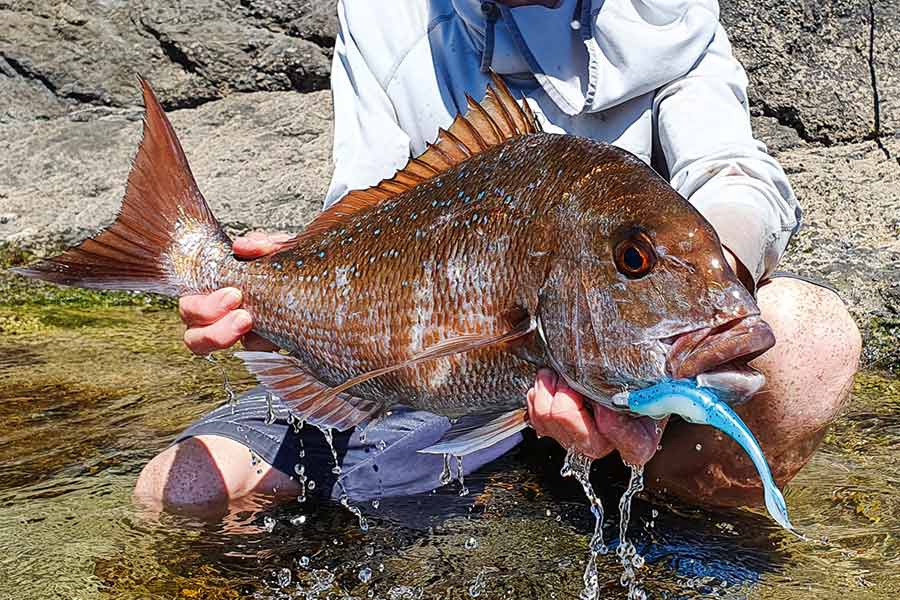 Soft-baits off the rocks can be fished slow enough to be very effective on snapper in kelpy environments. Jack Worthington with an east coast fish.
With this tackle and on these shores, I gradually developed an understanding of lure fishing and some of the intricacies involved. Each lure had its own particular action and the Stingsildas had an action that varied wildly depending on how much you ‘tweaked’ them. Lure action equalled fish catching success, or not. Consequently there was much debate about what the ‘right’ lure action was.
Soon we realised that different lures also had different retrieve styles that suited them best and that different retrieve styles would often result in a greater variety of species being caught. This was a real eye opener.
In particular, my first trevally on a lure in the surf really got this whole thinking process going. I was knee deep in water in the middle of spring at the time and my legs were going blue. A fairly generous surf was rolling in. There had been a bit of a storm a few days before and the waves were of a short period. I was leaping each wave as I fished and attempted to stay as dry as possible. Occasionally a larger than normal set of waves would require a frenzy of foam jumping or a short retreat back to the beach.
While doing this, I would open my bail arm up and let my line go loose so that my lure would stay out there. The trevally came after I re-engaged the bail arm, picked up all that loose line and started the retrieve again. My wave jumping had allowed the Zed Spinner I’d been fishing to ‘bottom out’, which imparted a unique trevally catching action to the lure. I quickly adopted retrieves that would hopefully emulate that first success.
From there I caught more trevally by letting smaller silver lures sink right down to the sand at the end of big casts and then slowly retrieving them along the bottom. Staying in contact with the sand seemed to be part of the secret. It became a retrieve I employed more and more. With the main catch in the surf being kahawai, every trevally caught was a real bonus. Not unexpectedly, I started catching snapper doing this as well. Even more snapper came by just casting straight out and doing a ‘yo-yo’ action in the deeper water.
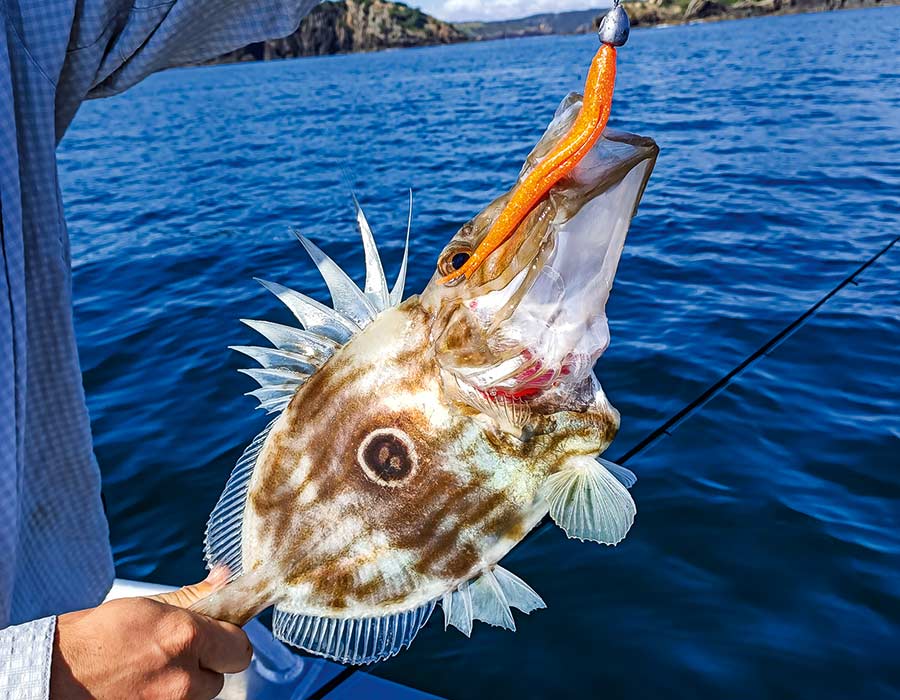
John dory have always shown a liking for slow 'yo-yo' retrieves and for lures that flutter and wiggle as they fall straight down. Soft-baits have really revolutionised john dory jigging.
Then came the time that we intended to fish with bait in the early morning darkness, before switching to casting lures the minute there was enough light to see. The only trouble was that we forgot the bait! This encouraged me to tie on one of my latest purchases – my new Mister Twister Sassy Shad.
Up until this moment, that Sassy Shad soft-bait had only been lovingly caressed at home. It was almost too precious to take fishing, but then it did come with two spare tails. It was time.
I figured that the heavily throbbing shad tail would give fish a greater chance of finding the lure in the dark. I also fished it slowly and near the bottom, figuring that in gloomy conditions a fish needed as much time as possible to see the lure.
The result was a beautiful three kilo snapper as the first rays of dawn began to spread across Polynesia. That shiny gilt-edged surf snapper emerging from the salty foam with the Mister Twister firmly locked in its jaws was a sight to gladden the heart of any teenage boy.
The upshot of all of this education was the realisation of how important retrieve style and action was for each different species. Sometimes the only secret to catching a new species on an artificial lure was to find the perfect combination of the retrieve and action.
This also extended into finding retrieves and lure actions that would deal with fussy fish. I soon learnt not to give up until every retrieve and lure action possibility had been exhausted.
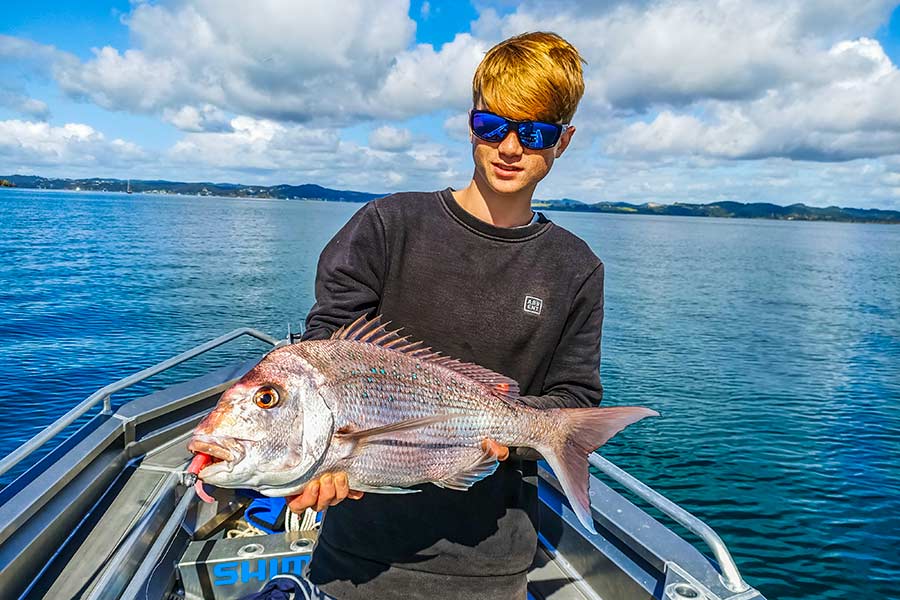
The unique action and retrieve style inherent in soft-baits has revolutionised snapper fishing in New Zealand. Jack Worthington with his Bay of Islands fish.
This was also the case when I moved on to fly fishing. Action and retrieve would be crucial in so many situations. Those infuriating ‘microbait’ feeders that I have written about lately are a prime example. They are enough to do your head in. Too often they follow and not strike.
When I first started, I remember how the fish would aggressively chase my fly, but not hook up. The same happened with both kahawai and skipjack tuna. And the faster I would retrieve, the more fish would follow, but there was nothing to show for my efforts.
These fast retrieves were a large ‘red herring’. Fish follows and fish excitement did not equal strikes. Connected fish on the end of my fly were the only thing that could be counted. I had to stop and tell myself that my current tactics weren’t working. I needed to give up on the fast retrieves and find a retrieve that actually put fish in the boat.
This involved testing all of the options I could think of. Each retrieve style would need a fair run and be tested for a good number of casts. This would take time. Luckily the fish kept feeding throughout, so I got busy.
A stationary retrieve didn’t work, nor did a rapid flicking presentation. I tried ‘cast and drop’ in front of feeding fish, then picking it up quickly and doing it again, but for no result. A ‘pull and pause’ approach didn’t work either. I was starting to get stumped.
Then a very steady hand-over-hand retrieve with the rod tucked under my arm produced a strike that came out of nowhere. This retrieve is sometimes known as the ‘roly-poly’ retrieve in fly fishing. It moves the fly forward no faster than the whitebait can swim, which makes sense I suppose. A fish grabbed the fly on my fifth attempt with this retrieve. I was almost ready to give up. Another fish connected on my ninth attempt. Suddenly I was onto something.
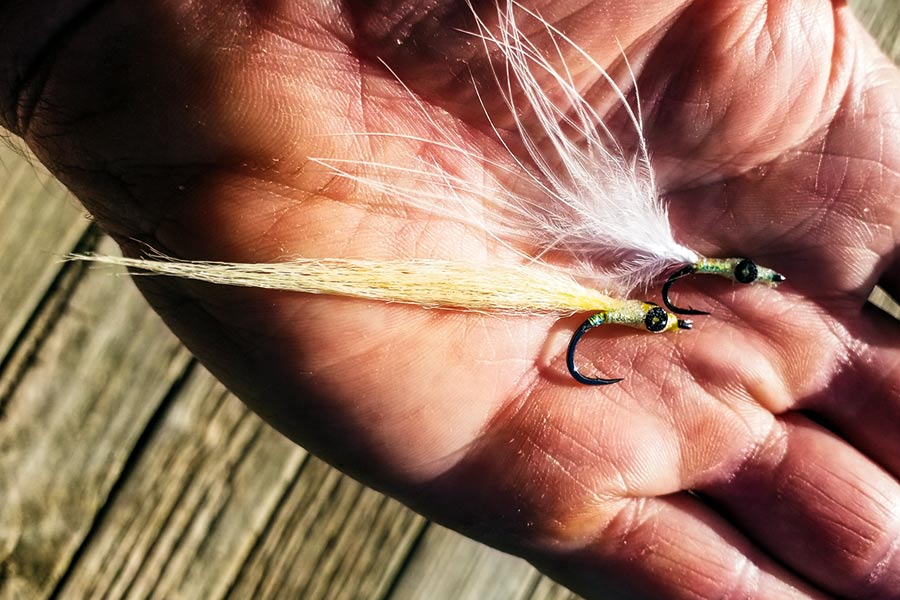
Tiny flies and ‘matching the hatch’ require the same approach – finding the right retrieve will be the secret to success.
I could have done twenty fast retrieves in that same amount of time and seen a lot of following fish, but I would have not caught a bloody thing. Spending the time to experiment and methodically work through the options eventually paid off. It was a very satisfying feeling.
It was another good example of how finding the right action and right retrieve can lead to great fishing success.

July 2021 - Craig Worthington
New Zealand Fishing News Magazine.
Copyright: NZ Fishing Media Ltd.
Re-publishing elsewhere is prohibited
Fishing Reports Visit Reports
Canterbury Fishing Report - 26/06/26
Canals still the place for a monster trout I am sitting at my desk and... Read More >
Raglan Fishing Report - 25/06/26
Trophy snapper in close The snapper fishing out deeper continues to be the most consistent... Read More >
Northland Fishing Report - 25/06/26
Swords aboard! With some of the smoothest seas and lowest winds we have seen in... Read More >
Bay of Islands Fishing Report - 25/06/26
Kingfish and snapper in the bay Having spent the week weighing kingfish, I decided that... Read More >


Major Bites
Minor Bites
Major Bites
Minor Bites
Comments