
Reels - Eggbeaters vs overheads
The photo was a simple one: young 20-something angler, cap askew, crunchy white Australian sand underfoot, three medium-sized tailor at his feet, clutching graphite spin rod, modern threadline reel attached, with chrome blue lure flashing in the sun. To me it was a 90s photo. There was no blood, no excessive killing, and the gear spoke only of simplicity.
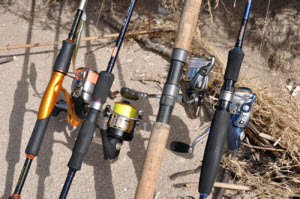
Contrast this with pictures from the past. A 60s angler would probably be blood spattered and knee-deep in fish with a huge shoulder-slung surfcaster. A 70s fisher might have a big bleeding kingfish draped across bell-bottom jeans and a sturdy Penn Senator spooled with serious line; while the 80s fishing-type person would be puffing his chest out over five or six monster snapper, with expensive gold anodised overhead reels firmly in frame. Obviously attitudes and tackle trends have been changing. Nowadays, with light lure and bait casting gear being ‘hot’ the threadline reel is once again king.
Some would say that threadline reels never stopped being number-one. In the last 10 years though, lots of weekend fishers have purchased overhead reels. Where once the overhead was regarded as the reel of only the seriously committed fisher, it is now commonplace and used by everyone. Their acquisition has been at the expense of threadlines. Yours truly even sold a couple of high-quality threadlines back in the late eighties and replaced them with baitcasters. Damned fool!
I did discover that I could cast further with an overhead. Also their direct line retrieval system was less aggressive on line and the reels’ own internal workings. Well made overheads always seem to last infinitely longer than threadlines. But there are some things an overhead simply will not do as well as a threadline. Casting light lures and baits is an example. And in a land blessed with kahawai, it is a crime not to flick a little chrome lure into the surf using a two-kilo spin stick.
Similarly, stray-lining is so much easier with a threadline than it is with an overhead reel. Controlling that first bait-grabbing run of a big wary snapper can be stressful with an overhead. Let the spool revolve backwards too freely and you'll get a birdsnest. But in order not to arouse the fish’s suspicion however you want the line to leave the spool as smoothly as possible – a ‘Catch 22’ situation. No such problem occurs with threadline tackle: simply open the bail arm and let the fish go. When it’s time to strike, flick the bail arm over and lift the rod. Nothing could be simpler.
A splash of spring snapper
I was reminded of this fact on a recent outing with a new home-rolled six-kilo graphite/glass spin stick armed with a Shakespeare Long Cast reel. Now the reel was a sensibly priced, easy casting eggbeater that I had enjoyed in a smaller format on my two-kilo rod. It made sense to go with the flow on the heavier rod. And, no, nobody paid me to say that, and yes, I did pay full retail price for the reel.
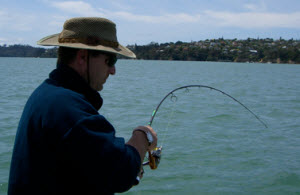
Thus rigged I headed to the water. A period of wet and blustery weather had just passed and the sea had been stirred to a soupy consistency – ideal conditions for spring snapper. The responsive composite rod fired out pilchard tail-end halves while the head and guts went in the water as berley. Runs came soon enough. The first fish had me holding the rod as high as I could and walking backwards up the rocks. There is a lot of weed and snags in this particular area so you have to get the fish up and moving as fast as you can – not an easy trick on six-kilo gear. It was just as well that the outfit was light enough to hold at full stretch with one hand high above my head. Many locals talk about being blitzed by big, unseen monsters at the same spot (I don't like to destroy their enthusiasm by suggesting eagle rays).
The first snapper was barely a keeper, but a couple of nice ones around the two-kilo mark were to follow, along with a quickly released kahawai – and a seagull! I had expected the fishing to go completely nuts from there, conditions looked so good, but the bites tapered off and even the pickers departed but I went home well satisfied. Those torrid few moments with the light spin tackle, running around the rocks, winding fast and pumping hard to keep the fish out of the weeds was exciting stuff and an excellent way to christen a new rod. The strikes had been effortless too. The fish picked up the bait and ran unhindered, the line coming easily off the long-cast spool. A quick flick of the bail arm and everything was tight.
Kahawai corners
Several nights later I was enjoying a balmy spring evening casting tiny Angler jigs across a dark and glassy bay, lined by oyster farms with a forest of mangroves further back. I was looking for some quick and easy sport on the two-kilo spin stick and didn’t have to look far to find it. Kahawai were about in force. They’d boil up behind the shimmering Angler Lure, fighting each other for the privilege of nailing that strange metallic fish. Kahawai after kahawai struck at the lure. The rod whipped over into a serious fighting bend over and over again. It was brilliant sport.
The only downside was the size of the fish. They were more kopapa than kahawai. Twenty-five centimetres seemed to be the average size. Luckily their keenness made up for any lack in size. The large single hook that hung off the Angler Lure made for easy release of such valuable sportfish.
The evening was beautiful. The dark still water was like liquid oil with only the ripple of baitfish, the splat of a mullet, or the gill-rattling leap of a lure-hooked kahawai marring its fine polished surface. Just being there was enough.
Tackling the surf
The larger rod quickly found favour for my lure casting expeditions in the surf. I had been using a Shimano baitcaster matched to a Composite Developments rod for this purpose but was now enjoying the new spin rod more, despite the older outfit delivering better casting distance.
Threadlines can lose a little bit on distance when compared to overheads but don’t suffer from the backlash/birdsnest bogey on those really big casts. Threadlines will tangle though, and especially so when spooled with too much new line. Always make sure any new line is packed down tight and not filled to the edge of the spool. The rim of the spool is there to stop line coming off the spool too fast and tangling. Threadlines cast better with a clearly exposed rim than with one smothered by line.
Also, monofilament often needs a good stretch before it really settles down, so after re-spooling I like to cast out into the surf and then run a couple of hundred metres up the beach. Standing in the water I then retrieve all the line back on while holding the rod tip low and making sure there is plenty of water drag on the line. It quickly sorts out the lay of your line on even a badly spooled reel.
With the nylon behaving itself, I then resume the serious business of tossing lures into the surf. On six-kilo gear, the 30g Angler metal jig/slug is the lure of choice. Like its smaller brethren it works well when given a slow to medium speed retrieve. I like the way this lure responds to really slow jigging retrieves but still does its thing at moderate speed. That ability to get down low and slow delivers snapper, trevally and gurnard over the sand. That matching ability to entice faster fish works well when the kahawai come surfing on through. A great rivermouth lure, it would have to be a boomer on salmon in the south.
Tricky tapes for home rolling rods
Which reminds me: that six-kilo spin stick I whipped together in record time was thanks to clever use (well I thought so) of plumber’s tape. I hadn't quite clicked onto its potential before but it is ideal for the tricky bits involved in binding up rods. Whereas all other tapes are bulky and lose their stick fairly fast, plumber’s tape flattens out to nothing and is never seen again. It is easily torn with fingers too, so the need for a third hand holding scissors disappears. Even better, I found it ideal for under-binding rod guides. When wrapped around several times, the thin self-sticking nature of plumber’s tape forms a soft invisible cushion for your guides to sit on and eliminates the need (if there ever was one) for underbindings. Difficult as the concept may seem, plumber’s tape has made my rod building faster and even less artistic than they was before!
Of ‘couta curses and ‘couta flies
Spring hasn’t all been about threadline tackle and spinning, however. As predictably as little white lambs appear on green, sun-drenched fields, the friend of every fisher in the Bay of Islands has made a strong showing this spring. Barracouta.
Now, like everyone, I hate the things with a vengeance. They are a pain in the proverbial butt. Yet I don't believe they warrant elimination nor wastage. There was a time when many anglers had similar feelings about kahawai. You won't hear a bad word these days. And ‘The Loopies’ love ‘coutas anyway. I know of boatloads of tourists who have had a ball catching and releasing ‘couta all day long. It seems like the local charter fleet won’t lower themselves to advertising that sort of activity though. Suffice to say, ‘couta are very much a part of the local fishing environment. We should enjoy them as best we can.
Putting these words into practice saw yours truly tossing a big fly at a bunch of ‘coutas that were annoying me in the boat. The hook-ups were marvellous. Those horrible silver-sided rockets would come blasting out of the depths and crawl all over that fly like it was the last meal they were ever going to get. I fed them three or four flies on heavy nylon trace and lost the lot. Bitten off. The ‘coutas were simply taking the fly with such enthusiasm that my poor insignificant 60-kilo leader was being chopped time and time again. No wire resided within my boat, but I dug around… and then dug some more, eventually uncovering a grotty old piece of thick galvanised wire that would have to do as a trace. This I connected to a big red Deceiver and cast the whole lot back in the water.
The ‘coutas were a bit more wary by this stage. Several made lunges at the fly but weren’t that keen on the new metal adornment sticking out the front. A bit more berley in the water and a quick thrash of the fly got them going. The rod was totally bent and I was hooked up.
Round and round the boat we went. And then round and round some more. Eventually I landed the fish and belted it on the head for future bait. It was a good fight – a fast and interesting fight. But, no, I don’t lie awake at night dreaming about ‘couta on the fly. But hey, as I said, the loopies love them…
A Blast from the Past, the article appeared in NZ Fisherman in November 1998.
Fishing Reports Visit Reports
Manukau/West Coast Fishing Report - 15/10/26
Big spring snapper in 60 metres. The El Niño weather pattern isn’t going to be... Read More >
Rotorua Fishing Report - 15/10/26
Solid start to the season! The Rotorua lakes have all started the season well, and... Read More >
Tutukaka Fishing Report - 15/10/26
Big snapper in shallow. Things remain relatively quiet on the fishing front out of Tutukaka,... Read More >
Tauranga Fishing Report - 15/10/26
Bait and temperature on the rise. It’s been great to get out and see some... Read More >


Wednesday 21 October 2026
Major Bites
 - -
- - Minor Bites
 - -
- - Thursday 22 October 2026
Major Bites
- - Minor Bites
- -
Comments