
Poppers versus Stick-Baits
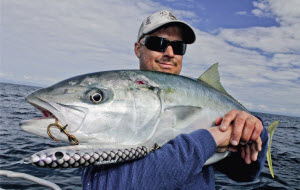 I can’t tell you how many times I get asked by intending top-water fishos, “What’s better, poppers
or stick-baits?”
Poppers come in lots of different shapes and sizes, but the most popular tend to be the cup-faced type that make big splashes, or ‘bloops’, which also create a nice amount of noise under water, enticing any predatory fish in the area to come in closer and have a look. Then, once there, the lure’s action often triggers a bite.
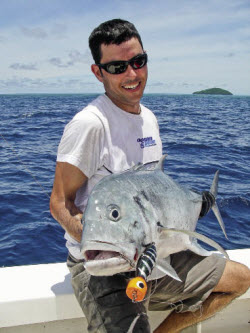
Poppers are more commonly used in the tropics for targeting fish such as giant trevally, wahoo, spanish mackerel and a lot of other species, including yellowfin tuna. In fact, I reckon poppers come into their own in the tropical environment; I spent some time fishing the Great Barrier Reef, and I think the noise of the popper’s bloop triggers the natural attack instincts of a fish, encouraging it to have a crack. For example, I was on the wheel of one of the centre-console 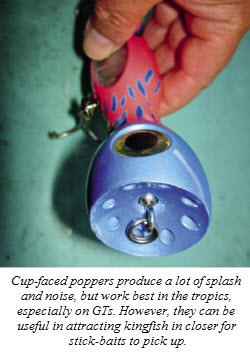 boats making our way along the edge of a section of reef when I spotted a big shoal of fusilier baitfish. So I told the anglers to cast, and out went a stick-bait up at the bow and a popper from the boat’s stern. The stick-bait hit the water first, and following the initial splash and first sweep of the lure, a nice dark GT quickly zoomed in… But then the popper hit the water a few seconds later, and after the first bloop the GT changed tack, spun around and made a beeline for the popper in a much more aggressive mood. Seconds later the popper was inhaled, we had a rod bending, and the fight was on. During the time I’ve spent on the Great Barrier Reef, I would have to say around 80% of the fish have been taken on poppers over stick-baits and I think the reason for this is that the big predators are always on the alert for fish freaking out and in trouble. Indeed, at night at the back of the mothership there were often good numbers of GTs hanging around, and a simple slap on the water with your hand would cause a fish to change direction and strike the surface of the water where you’d just hit it.
 Back here in Godzone, we have the hard-fighting kingfish as our reef gangster. I don’t tend to use poppers so much when targeting kingfish though, as although you can still catch kingfish on them at times, in my opinion the blooping noise does not have the same effect on the kingfish here. While I find that these lures will raise fish and get them following, they tend to be very wary on the lure. Consequently, I will often be casting a popper while my client will be using a stick-bait; I am just trying to raise a fish, so the client can then land a stick-bait in the same area, and nine times out of ten it will hook the teased-up kingfish nicely.
Stick-baits are a streamlined lure that’s basically the shape of a baitfish and which possess an action imitating an injured swimming baitfish, making it appear to be an easy meal.
As with the popper, it is a very good option in the tropics, with all the predatory fish species having a go at them, but the fish I really liked targeting with stick-baits were the line-burning wahoo. Casting to a pack of worked-up wahoo was simply spectacular, as the speed with which these fish hit the lures has to be seen to be believed, with stick-bait attacks often involving the fish firing up to five metres out of the water.
But these lures certainly work just as well on our less acrobatic kingfish – in fact, I believe stick-baits are the way to go with kingies, hands down, producing massive surface strikes and getting the adrenalin really pumping.
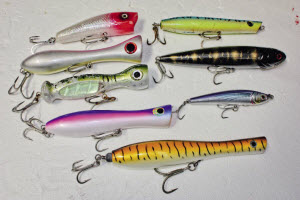 I think the reason why kingfish love stick-baits so much is due to the lure’s action, which resembles a wounded baitfish such as a kahawai, jack mackerel or koheru and effectively mimics live baits presented on the surface, attracting the kingfish’s attention and getting bites. However, there are a few advantages to using stick-baits rather than live baits: one is that a stick-bait is always ready and available, another is it can be quickly and repeatedly cast to specific areas and distances, and thirdly it will not die on you after having a run-in with a big, angry, green-back kingie.
The other thing I really like about using stick-baits is that you will usually come across packs of kingfish when using them, with a typical scenario playing out like this:
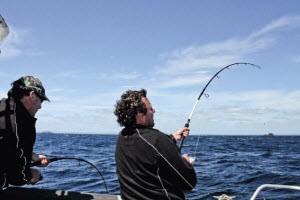 Angler John calls out, “Yep, I’ve got some interest on my lure, boys!” indicating that he has a fish or even a pack of jostling, swirling kings charging around behind his lure. In response, the other anglers wind in as fast as possible and then whip their lures out into the same area as John’s lure. Boom! John is hooked up and has his rod bending; then BOOM! Mike on the bow plucks one out of the pack too, followed soon after by Jimmy, who snags one about five metres away from the boat’s stern. Over the next ten minutes the skipper (me) goes into overdrive, driving the boat this way and that to keep lines clear of the side of the boat and help the anglers as best I can to fight their fish. In between times I unhook fish and try and snap a photo or two, before returning to the other anglers still fighting kingies. When the spray and exhaust fumes finally settle, the photos have been taken and fish released, a round of high fives usually takes place.
Just recently we landed over one hundred kingfish ranging from 12kg to 22kg in one day, and only lost five lures – one for the books! And while I did get a de-barbed hook in my hand during the session, catching this many fish on surface lures made it more than worthwhile.
We are currently in the midst of the best time to target kingfish (spring), as the fish are often high in the water column feeding on squid, so if you’ve never tried targeting them on surface lures, this is definitely a box that needs ticking!
 |
This article is reproduced with express permission of
written by Ben Pokaia - 2012 Originally published in New Zealand Fishing News ----- Advertisement -----
|
Fishing Reports Visit Reports
Manukau/West Coast Fishing Report - 15/10/26
Big spring snapper in 60 metres. The El Niño weather pattern isn’t going to be... Read More >
Rotorua Fishing Report - 15/10/26
Solid start to the season! The Rotorua lakes have all started the season well, and... Read More >
Tutukaka Fishing Report - 15/10/26
Big snapper in shallow. Things remain relatively quiet on the fishing front out of Tutukaka,... Read More >
Tauranga Fishing Report - 15/10/26
Bait and temperature on the rise. It’s been great to get out and see some... Read More >



Tuesday 27 October 2026
Major Bites
 - -
- - Minor Bites
 - -
- - Wednesday 28 October 2026
Major Bites
- - Minor Bites
- -
Comments