
No Waste Tuna

Over the years, Herb Spannagl’s passion for blue water tuna hunting when they show up off the Taranaki coast during the short summer months has grown into an almost uncontrollable fixation. That passion extends to preparing the catch for the table, and he often wonders why more people don’t make a meal of this great sport and eating fish.
Luckily, the fickle west coast weather, my strong desire for self-preservation and the fact that most of my fishing mates are still working all greatly restrict my offshore kayak expeditions. However, on those rare weekends when all the fishing stars line up, we make the most of it and sometimes come back bow up with a good load of albacore tuna in the bin. Everything about this fish is superb; they are built for speed, look stunning in their chrome livery, fight like demons and above all, are one of the world’s most sought-after food fish.
So why do we Kiwis rate them so lowly that they almost never show up in the fish shops? Many fishers just use them as good snapper bait. Topping this sacrilege of waste is a fisho I know who throws them frozen into a commercial tree mulcher to shred his annual supply of berley into a 44 gallon drum.
I am old enough to remember the post WW2 food shortages in much of Europe and have grown up to detest waste, whether this is of food or any other useful resource. In this article, I want to show you how I dissect my tuna and then use every part of it to reap multiple benefits.
Even though I have an insulated kayak fish bin with frozen water in a couple of milk bottles, the fish never get as cold as they would in a salt ice slurry. It is therefore important to process them as soon as possible when I get home, no matter how buggered I feel after the day’s marathon paddle. If you have the luxury of cooler space and ice, treat your albacore as you would a prized snapper, cod, or john dory.
Tuna are best partitioned into four loins; two from the back and two from the belly. You can see how to do this best on YouTube.
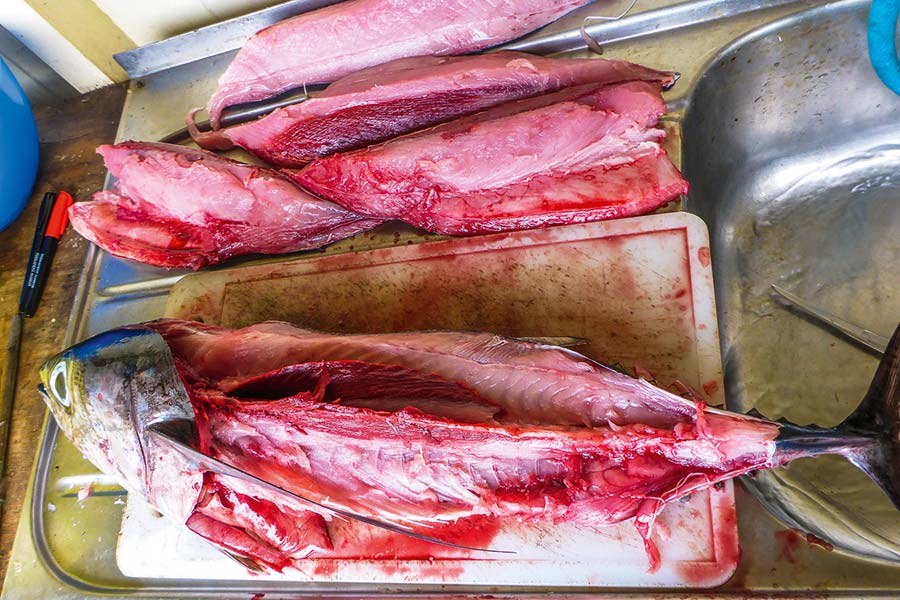
Four loins; two from the back and two from the belly.
For the table
The two back loins and parts of the lower belly loins I put aside for food. There are numerous recipes available on the internet ranging from almost raw sashimi to kebabs, fries and curries. Last night we had tuna curry, which my son was convinced tasted like chicken. During the Christmas holidays, my Austrian nephew and his family visited us and just could not get over how easy it is for us to get high quality fish from the sea and fresh water. Over there, fish are outrageously expensive and almost never taste fresh. It’s a good thing I caught some good snapper and the first tuna of the new season on December 29 to give them a real Kiwi fish treat.
One of the best baits
Tuna flesh is rich in oil. This makes it one of our best baits for bottom species. The flesh of the thinned down, almost scaleless silver belly loins is much denser and makes the best bait cubes. A few years ago I discovered that a super way to preserve it is to put the cubes in a 10L paint pot and mix it with lots of plain salt. This preserves it almost indefinitely without having to freeze it and is available whenever I go bottom fishing. The salt draws out the oil, which greatly enriches the bait’s scent trail.
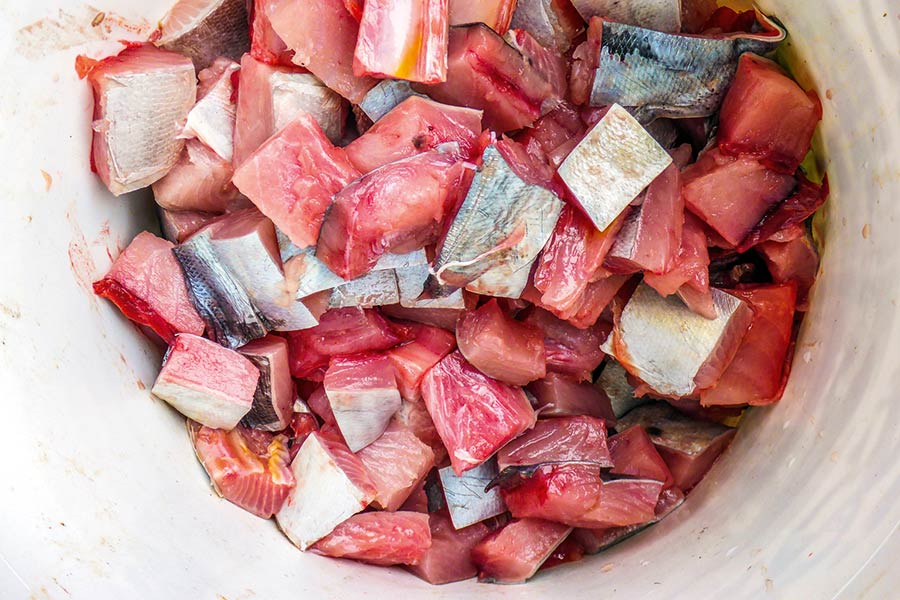
Chunks ready for salting.
Meat scraps
Any meat I scrape off the bones I save for our little dog. Tuna meat is rich in good Omega 3 oil and when cooked has the texture and taste of chicken meat. Our mini schnauzer has never heard any negative tuna comments and laps it up.
Cray bait
I split the heads with a tomahawk and freeze them as bait for my cray pots. Opening the heads up allows for the oil and juices to come out more freely and helps to draw in crayfish from afar.
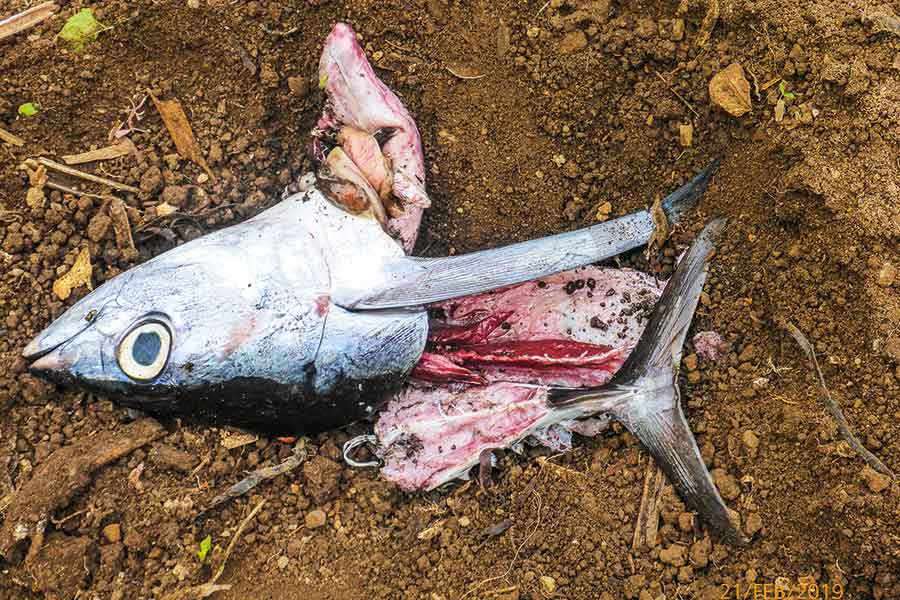
Ready for the garden or craypots.
Soil enrichment
In the past, I have borrowed my mate’s motorised mincer to make berley from the remaining gut, backbone and skin flaps. However, I usually don’t have enough to make the inevitable mess worthwhile so have resorted to burying it all in my vege garden. Together with other compost, it enriches the soil for bountiful crops that feed my family all year round and sometimes my neighbours as well. Contrary to the general fear that this creates unpleasant smells and attracts vermin, neither happens if the remains are well covered with soil. It is amazing how quickly soil organisms break it down. Over the years I have buried hundreds of frames and only occasionally unearth a bone or two. The rest has simply vanished.
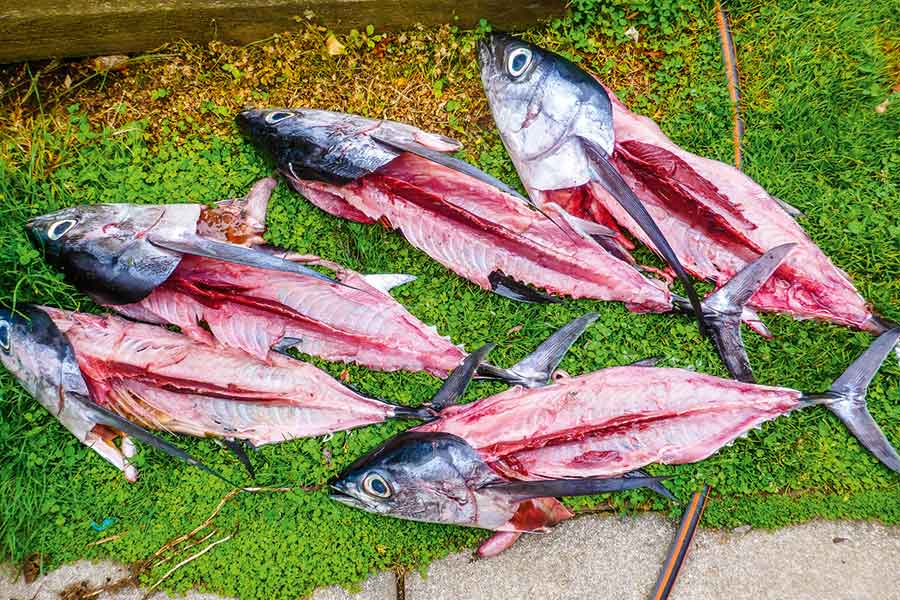
Frames for the berley mincer.
How lucky we are
When I came to New Zealand in 1960, people were lamenting how isolated it was. We were so far away from any market and our international friends. How things have changed. Today, being at what was once called the backside of the world has become one of our greatest assets and has retained for us much of what more populous nations have already squandered. The world’s population has trebled in my lifetime and more and more natural resources are under increasing stress. This country is not immune. Our once bountiful fish resources are not what they used to be, despite what the fishing industry wants us to believe with their almost ridiculous TV campaigns. The stark reality is that if we want to remain the Lucky Country, our fish need to be managed more sustainably and used by us less wastefully. All it takes is a little effort.

April 2021 - Herb Spannagl
New Zealand Fishing News Magazine.
Copyright: NZ Fishing Media Ltd.
Re-publishing elsewhere is prohibited
Fishing Reports Visit Reports
Tauranga Fishing Report - 28/05/26
Tarakihi on the bite Trips are few and far between at this time of year,... Read More >
Canterbury Fishing Report - 28/05/26
Fresh and salt turning it on! It is not very often I get to say... Read More >
Bay of Islands Fishing Report - 28/05/26
Lures paying dividends We finally had a break in the SE winds that have been... Read More >
Manukau/West Coast Fishing Report - 28/05/26
Snapper and gurnard in the harbour The weather has finally taken a turn for the... Read More >



Major Bites
Minor Bites
Major Bites
Minor Bites
Comments